
You brought home a Border Collie. You likely envisioned peaceful hikes and a dog that catches frisbees with Olympic precision. But the reality? You might be dealing with a puppy that nips your children’s heels or an adolescent that screams at every bicycle.
You are not alone.
Border Collies are the Ferraris of the dog world. They are high-performance, sensitive, and incredibly fast learners. Unfortunately, they learn fear just as quickly as they learn tricks. Border Collie socialization isn’t just about “making friends.” It is about teaching a hyper-aware working dog how to switch off in a chaotic human world.
Whether you are a novice with an 8-week-old puppy or a “reactive rescuer” helping an anxious adult, this guide will help you navigate the unique brain of the Border Collie.
Key Takeaways for Border Collie Socialization
- Neutrality > Interaction: Teach your Collie to observe the world without reacting.
- Respect fear periods: Adolescence (6–14 months) is tricky—avoid forcing interactions.
- Manage motion sensitivity: Interrupt “The Eye” before it escalates to chasing/nipping.
- Prioritize mental exercise: Aim for 6+ hours/week of training/play (short, frequent sessions).
- Use decompression walks: Sniffing lowers stress and burns mental energy.
- Noise reactivity is common: Use desensitization for fireworks/storms.
- Gear matters: A Y-shaped harness and long-line leash are non-negotiable for safety.
Table of Contents

Border Collie Socialization 101: Preventing the “Frustrated Greeter”
While standard advice suggests letting puppies meet everyone, successful Border Collie socialization requires a more strategic approach to prevent overstimulation.
Driven by a potent herding instinct, this breed is genetically wired to notice everything. They see a sheep move a muscle 500 yards away. Consequently, they become overstimulated easily. If you force them to greet every stranger instead of cultivating neutrality, you risk creating a “frustrated greeter.” This dog lunges on the leash because they lack neutrality and believe they must interact with the world.
The Goal: Neutrality
Modern experts take a different approach. Dog trainer Ali Smith from Rebarkable notes that true socialization is neutrality. She defines it as the ability to observe the surrounding world without feeling the need to engage or react.
For a Border Collie, success isn’t a dog that plays with everyone. Success is a dog that can watch a skateboarder go by and choose to sniff the grass instead.
The smartest dog breed traits Trap: Why Smart Dogs Learn Fear Faster
Intelligence is a double-edged sword. Your Collie can learn Border Collie Obedience Training in record time. However, they also memorize negative experiences instantly. If a loud truck scares them once, they may decide all trucks are monsters. This genetic wariness makes them great watchdogs but complicates their guide to apartment living.

The Critical Socialization Windows: From Puppies to Fear Periods
Timing is everything. Biology dictates two major windows where your dog’s brain wires itself for the future.
| Developmental Stage | Age Range | What is Happening? | Owner Strategy |
|---|---|---|---|
| The Magic Window | 8–16 Weeks | The brain is a sponge. Positive exposures act as a “vaccine” against future fears. | Focus on quality over quantity. Short, calm sessions (e.g., watching kids from a distance). |
| Secondary Fear Period | 6–14 Months | Adolescence. Sudden fear of familiar objects (trash cans, statues) or increased reactivity. | Do not push them past their threshold or force the dog to “face fears.” Allow them to observe and back away if needed. |
The Magic Window
Renowned behaviorist Dr. Ian Dunbar famously states, “Puppyhood is the most critical time for socialization and training.” During this brief window, your puppy is a sponge. Positive exposures act as a vaccine against behavior problems later. As the AVSAB states, “behavioral issues, not infectious diseases, are the number one cause of death for dogs under three years of age,” making early socialization critical.
Avoid flooding the puppy by keeping environmental exposure strictly below their emotional threshold. Prioritize quality over quantity; a calm, five-minute session watching kids from a distance is far more effective than 30 minutes of chaos.
“The critical social development period for dogs is approximately between 3 and 14 weeks. This is the age that they are most accepting, less cautious, and very curious about their environment. Even though socialization can occur at any age, it will be a slower process for an older dog than for a puppy that is under 14 weeks of age.”
The most sensitive period for socialization is 3–14 weeks (UC Davis, AVSAB), but the 8–16 week window is often emphasized because it balances behavioral development with vaccination safety. After 14 weeks, socialization is still possible but requires more patience.

When Do Fear Periods Strike? Navigating Adolescence
Just when you think you are safe, adolescence hits. Between 6 and 14 months (though Pupford notes it can vary), Border Collies often enter a “secondary fear period.”
- What it looks like: Your confident 7-month-old suddenly refuses to walk past a trash can. They bark at a statue they have seen a hundred times.
- What to do: Do not force them to “face their fears.” Dr. Dunbar warns that during these sensitive times, “a strange, one-time period… any negative encounter can traumatize them forever.” If they are scared, let them back away. Let them observe from a distance.
Is It Too Late? (Adults & Rescues)
Did you miss the puppy window? Take a deep breath. It is not too late. Adult dogs can learn “remedial socialization.” The process is slower, but Border Collies are work-oriented. You can often train them to maintain engagement with you through a job (like heeling or carrying a toy) rather than the scary trigger.
Taming the Herding Instinct: Motion Sensitivity and “The Stare”
Generic training advice often fails here. Proper Border Collie socialization accounts for the fact that your dog isn’t just “reactive” but acting on innate motion sensitivity.
Why Moving Objects Trigger Your Dog
As biologist Raymond Coppinger explains in Dogs, Border Collies display an exaggerated predatory motor sequence of “eye-stalk-chase.” This is genetically hardwired. It causes them to lock onto moving objects like bicycles. They feel an urgent need to control that movement.
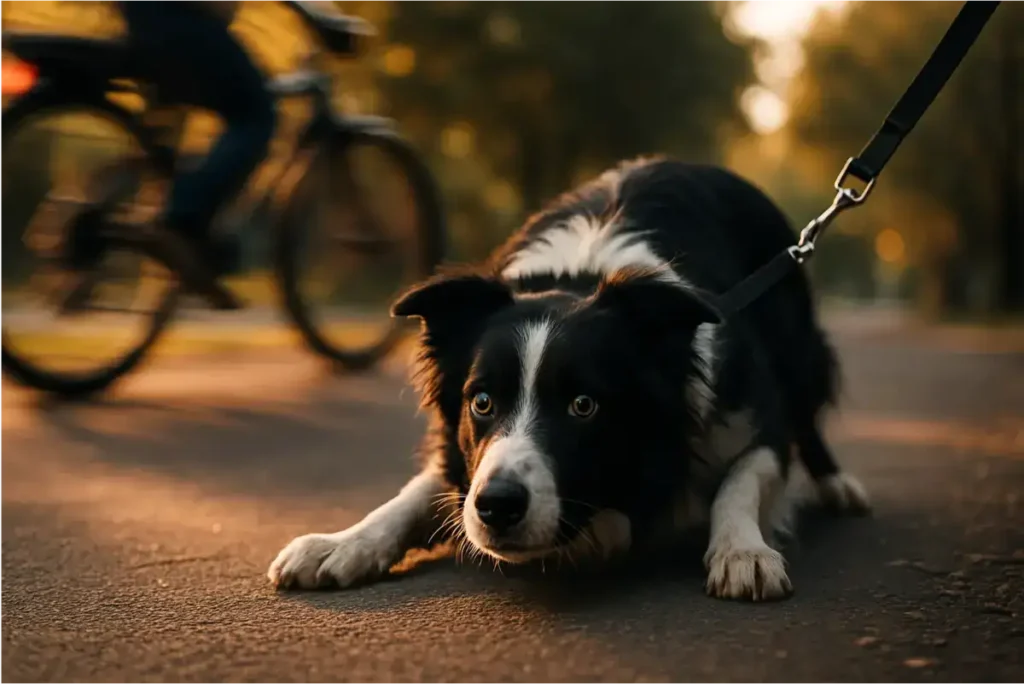
Understanding “The Eye”
Have you seen your dog lower their head and stare intensely? This is “The Eye.” In a pasture, this stare moves sheep. On a sidewalk, it is a warning sign. * The Danger: If the “sheep” (bicycle/child) doesn’t stop moving when the dog stares, instinct escalates to the next step: the nip. * The Fix: You must interrupt “The Eye” before it turns into a lunge.
Noise Reactivity: A Special Challenge for Border Collies
Border Collies are not only sensitive to motion but also to noise.
“Border Collies aren’t just sensitive to motion—they’re also highly reactive to noise. A study in the Journal of Veterinary Behavior found that Border Collies scored higher on ‘Anxiety Intensity Rank’ for noise reactivity (e.g., fireworks, storms) than German Shepherds and Australian Shepherds. This means loud, sudden noises can trigger intense fear or panic, even in otherwise confident dogs. If your Collie startles at thunder or fireworks, it’s not just a quirk—it’s a breed trait. Use desensitization and counter-conditioning (pairing noises with treats or play) to help them cope.”
If your Border Collie is reactive to noises, it’s not just a quirk—it’s a breed-specific trait. Management strategies like desensitization and counter-conditioning (pairing noises with positive experiences, such as treats or play) are essential. For severe cases, consult a veterinary behaviorist.
How to Desensitize a Border Collie to Motion
Follow these steps to stop your Border Collie from staring or lunging at moving objects:
- Establish a safe distance: Start training in an area where triggers (like bicycles) are visible but far enough away to not cause a reaction.
- Mark and reward: The moment your dog notices the object—but before they lock eyes or stare—use a marker word (like “Yes!”) and give a high-value treat.
- Disengage and reset: If your dog stiffens or locks eyes, you have crossed their threshold. Immediately move further away to help them relax before trying again.
For more on how this instinct interacts with other animals, check our guide on Border Collies and Other Pets.

Modern Methods: Neutrality, Decompression, and Consent
We need to shift our focus. Move away from “obedience” (commanding the dog) and toward “state of mind” (helping the dog relax).
Neutrality > Interaction
Instead of letting your dog drag you to meet another dog, teach them that other dogs are just scenery. * The “Engage-Disengage” Game: When your dog looks at a trigger, wait for them to offer engagement and look back at you. When they do, reward heavily. You are rewiring their brain. They learn, “Seeing a dog means I get chicken from Mom/Dad,” rather than “Seeing a dog means I have to bark.”
Mental Stimulation: The Border Collie Benchmark
Border Collies thrive on both physical and mental challenges. Research published in Frontiers in Aging Neuroscience highlights just how active Border Collie owners are:
“In Wallis et al. (2014) study, the Border collie owners participated in on average five different types of training and spent 6 hours per week doing different types of physical and mental training.”
Frontiers in Aging Neuroscience: Aging of Attentiveness in Border Collies and Other Pet Dog Breeds
This level of engagement isn’t just for fun—it’s essential for preventing boredom, anxiety, and reactive behaviors. If your Border Collie isn’t getting enough stimulation, they may channel their energy into unwanted behaviors like nipping, barking, or obsessive staring.
Pro Tip: *”Border Collie owners in the Wallis et al. study averaged 6 hours of training per week—but this doesn’t mean 6 hours of drills! Include:
- Short training sessions (5–10 minutes, 2–3x/day)
- Mental games (puzzle toys, scent work, ‘find it’ games)
- Decompression walks (sniffing = mental exercise!)
- Structured play (fetch, flirt poles, herding simulations) Without enough stimulation, Collies invent their own ‘jobs’—like herding children or barking at bikes!”*
The Decompression Walk
High-drive dogs need to lower their cortisol levels. A “Decompression Walk”—a term coined by trainer Sarah Stremming – is a walk where the dog is allowed freedom of movement in nature to lower stress. Sniffing lowers pulse rates and burns more mental energy than physical exercise requirements.
Consent-Based Socialization
Does your dog want to say hi? * The 3-Second Rule: Let the dogs sniff for 3 seconds. Then, call your dog away. If your dog eagerly goes back, they consent. If they turn away or stiffen, the interaction is over. Respecting this prevents the “fear snap.”
Troubleshooting Common Triggers and Reactions
Drawing from over a decade of behavioral rehabilitation work with high-drive herding breeds, we have compiled this table to help you identify the root cause and immediate solution for specific bad behaviors.
| Trigger | The Root Cause | The Quick Fix |
|---|---|---|
| Nipping Heels | Herding Instinct: Trying to control movement. | Stop moving immediately. Redirect to a tug toy. |
| Barking at Bikes/Cars | Motion Sensitivity: “I need to chase/stop that.” | Increase distance. Play a “Find It” game (toss treats in grass) to break eye contact. |
| Lunging at Dogs | Frustration or Fear: “I want to say hi!” or “Go away!” | Do not let them meet. Use the “Engage-Disengage” game from a safe distance. |
| Freezing/Staring | The Eye: Assessing the “stock.” | Break their focus instantly with a happy noise or U-turn. |
- Managing the Nipping: For the “Prepared Novice,” know that nipping kids is not aggression. It is misplaced work. You can learn more about redirecting this energy in our Border Collie Working Roles article, which explains what they should be doing.
- Counter-Conditioning: This simply means changing the emotion. If “Mailman = Bark,” we want to change it to “Mailman = Cheese Party.”
Essential Gear for Socializing a High-Energy Breed
You wouldn’t climb a mountain in flip-flops. Don’t socialize a Border Collie without the right tools.
| Essential Gear | Purpose | Why It Matters for Border Collies |
|---|---|---|
| Secure Y-Shaped Harness | Safety & Control | Prevents choking or neck injury if the dog lunges at a moving object. |
| Long-Line Leash (10-15ft) | Decompression | Allows freedom to sniff (lowering pulse rate) while keeping the dog safe. |
| High-Value Rewards | Motivation | High-drive dogs need high-value payment (chicken/cheese) to maintain voluntary engagement and compete with distractions like squirrels. |
| Mental Stimulation Toys | Stress Relief | Activities like shredding or licking help lower cortisol levels after a stimulating walk. |
Frequently Asked Questions
When should I start socializing my Border Collie puppy?
Start immediately at 8 weeks, but prioritize safe exposure (e.g., carrying your pup in a sling to avoid disease risk). The most critical window is 3–14 weeks—after that, socialization is still possible but slower.
My Border Collie is shy around new people. How can I help them feel more comfortable?
Shyness is common in Border Collies, but you can build their confidence with these steps:
Start at a distance: Let your dog observe new people from afar, rewarding calm behavior with treats.
Create positive associations: Pair new people with high-value treats or toys.
Respect their pace: Never force interactions. Let your dog approach when they’re ready.
Use a “safe space”: Provide a quiet retreat (like a crate or bed) where your dog can relax if overwhelmed.
Example: If your dog is nervous around strangers, ask friends to ignore your dog at first and toss treats their way. Over time, your pup will learn that new people = good things!
How do I teach my Border Collie to greet people politely instead of jumping?
Border Collies are enthusiastic greeters, but you can teach them calm manners with these techniques:
Practice impulse control: Use commands like “sit” or “wait” before allowing greetings.
Reward calm behavior: Only let your dog greet people when they’re sitting or standing politely.
Use a “say hello” cue: Teach your dog that they can only greet when given permission (e.g., after you say, “Say hello!”).
Redirect energy: If your dog gets too excited, redirect them to a toy or ask for a simple command (like “sit”).
Pro Tip: Practice with one person at a time in a controlled environment before moving to busier settings.
Are puppy socialization classes worth it for Border Collies?
Absolutely! Puppy socialization classes are one of the best investments you can make for your Border Collie. Here’s why:
Safe exposure: Your pup can interact with other dogs in a controlled, supervised environment.
Learning doggy etiquette: They’ll practice bite inhibition, body language, and play skills.
Obedience basics: Classes often include training for commands like “sit” and “stay,” which are essential for managing their energy.
Confidence building: Meeting new dogs and people helps your pup grow into a well-adjusted adult.
What to look for:
Classes that use positive reinforcement (no harsh methods).
Small class sizes with vaccinated puppies.
A focus on both play and learning.
My Border Collie is reactive to other dogs on walks. How can I help them stay calm?
Reactivity is often a sign of fear, frustration, or overstimulation, but it can be managed with patience and training. Try these steps:
Increase distance: Start by walking your dog far enough from other dogs that they notice but don’t react. Reward them for staying calm.
Use treats to refocus: When your dog sees another dog, immediately offer a high-value treat (like chicken or cheese) to redirect their attention to you.
Teach a “watch me” cue: Train your dog to look at you on command, which helps them disengage from triggers.
Gradually decrease distance: Over time, slowly move closer to other dogs while keeping your pup under threshold (the point where they react).
Consider professional help: If reactivity is severe, a certified dog trainer or behaviorist can create a tailored plan.
Example: If your dog barks at dogs 20 feet away, start rewarding them for staying calm at 30 feet, then gradually close the gap as they improve.
Conclusion
Raising a Border Collie is not a casual commitment. It is a project. But remember, the same sensitivity that makes them bark at a rustling plastic bag makes them attuned to your every emotion.
Prioritize neutrality over popularity. Respect their motion sensitivity by giving them space. And most importantly, be the calm leader they need during their fear periods.
Socialization isn’t about creating a dog that loves the whole world. It is about raising a dog that is happy and confident in your world.
Ready to burn off that mental energy? Check out our next guide on brain games.
Leave a Reply
You must be logged in to post a comment.