
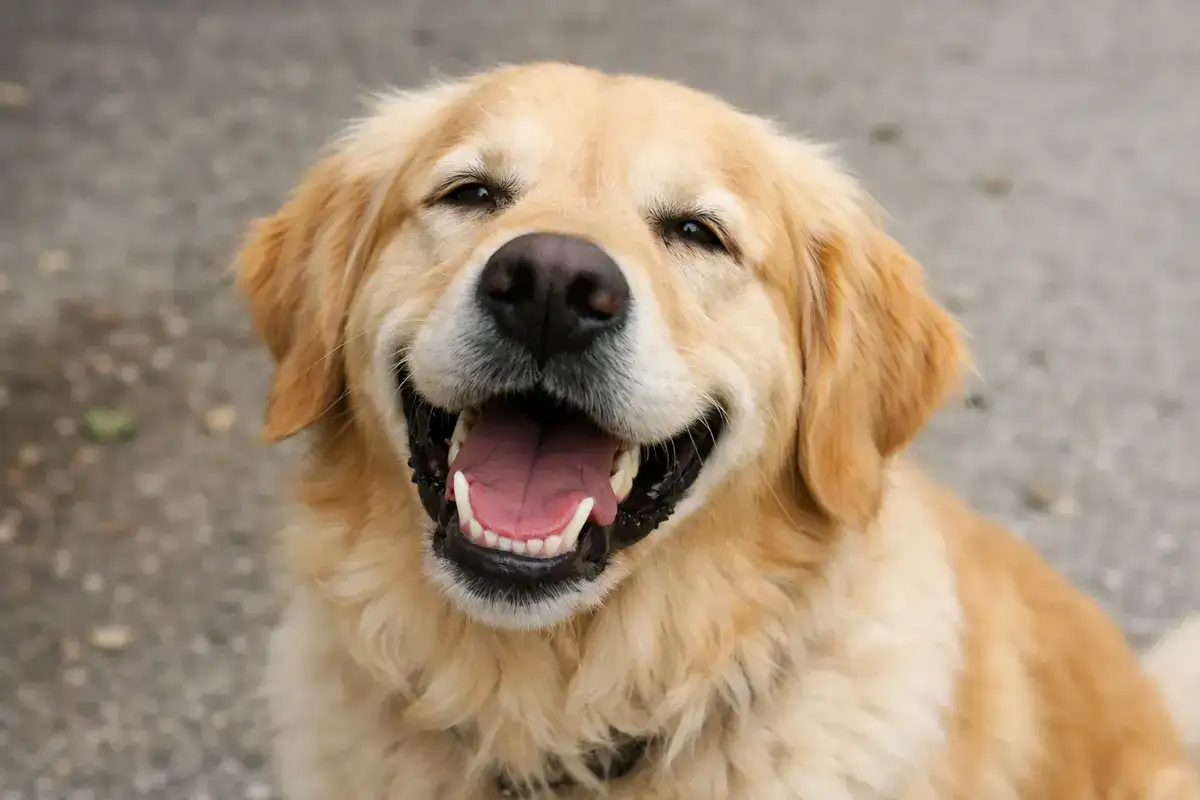
Golden Retriever body language reveals exactly how your dog feels – if you know how to read it. From tail wag patterns and ear positions to soft eyes, submissive grins, and full-body butt wags, every movement sends a message.
What Is Golden Retriever Body Language?
Golden Retrievers are famous for their smiles, wagging tails, and friendly personalities. But behind that cheerful expression lies a sophisticated communication system. Golden Retriever body language is how your dog tells you what they’re feeling – without ever saying a word.
From subtle ear shifts to tail direction changes, Golden Retriever mood signals reveal whether your dog is excited, relaxed, anxious, or overstimulated. When you learn how to read Golden Retriever body language correctly, you prevent misunderstandings and strengthen trust.
In this Golden Retriever body language guide, you’ll learn how to read tail signals, facial expressions, posture changes, play bows, stress signs, and subtle calming signals. By the end, you’ll be able to confidently understand what your Golden Retriever is communicating – whether they’re excited, anxious, playful, or unsure.
✅ Key Takeaways: Golden Retriever Body Language
- Golden Retrievers are friendly, but they can still feel stressed or uncomfortable.
- A wagging tail does not always mean happiness; speed and stiffness matter.
- Always read the whole dog – eyes, ears, tail, and posture together.
- Goldens often show subtle stress signals before growling or snapping.
- A “smile” can be a sign of nervousness or appeasement, not joy.
- Calming signals are requests for space, not bad behavior.
- Understanding body language helps prevent fear-based reactions and bites.
It is very important to learn these secret signals. A 2023 report by the PDSA (People’s Dispensary for Sick Animals) found that 66% of veterinary professionals believe behavior problems are worsening because owners misunderstand their dogs’ behavior. By learning to read your Golden’s tail, eyes, and posture, you can keep them happy and safe.
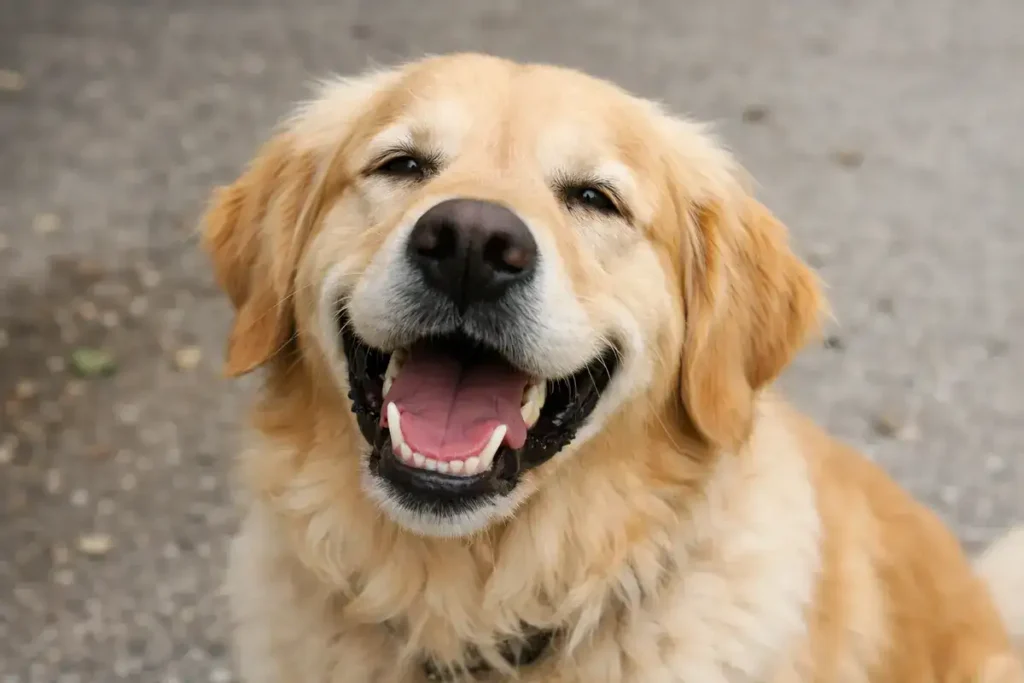
Table of Contents
History and Origins of Golden Retriever Body Language
To understand your dog’s body language, you first need to look at their history. Dudley Marjoribanks bred Golden Retrievers in mid-1800s Scotland to serve as focused “gundogs.”
These dogs had a very specific job. They had to work quietly next to hunters, watch for hand signals, and have great self-control. This is a skill used in obedience training for working breeds.
Because they were bred to work silently with people, Goldens became experts at subtle physical cues and eye contact. This history explains why your Golden stares at you so intently. They are born to look at humans for directions. Unlike other dogs that might work alone, a Golden’s body language is all about connecting with you.
Facial Signals: Golden Retriever Submissive Grin vs Aggression
Since Goldens are known for smiling, it can be confusing when they show their teeth for other reasons. Not every toothy face means a dog is happy. You need to know the difference between a relaxed face and a nervous one.
Understanding Golden Retriever facial expressions allows you to distinguish between a playful grin, stress signals like whale eye, and early warning signs of discomfort.
The Happy Pant: How to Tell If a Golden Retriever Likes You
When your dog is truly relaxed, you will see a “happy pant.” Their mouth is open, their tongue hangs out, and their eyes look soft and squinty. Seeing this relaxed look is the best way to know how to tell if a Golden Retriever likes you and feels safe.
7 Heartwarming Signs Your Golden Retriever Truly Loves You
Does your Golden Retriever have a “love language”? While they can’t say the words, these loyal companions have a specific set of behaviors—often called “The Golden Standard of Affection”—to show you you’re their whole world.
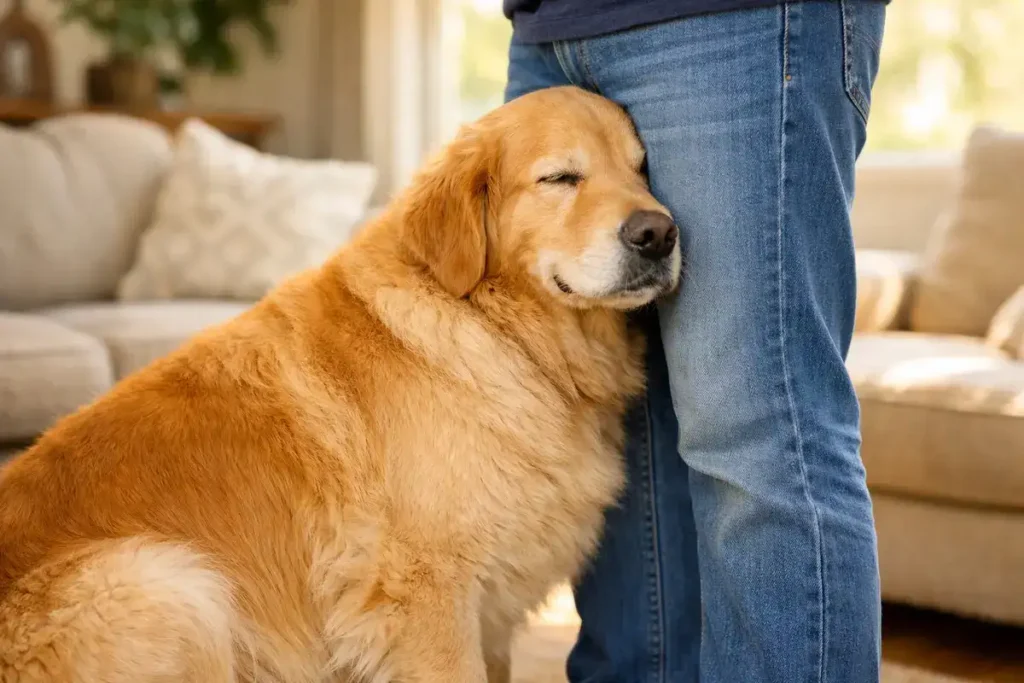
1. The “Golden Lean.”
If you’re standing in the kitchen and suddenly feel 70 lbs of fluff resting against your shins, take it as a compliment! By resting their full body weight against your legs, your dog is seeking physical security and showing they feel safest in your “bubble.”
2. The Morning “Present.”
Does your dog greet you with a soggy shoe, a stuffed duck, or a random sock? In the Golden Retriever world, this is a “Retriever Greeting.” They aren’t asking to play; they are so overwhelmed with joy that they must bring you a trophy to celebrate your arrival.
3. Soft Eye Contact
Unlike the “hard stare” used by some breeds to show dominance or focus, a Golden in love will look at you with relaxed, “soft” eyes. This releases oxytocin (the cuddle hormone) in both of your brains, strengthening your bond.
4. Constant Physical “Checking.”
Goldens are “velcro dogs.” Whether it’s a paw on your foot while you work or a wet nose nudging your hand for a scratch, they use physical touch to maintain a constant emotional connection with you.
5. The Happy “Golden Smile.”
A relaxed, open mouth with a loose tongue—often called the Happy Pant—is a sign of a dog that is completely at ease. If they look at you while doing this, they are effectively “smiling” at their favorite person.
6. The “Belly Up” Sleep Position
Sleeping on their back with paws in the air is the ultimate sign of vulnerability and trust. By exposing their belly, they are telling you they feel 100% safe in their environment and don’t feel the need to protect themselves from you.
7. The Walking “Check-In.”
Next time you’re on a hike, watch your Golden. If they trot ahead but constantly stop to look back and make eye contact, they are “checking in.” This shows that while they love the adventure, the most important part of the walk is staying close to you.
The Submissive Grin (Appeasement)
| Physical Feature | Happy Pant (Relaxed) | Submissive Grin (Anxious) |
|---|---|---|
| Mouth Position | Open, loose jaw | Lips pulled back (showing teeth) |
| Tongue | Hanging out loosely | Tucked inside or licking lips |
| Eyes | Soft, squinty, relaxed | Squinting hard or showing whites (Whale Eye) |
| Body Posture | Wiggly, natural stance | Lowered to ground, stiff, or cowering |
| Meaning | I am safe and happy. | I am uncomfortable, please don’t hurt me. |
Sometimes, a Golden pulls their lips back to show their front teeth. Humans often think this is a smile. However, if the dog also squints hard and gets low to the ground, this is called a ‘submissive grin.’ This is a way for the dog to ask for peace because they feel uncomfortable.
As Dr. Stanley Coren notes in his research on canine communication, a dog’s most reliable sign of happiness is found in the tail, while facial expressions like the ‘submissive grin’ are often complex signals of de-escalation rather than simple joy.
Understanding the Golden Retriever submissive grin vs aggression is key. If the body is wiggly and low, they are saying, “I’m friendly, please be nice.” However, if the body is stiff and tall, with teeth showing, that is a warning.

Golden Retriever Tail Meaning: How to Read Tail Positions
Understanding Golden Retriever tail meaning starts with observing height, speed, and stiffness.
- Loose, mid-level wag → relaxed and friendly
- Wide sweeping wag with whole-body movement → excitement
- High, stiff tail → alert or overstimulated
- Low or tucked tail → anxiety or fear
- Helicopter tail spin → extreme happiness and recognition
Your Golden Retriever’s tail meaning should always be read together with posture and facial expression for accuracy.
Golden Retriever Tail Wag Direction Explained
Just like a smile can be tricky, a wagging tail does not always mean a friendly dog. You have to look at the speed and the direction of the wag to get the real story.
The Right vs. Left Wag
Scientists have found that the direction of the wag changes the meaning. A study in Current Biology (2013) showed that dogs wag their tails to the right when they see something good, like their owner. However, they wag to the left when they see something bad, like a scary dog.
So, watching the Golden Retriever’s happy tail wag direction can tell you if they are excited or nervous.
The “Helicopter” Tail
Sometimes, you might see your dog’s tail spinning in a wide circle. People call this the “helicopter tail.” This is a classic sign of pure joy. It usually happens when they are playing or greeting you.
| Tail Movement | Direction/Shape | Meaning | Emotional State |
|---|---|---|---|
| Right Wag | Swings to the right | Seeing something good (Owner) | Happy / Relaxed |
| Left Wag | Swings to the left | Seeing something bad (Threat) | Anxious / Alert |
| Helicopter | Wide, spinning circle | Extreme excitement | Pure Joy |
| Tucked | Between legs | Submission or avoidance | Fearful |
| Stiff High | Vibrating/Fast | High energy or possible aggression | High Alert |
A tail tucked between the legs is a clear sign of fear. On the other hand, a tail held high that is stiff or vibrating quickly is a sign of high alert. This means the dog is not relaxed.
For more on the science of tails, you can read studies from the Royal Society Publishing.
Body Language in Mixes: The “Coltriever” Factor
Purebred Goldens have specific traits, but mixed breeds can show different signals. A great example is the Coltriever (also spelled Coltreiver). This is a mix between a Golden Retriever and the intense Border Collie breed.
Because the Coltriever has the intense herding instinct of a Border Collie, they act differently than a pure Golden:
Decoding the Coltreiver: Is It Focus or Aggression?
Because the Coltreiver inherits the “Working Drive” of a Border Collie, they often display intense body language that might look intimidating to those used to the goofy, open nature of a pure Golden Retriever.
1. The “Border Collie Eye” (The Stare)
- The Behavior: Your Coltreiver lowers their head and fixes a “hard stare” on a ball, a toy, or even another dog during play.
- The Difference: In a pure Golden Retriever, a fixed, hard stare can be a sign of resource guarding or a threat. However, in a Coltreiver, this is usually the famous “Herding Eye.” * What it means: It is a sign of extreme focus and mental engagement. They aren’t being aggressive; they are “working” the object of their attention.
2. The Stalking Posture (The “Crouch”)
- The Behavior: Your dog drops low to the ground, shoulders hunched, walking slowly and deliberately toward a target.
- The Difference: While this looks like a predator stalking prey, in this mix, it is a herding posture. Border Collies use this low center of gravity to move livestock without needing to bark or bite.
- What it means: Your Coltreiver is in “play mode.” They are likely about to initiate a game of chase or fetch.
???? Pro Training Tip: Management vs. Discipline
“If your Coltreiver uses ‘The Eye’ or ‘The Stalk’ on small children or cats, don’t punish the dog for their genetics. Instead, redirect that focus. Give them a job to do, like fetching a specific toy or performing a ‘sit-stay,’ to break the intensity of the stare.” — Life at Her Paw Advice
Comparison of Behavioral Traits: Purebred Golden Retriever vs. Coltriever
| Behavior Signal | Purebred Golden Interpretation | Coltriever (Border Collie Mix) Interpretation |
|---|---|---|
| Hard Stare | Threat / Guarding | Herding Eye (Focus/Play) |
| Crouching/Stalking | Predatory / Aggressive | Working Herding Posture |
| Energy Level | Moderate bursts | High endurance, Intense focus |
| Nipping Heels | Abnormal / Puppy behavior | Instinctual herding drive |
If you own a mix, you must learn the difference between soft, wiggly Golden body language and the focused, stiff posture of a herding dog.

Eyes, Ears, and Calming Signals for Golden Retrievers
Fear is one of the most significant challenges facing modern pets. While many owners assume their dogs are “fine,” a landmark study utilizing C-BARQ data—frequently cited by behaviorists at the Cummings School of Veterinary Medicine at Tufts University-revealed that a staggering 72.5% of dogs exhibit at least one anxiety-related behavior. Of those, nearly half suffer from comorbidity, meaning they struggle with two or more distinct fears simultaneously. If you can catch these “silent” signals early, you can intervene before a dog feels forced to escalate to a bite.
The “Whale Eye”: Golden Retriever Whale Eye Meaning
To understand the Golden Retriever whale eye meaning, watch for the whites of the eyes. This occurs when a dog turns their head away but keeps their gaze fixed on a perceived threat in a half-moon shape. This is a clear “STOP” signal that means: “I am scared and uncomfortable. Please give me space.”
Ear Positions
1. The “Neutral” Hang (Relaxed)
- The Look: The ears hang down naturally at the sides of the head without any tension at the base.
- The Meaning: Your dog is calm, comfortable, and content. This is the “default” setting for a happy Coltreiver.
2. The “Seal Head” (Pinned Back)
- The Look: The ears are pulled tightly back and “stuck” flat against the skull, often accompanied by a furrowed brow or a “whale eye” (showing the whites of the eyes).
- The Meaning: This is a clear sign of stress, anxiety, or fear.
⚠️ Safety Note for Owners
“Pinned-back ears are a dog’s way of saying, ‘I am uncomfortable.’ If you see this during a social interaction – especially with children or other dogs – give your pet some space and remove them from the situation to prevent an anxious reaction.” – Life at Her Paw Training Tip
Common Golden Traits: Paw Lifts and Soft Mouths
Goldens were bred to retrieve birds. This job changes how they use their bodies compared to other dogs.
The Golden Retriever Paw Lift Meaning
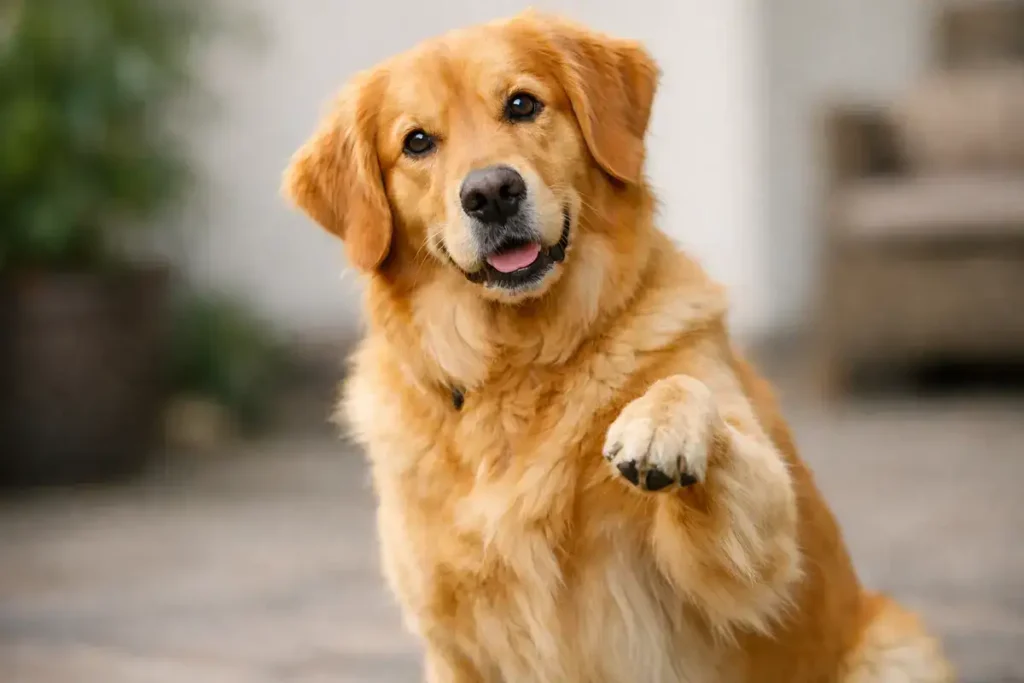
Have you ever seen your dog lift one front paw off the ground? The Golden Retriever paw lift meaning changes based on what is happening around them.
| Context | Paw Signal Meaning | Action Required |
|---|---|---|
| Staring at Squirrel/Bird | Focus (Pointing) | Genetic hunting instinct; let them watch. |
| During Training | Anticipation | Waiting for a treat; paying close attention. |
| Greeting You | Affection/Request | Asking for pets; wanting attention. |
| Head Turned Away | Uncertainty | Feeling stressed; give them space. |
| Limping | Pain/Injury | Check their foot for thorns or cuts immediately. |
Understanding Golden Retriever Soft Mouth Behavior
Goldens have a “soft mouth.” This means they can carry things very gently without biting down hard. Golden Retriever soft mouth behavior often involves carrying pillows or stuffed toys to greet you at the door. It is a way for them to comfort themselves.

Warning Signs a Golden Retriever Will Bite
It is rare, but Goldens can bite. We must respect their space to keep everyone safe. The American Veterinary Medical Association (AVMA) reminds us that any dog can bite if they are scared or in pain. Ignoring warning signs is the main reason bites happen.
Fear-Based Aggression
When Goldens get aggressive, it is usually because of fear, not because they are mean. Data from Golden Retriever Guides (2025) suggests that fear-based aggression causes about 40% of Golden Retriever attacks. This often happens when the dog feels trapped.
This is why understanding body language is so important. Prof. Claire Parkinson warns that many owners can’t tell what their dog is saying. She says that “attempting to cuddle a worried dog increases the risk of being bitten.”
Freezing and Turning Away
If you are looking for signs a Golden Retriever will bite, watch for stillness. If a dog suddenly stops moving (freezes) or deliberately turns their head away, they are using calming signals for Golden Retrievers. They are politely asking you to stop.
Dog expert Turid Rugaas famously said, “Turning the head to one side, or turning the whole body away, is a strong calming signal used to diffuse tension.”
How to React to Your Dog’s Body Language
If you misread these signals, especially with children, accidents can happen. Studies like those in Frontiers in Veterinary Science show that children often mistake angry dog faces for happy ones, increasing bite risks.
Here is how to handle Golden Retriever body language with toddlers and adults:
What to Do When You See These Golden Retriever Signals
Play Bow (front elbows down, butt in the air): This means they want to play! Grab their favorite toy and join in the fun.
Whale Eye (whites of their eyes showing): Stop touching them and step back right away. This means they’re feeling anxious or uncomfortable.
Submissive Grin (lips pulled back, teeth showing slightly): Speak in a happy, soft voice to reassure them they’re safe. This is their way of saying, “I’m not a threat!”
Freezing (suddenly still, tense body): Do NOT hug them or lean over them. To a dog, this can feel like a threat. Instead, back away slowly to give them space to move.
For more safety tips, review the AVMA Dog Bite Prevention resources. Recognizing these clues is the first step, but many owners still have questions about specific behaviors.
???? Glossary of Golden Retriever Body Language Terms
Body Language
Non-verbal signals dogs use to communicate emotions through posture, facial expressions, tail position, and movement.
Soft Eyes
Relaxed eyelids and a gentle gaze — a sign of comfort and trust.
Whale Eye
When the whites of the eyes show as the dog turns its head — often signals stress or discomfort.
Submissive Grin
Lips pulled back in what looks like a smile, paired with relaxed or lowered posture — a friendly, appeasement gesture.
Play Bow
Front legs lowered, rear end raised — an invitation to play.
Helicopter Tail
A full circular tail wag usually indicates high excitement or joy.
Pinned-Back Ears
Ears flattened against the head may signal fear, anxiety, or uncertainty.
Hard Stare
Fixed, intense eye contact — a warning or sign of tension.
Tucked Tail
Tail held low or between the legs — typically shows fear or submission.
Calming Signals
Subtle behaviors like lip licking, yawning, or looking away used to reduce tension.
Frequently Asked Questions about Golden Behavior
Why is my Golden Retriever showing his teeth when I get home?
This is likely a “submissive grin.” If his body is low and wiggly, he is happy to see you but feels a little submissive. He is not being aggressive.
Do Golden Retrievers show affection by biting?
Yes, Golden Retrievers often use their mouths to show love. This is called mouthing or cobbing Unlike an angry bite, this is a gentle nibble using just the front teeth. It comes from their instinct to carry soft things gently. However, if the biting is hard, or if they growl and act stiff, it is not affection. That is a sign they are overwhelmed or aggressive.
Why is my Golden Retriever showing teeth but not growling?
This is often a submissive grin – a friendly, appeasing behavior common in Golden Retrievers. Look for loose posture and soft eyes to confirm it’s not aggression.
What does it mean if my dog’s tail spins in a circle?
This is called a “helicopter tail.” It is a sign of extreme happiness and excitement.
Do Golden Retrievers bite without warning?
True sudden aggression is rare. Most Golden Retrievers display clear body language warning signs first, including stiff posture, hard staring, freezing, or whale eye.
Final Thoughts
Understanding Golden Retriever body language is the best gift you can give your pet. Even though they are famous for being friendly, Goldens can still feel fear, worry, and confusion.
You can become a better friend to your dog by learning the difference between a “happy pant” and a “submissive grin.” You should also learn when a wagging tail means stress instead of joy. Pay attention to the small clues—the whale eye, the paw lift, and the body stiffness. When you really “listen” to what your dog is saying with their body, you will have a stronger bond and a safer, happier home.
Have you noticed your Golden using the ‘submissive grin’ or ‘helicopter tail’? Share your experiences in the comments below!
References:
2023 PDSA PAW Report: The People’s Dispensary for Sick Animals Annual Report on Pet Wellbeing.
Current Biology Study: Asymmetric tail-wagging responses by dogs to different emotive stimuli, Vallortigara, A., et al. (2013). This landmark study identified the “Left vs. Right” wagging bias in relation to brain hemisphere activity.
C-BARQ Research: The Canine Behavioral Assessment & Research Questionnaire, University of Pennsylvania, directed by Dr. James Serpell. This is the gold standard for standardized behavioral data in domestic dogs.
Meet Your Dog: Brophey, Kim (CDBC). A comprehensive guide to the “L.E.G.S.” (Learning, Environment, Genetics, Self) framework for understanding breed-specific behavior.
Coren, S. (2004). How To Speak Dog: Mastering the Art of Dog-Human Communication. Free Press.
Salonen, M., Sulkama, S., Mikkola, S. et al. Prevalence, comorbidity, and breed differences in canine anxiety in 13,700 Finnish pet dogs. Sci Rep 10, 2962 (2020). https://doi.org/10.1038/s41598-020-59837-z
Leave a Reply
You must be logged in to post a comment.