

Do Golden Retrievers Bark a Lot? What to Expect
Do Golden Retrievers bark a lot? Not usually. They are not an unusually noisy breed, but they are not silent either. Most bark at people, sounds, excitement, or frustration, then stop. Barking that keeps going is worth looking into, because it can mean unmet needs, anxiety, learned behaviour, or a medical problem.
Breed averages tell you less than most people expect. Barking is driven by what a dog is reacting to, what it has learned, and how its day is structured. This guide covers what normal Golden barking looks like, the nine reasons dogs bark, and what actually reduces it.
Key Takeaways
- ✅ Goldens are not usually a noisy breed. A few barks at the door is normal.
- ⚠️ No published measure ranks breeds by barking. “Quiet breed” lists are opinion.
- ❌ Look at the pattern, not the clock. Long, intense barking your dog cannot settle after is a signal to investigate.
- ⚠️ Attention barking gets worse when it works. Repeated rewards can turn it into a habit.
- ❌ Yelling and shock collars suppress the noise, not the cause. Welfare guidance advises against both.
- ⚠️ Sudden barking in an older Golden can be pain, hearing loss, or cognitive decline. See a vet.
Short answer: expect a few barks at the doorbell and during play. Expect a problem if your Golden barks at length, cannot settle afterwards, or barks when left alone.
Table of Contents
How Much Do Golden Retrievers Bark?
There is no barks-per-day figure, and no veterinary body publishes one. Anyone quoting a number is guessing.
What you can judge is the pattern. Normal barking has a trigger, lasts a short time, and stops when the trigger passes. A dog that barks twice at the mail carrier and goes back to sleep is behaving normally.
Barking that needs attention looks different. It runs long, or restarts every time you sit down. It is hard to interrupt, and the dog cannot settle afterwards. It comes with pacing, drooling, or destructiveness, or it only happens when the dog is alone. ASPCA’s behaviour guidance frames the goal as reducing barking, not eliminating it, because barking is normal dog communication.
| What you hear | What is usually happening | Normal? |
|---|---|---|
| A few sharp barks at the door or a noise | Alert barking | Yes |
| Short barks during fetch or greeting | Excitement | Yes |
| Soft grumbles, whines, “woo-woo” sounds | Talking, or asking for something | Yes |
| Repeated barks at you while you sit down | Attention or demand barking | Work on it |
| Long stretches, cannot be interrupted | Distress, frustration, or a medical issue | No, investigate |
Goldens are talkers. Many owners describe grumbles and whines as conversation, though how much a dog does it varies. The breed tends to vocalise more in play than in conflict. That is not the same as nuisance barking, and it does not need training out of the dog. Our guide to Golden Retriever body language covers the sounds that go with each mood.

9 Common Reasons Golden Retrievers Bark
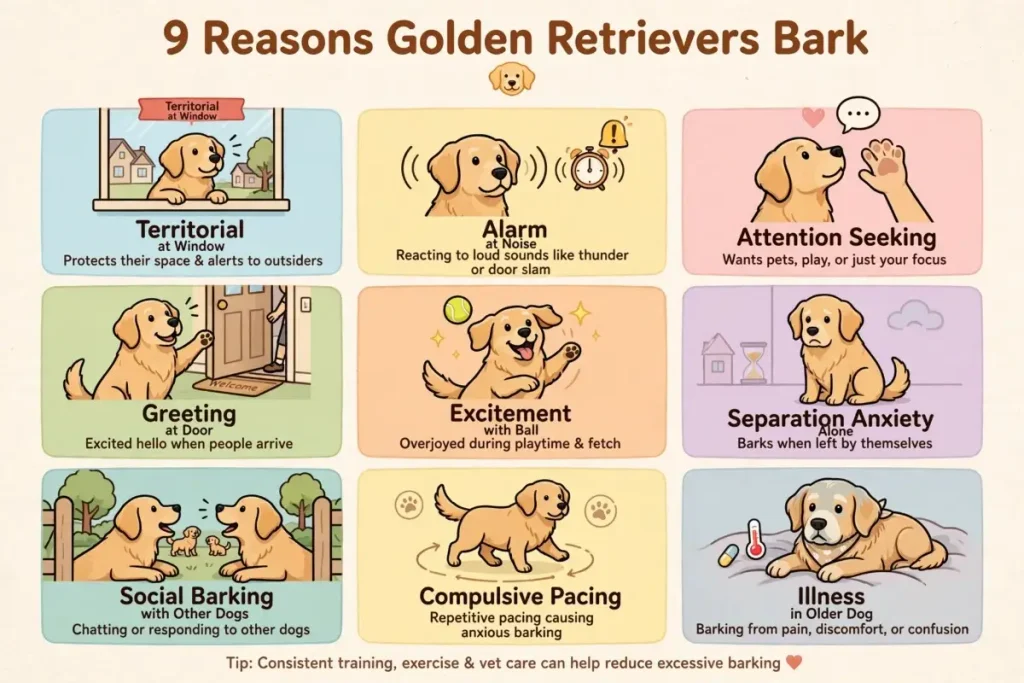
ASPCA groups seven common functions under “Why Dogs Bark“, then lists two more under “Other Problems That Can Cause Barking“: illness or injury, and separation anxiety. The nine below cover all of them. Naming the right one is the whole job, because the fix changes with the cause. A territorial dog needs the window managed. An attention barker needs quiet to pay off instead of barking.
| Cause | What it looks like | What helps |
|---|---|---|
| Territorial | Barks at people or dogs near the house or garden | Block the sightline, reward quiet, call the dog away |
| Alarm | Barks at any noise, stiff body, hard to settle | Mask the sound, pair noises with treats, keep responses calm |
| Attention-seeking | Barks at you while you eat, work, or sit | Avoid rewarding it. Pay for quiet or a sit once needs are met |
| Greeting | Excited barks when you come home, or a visitor arrives | Wait for quiet before greeting. Keep arrivals dull |
| Excitement or frustration | Barks at the lead, the ball, or a dog it cannot reach | Pause the game until quiet, then restart |
| Separation-related | Starts soon after you leave, often with pacing and drooling | Graded absences, vet or behaviourist involvement |
| Socially facilitated | Joins in when other dogs in the house or street bark | Manage the trigger, not just your dog |
| Compulsive | Repetitive barking with no clear trigger, often pacing | Vet check, then a behaviour plan |
| Illness or injury | New barking, especially in an older dog, with other changes | Vet visit first |
Goldens are social dogs, which makes attention and separation barking more likely. They were bred as gundogs to work close to people. The Golden Retriever Club of America traces the breed to 19th-century Scotland and upland game hunting. None of that means barking was selected for. There is no evidence the breed was shaped to be vocal, and no evidence it was shaped to be silent either.
Poodle crosses can show similar patterns, depending on temperament and environment. If you have a cross, our guide to Goldendoodle barking walks through the same nine causes.
What Makes Golden Retriever Barking Worse?
Payoff. A bark that produces a door opening, a treat, or a walk is a bark that gets repeated. ASPCA notes that attention barking generalises: a dog rewarded for barking at the fridge starts barking for play and walks too.
Sightlines. A window onto a pavement is a full-time trigger. So is a garden fence with gaps a dog can see through.
Too little to do. Goldens need daily activity, and the AKC’s exercise guidance notes that needs vary by age and energy. Under-stimulated dogs find their own work, and barking is cheap work.
Inconsistent rules. Barking that works on Tuesday and fails on Wednesday is harder to change. Intermittent rewards can make a habit stick.
Other dogs. One barking dog sets off the household. If you have two, work the loud one first.
What Not to Do
Do not yell. Shouting adds noise and attention to a dog that may already be barking for attention. ASPCA’s guidance is to avoid punishment and to reward quiet instead.
Do not use shock or spray collars. These devices punish the bark, not the reason for it. Welfare organisations including the RSPCA advise against aversive training. A dog shocked for alerting at a visitor can end up more fearful of visitors, not quieter.
Do not reward demand barking. If barking reliably produces attention, food, or play, it can become the dog’s default strategy. Meet the need it is signalling first, then reward quiet and a better behaviour instead. A dog barking because it is frightened, in pain, or desperate to get out is not being demanding, and ignoring it teaches nothing.
Do not remove all barking. A dog that never alerts you to a stranger at the door is not well trained. It is silenced.
5 Steps to Reduce Golden Retriever Barking
- Name the trigger. Keep a log for three days: time, trigger, how long it lasted, what stopped it.
- Remove or block the trigger. Frosted film, a closed curtain, white noise, a different walking route.
- Teach “quiet” on cue. Wait for a natural pause, mark it with a “yes”, and reward. Start at one or two seconds, then build. Practise away from the door and the window first, and only use the cue when your dog is calm enough to learn.
- Pay for an alternative behaviour. Teach a mat, a sit, or fetch a toy. Reward that instead when the trigger appears. A dog can bark while lying down, so the point is to give it a better response, not to trap it in a position.
- Meet the exercise and enrichment need. A walk, a swim, a puzzle, or a training session. Our guide to reading your Golden’s happiness covers enrichment that actually tires a dog out. Then reassess in a few weeks.
Order matters. Step one is the diagnosis. Trainers who skip it end up teaching a dog to bark more quietly, which is not the same as barking less.

Alone, at Night, in an Apartment
Left alone. Barking that starts minutes after you leave is not spite. It is distress, and it looks like pacing, drooling, destruction at exits, and refusing food. True separation anxiety is a panic response. Both ASPCA and VCA treat it as a condition to manage with a behaviour plan, not a bark collar. A vet or a certified behaviourist should be involved early.
At night. A young puppy may need a toilet break. An older Golden that starts barking at night needs a vet check first. Pain, hearing loss, and cognitive decline all change sleep patterns. Only after health is ruled out is it a training problem. Our guide to keeping a Golden healthy into old age covers the changes to watch for.
In an apartment. Are Goldens good apartment dogs? Yes, if their exercise and company needs are met. The work is management. Pick a unit away from the street, block the sightlines, and talk to the neighbours early. Exercise before you leave helps with boredom, but it will not fix separation-related distress in a dog that panics alone. A dog that is fine in a house can still be loud in a hallway.
Golden Retriever vs Other Breeds
Forget invented noise ratings. What predicts barking better is what the breed was developed to do.
| Breed | Bred for | What to expect |
|---|---|---|
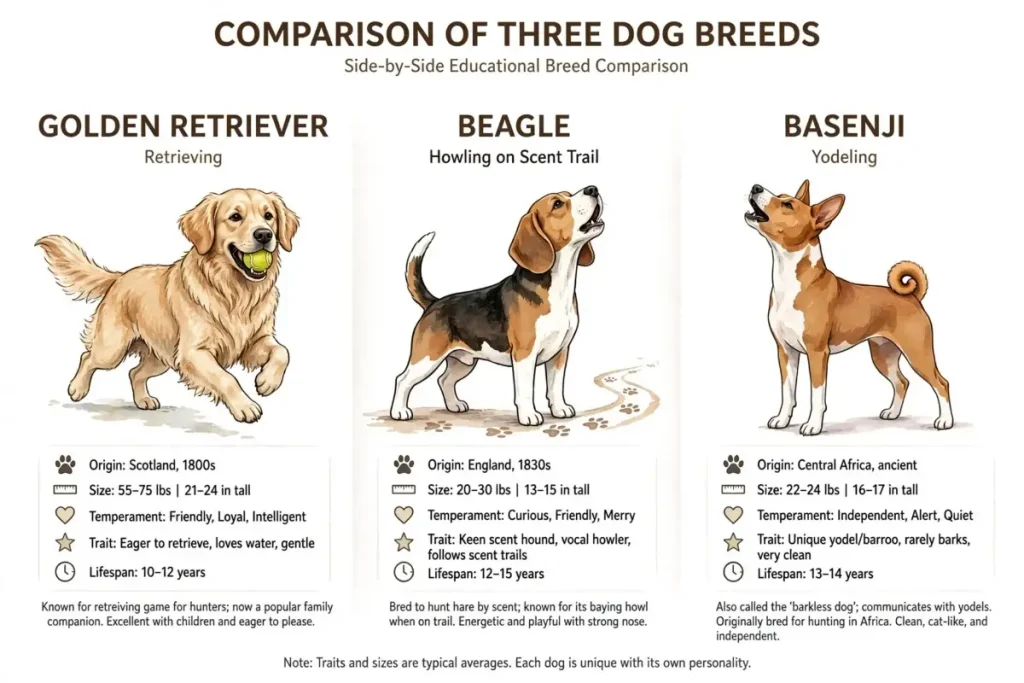
| Golden Retriever | Retrieving game, working close to a handler | Alert barks, play barking, lots of “talking” |
| Labrador Retriever | Same retrieving work | Similar pattern, often less vocal in play |
| Beagle | Following scent in a pack and voicing on the trail | Noise is part of the job. Expect more, not less |
| Basenji | Hunting in dense cover | Does not bark in the usual way, but yodels and screams. Not a silent dog |
The Basenji is often sold as the quiet option. AKC calls it the “Barkless Dog“, and it is still loud. If silence is the requirement, no breed delivers it. What you can choose is a dog whose job does not involve noise, and then train and manage it.
When Barking Is a Red Flag
- Barking starts suddenly in a dog that was quiet for years
- Barking at night, with confusion, staring at walls, or house soiling
- Barking with yelping, reluctance to move, or a change in appetite
- Barking that continues for hours and cannot be interrupted
- Barking with drooling, pacing, or destruction only when alone
- Barking that gets worse after a change at home
Each of these points to a health or welfare issue before it points to training. VCA’s guidance is that medical problems can contribute to vocalisation, especially in older dogs.
Final Verdict: Do Golden Retrievers Bark a Lot?
No. Goldens bark in play, when greeting people, and when alerting you to something. Beagles are known for the sounds they make while working a scent. Basenjis make yodel-like sounds rather than ordinary barks. None of that predicts how noisy an individual puppy will be. Most of the barking an owner hears is normal communication.
The part that becomes a problem is usually environmental. A dog with a window full of triggers, four hours alone, and one walk a day may bark more. Change the day and much of the noise goes with it.
And judge the individual dog, not the breed page. A breed average describes a group, not your dog. Meeting the parents and watching the litter play tells you more than a “quiet breed” list does.
If your Golden is in the adolescent window and the noise has just started, that timing is normal. Our guide to the hardest age for a Golden Retriever explains what changes between six months and two years.
Frequently Asked Questions
Do Golden Retrievers bark a lot?
No. Most Goldens are moderate barkers. They alert to noises and bark in play, then settle. Long stretches of barking usually point to boredom, distress, or a health problem.
Are Golden Retrievers a quiet breed?
Not quiet; moderate. They talk more than many breeds, with grumbles and whines as well as barks. They are not usually listed among the breeds known for nuisance barking.
Do male or female Goldens bark more?
There is no reliable sex difference. Individual personality, training, and environment matter far more than sex.
At what age do Goldens bark most?
There is no established age when Goldens bark the most. Barking can change during adolescence as dogs meet new situations and test boundaries. Training, socialisation, and temperament shape the pattern more than age does. It can also rise again in old age if hearing or cognition changes.
Does neutering stop a Golden from barking?
No. Neutering does not reliably change barking. Barking is learned and triggered by the environment, so training is the lever.
Do bark collars work on Goldens?
They suppress noise, not the cause, and welfare guidance advises against aversive devices. A shocked dog can become more anxious, which often makes barking worse over time.
Why does my Golden bark at night?
Common causes are noise, a need to toilet in puppies, pain, hearing loss, or cognitive decline in seniors. New night barking in an older dog is a vet visit first, not a training problem.
Can a Golden Retriever live in an apartment?
Yes, if exercise and company needs are met. Block the sightlines, exercise before you leave, and expect to manage noise around the hallway and lift.
How do I stop my Golden barking at the doorbell?
Teach a mat or “place” cue, reward the dog for going there, and practise with a recording at low volume before real visitors. Reward quiet, never the barking.
Is it normal for a Golden to grumble and whine?
Yes. Many Goldens “talk” with soft grumbles, especially when happy or asking for something. That is different from repeated barking at a trigger.
Related Golden Retriever Articles



Glossary
Alert barking — Barking at a new sound or sight. Normal and usually short.
Demand barking — Barking aimed at a person to get food, play, or a door opened. Gets stronger when it works.
Extinction burst — A short spike in barking when a behaviour stops working. It usually fades if you hold the line.
Separation anxiety — Panic when left alone, with pacing, drooling, and destruction. A welfare problem, not disobedience.
Cognitive dysfunction — Age-related decline in memory and awareness in senior dogs. It can change sleep and vocalisation.
Sources
- ASPCA — Barking
- VCA Animal Hospitals — Barking in Dogs
- ASPCA — Separation Anxiety
- VCA Animal Hospitals — Separation Anxiety in Dogs
- RSPCA — Barking
- AKC — Golden Retriever breed information
- Golden Retriever Club of America — About the Breed
- AKC — Basenji breed information
- AKC — How Much Exercise Does a Dog Need?
Medical & Safety Disclaimer
This guide is for information only. It is not a substitute for veterinary or behavioural advice. Barking that starts suddenly, or that comes with pain, confusion, or distress, needs a vet visit before any training plan. If your dog shows separation-related panic, ask your vet about a referral to a certified behaviourist.

Leave a Reply
You must be logged in to post a comment.