
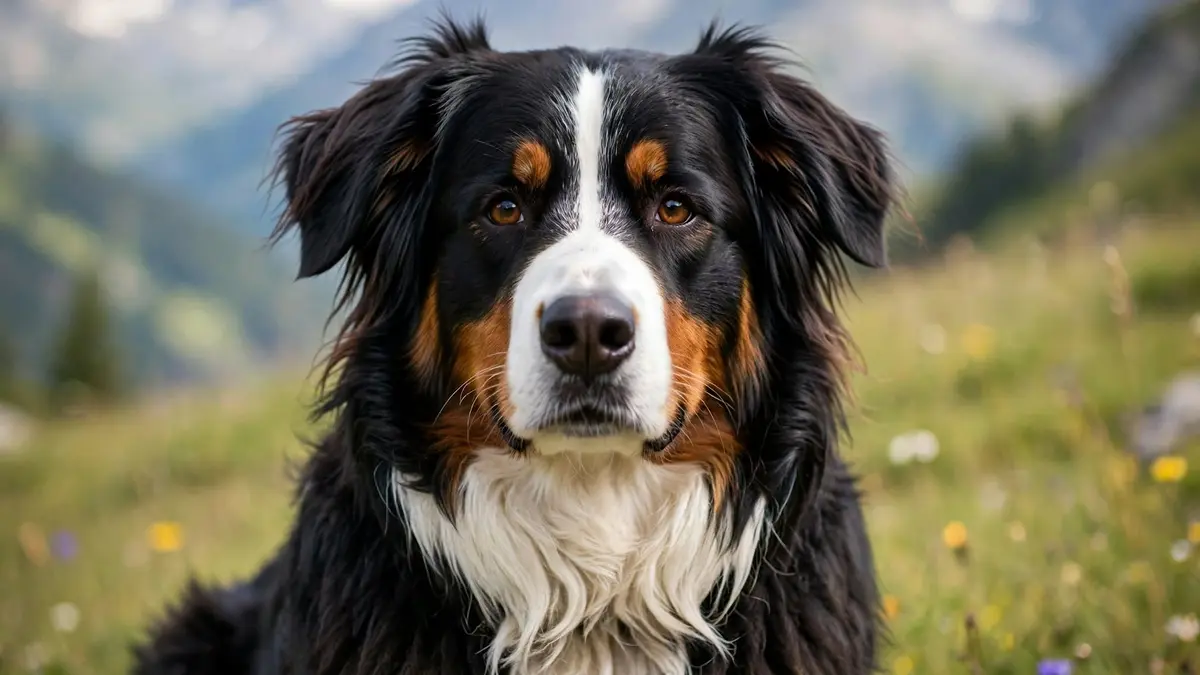
Bordernese: Border Collie Bernese Mountain Dog Mix
The Bordernese is a cross between a Border Collie and a Bernese Mountain Dog. It may combine the Border Collie’s intelligence with the Bernese’s calm, gentle nature in a large, striking package — or it may take after the high-energy, herding side instead. Some Bordernese dogs inherit the Bernese’s laid-back temperament; others keep much of the Border Collie’s drive. There’s no guarantee of a calmer indoor dog. What you can expect is a big, smart cross with real grooming and commitment needs, plus exercise demands that vary with the individual dog.
Quick Facts
- ✅ Potentially calm — May inherit the Bernese’s relaxed nature, but energy varies by dog
- ✅ Good with families — May suit active families with appropriate training and supervision
- ✅ Striking appearance — Large, fluffy, often tri-colored
- ✅ Potentially heavy shedding — Both parent breeds have double coats, so regular brushing and seasonal shedding are important considerations
- ❌ Potentially shorter lifespan — The Bernese parent has a relatively short median lifespan
- ❌ Large size — Medium-large to large; adult weight varies with the parents
Bordernese Quick Facts Table
| Trait | Details |
|---|---|
| Parent breeds | Border Collie + Bernese Mountain Dog |
| Other names | Bordernese, Bernese Collie |
| Size | Medium-large to large; varies with parents |
| Weight | Varies considerably; no established breed-wide range |
| Lifespan | Not well established; may be influenced by the Bernese parent’s shorter lifespan |
| Coat | Long, thick double coat |
| Energy level | Moderate to high, varies by dog |
| Best for | Owners prepared for a large dog with grooming and exercise needs |
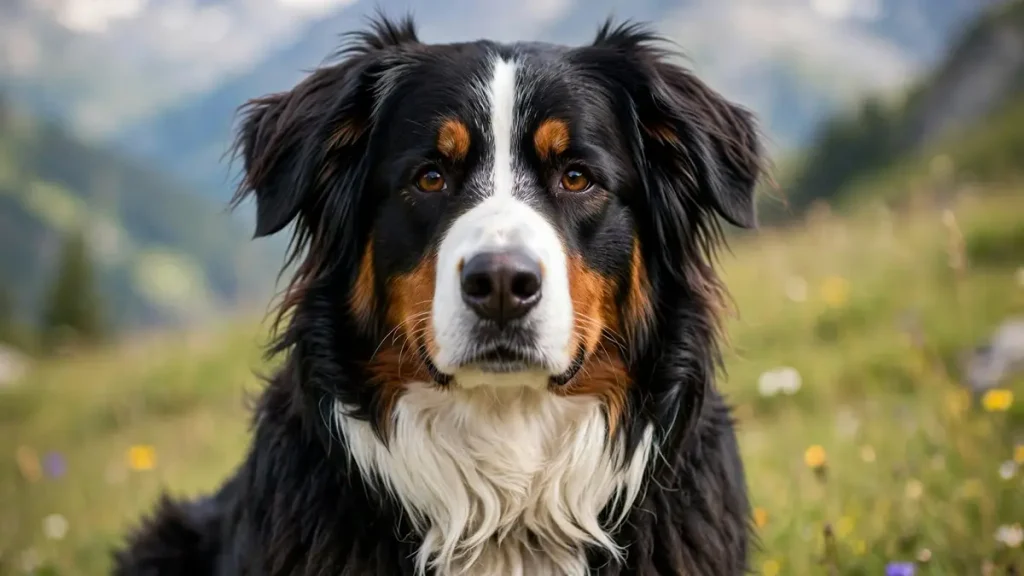
Table of Contents
What Is a Bordernese?
The Bordernese is a relatively rare cross between a Border Collie and a Bernese Mountain Dog. The Bernese was developed in Switzerland as a farm dog, pulling carts, guarding property, and working alongside families. That farm heritage overlaps with the Border Collie’s shepherding background, but the two breeds differ a lot in energy and intensity.
This is not a standardized breed. Size, temperament, coat, and exercise needs can vary a lot — even between puppies in the same litter. Lifespan is worth thinking about: Bernese Mountain Dogs have a relatively short median lifespan, but no average for the Bordernese has been established.
Bordernese Temperament
A Bordernese can be affectionate, smart, and people-focused, but temperament depends on which parent traits win out. Some dogs are relatively relaxed at home. Others carry the Border Collie’s high energy and strong herding instincts.
- Affectionate and social — Both parent breeds can form strong bonds with their families.
- Potentially energetic — A Bordernese may inherit the Border Collie’s need for daily activity and mental stimulation.
- Intelligent and trainable — Many will enjoy learning, but sensitivity, excitement, and distraction can affect training.
- Gentle but large — A friendly dog can still accidentally knock over small children through its size or enthusiasm.
- Variable with strangers — Some may be outgoing, while others are more reserved. Early, positive socialization can help build confidence.
Don’t assume that every Bordernese will be calm indoors. Meet the puppy’s parents if it’s possible, and ask the breeder about their energy levels, sociability, and behavior in the home.
What Does a Bordernese Look Like?
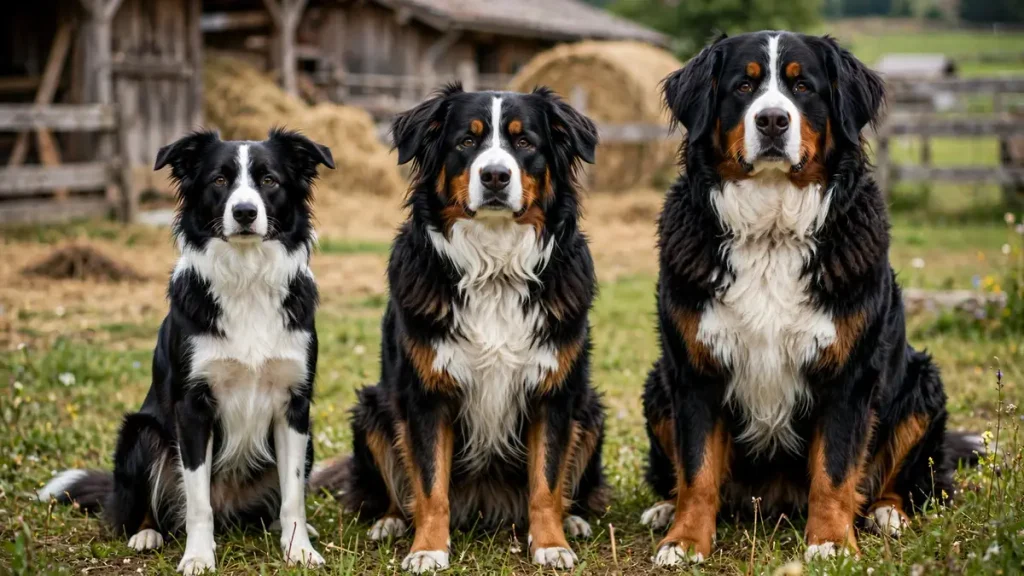
Bordernese looks vary plenty. Many have the long, thick double coat of a Bernese; others carry a shorter coat closer to a Border Collie’s. Color varies too. The classic Bernese tri-color — black, white, and rust — is common, but some dogs inherit mostly black-and-white Border Collie markings, and not every puppy is tri-colored.
Adults are generally medium-large to large, with sturdy builds. Exactly where a given dog falls within that range depends on the size and genetics of its parents.
Bordernese Size and Growth
A Bordernese can grow into a medium-large or large dog, but there is no established weight range for this cross. Its final size depends on the genetics and size of both parents.
If you’re choosing a Bordernese puppy, ask about the parents’ adult weight and build. Remember that even puppies from the same litter can grow at different rates.
Because some Bordernese dogs may become large and heavy, plan for suitable bedding, secure transport, and enough space to move comfortably. Your veterinarian can help you monitor your puppy’s growth and body condition as it matures.
Exercise Needs
How much exercise a Bordernese needs depends on the dog. One that inherits the Border Collie’s working drive may want substantial daily exercise plus mental enrichment. Another may be far more relaxed. There’s no published exercise requirement for this mix.
Daily walks, sniffing opportunities, play, reward-based training, and other age-appropriate activities can help keep your dog physically and mentally engaged. Avoid assuming that a large dog needs strenuous exercise every day.
Puppies need age-appropriate activity. Growing large-breed dogs should avoid forced running, repetitive high-impact exercise, and excessive jumping. Large dogs mature at different rates, so ask your veterinarian when more demanding activities are safe for your dog.
Because of the thick coat, take extra care during warm weather. Provide shade, fresh water, and opportunities to rest.
For training ideas that work for this mix, see our BC obedience training guide.
Training
Most Bordernese dogs respond well to reward-based training, since both parent breeds are smart. But intelligence alone doesn’t make a dog easy to train. Energy level, sensitivity, and how easily the dog gets distracted all play a part.
Key tips:
- Start socialization early — some dogs may be reserved around strangers, so positive, gradual exposure can help build confidence.
- Use reward-based methods; this mix is often sensitive to harsh corrections.
- Keep training sessions positive and consistent.
- Teach polite leash walking early — a large dog that pulls is hard to manage.
- Provide mental stimulation: puzzle toys, nose work, and trick training.
Health: What to Know
The Bernese is known for a shorter lifespan and higher cancer risk, and that matters for this cross. A 2016 Swiss study of 389 Bernese Mountain Dogs reported a median life expectancy of 8.4 years. Neoplasia was recorded in 222 of the 381 dogs that had died, though not all diagnoses were confirmed by lab testing. It’s useful background on the Bernese side, but it does not establish the lifespan or cancer risk of a Bordernese — there’s no comparable dataset for this cross.
| Condition | Parent Breed Context | Notes |
|---|---|---|
| Cancer | Bernese | Bernese Mountain Dogs have documented cancer-related mortality; Bordernese-specific risk is unknown. |
| Hip and elbow dysplasia | Both | Relevant to both parent breeds; ask for screening results. |
| Bloat (GDV) | Bernese | A concern associated with large, deep-chested dogs; discuss risk with a veterinarian. |
| Collie Eye Anomaly | Border Collie | Genetic eye condition; screening recommended for the BC parent. |
| Progressive Retinal Atrophy | Border Collie | Discuss relevant eye and genetic screening with the breeder; testing depends on the specific condition and lines. |
| MDR1 mutation | Certain herding-breed lines | Testing relevance depends on the specific parent lines; not every Border Collie carries it. |
Health Testing Before Getting a Bordernese
Ask the breeder for documented health-testing results for both parents, not just a verbal assurance that they are healthy. Relevant screening may include hip and elbow evaluations, eye examinations, and genetic tests recommended for the parent breeds.
The Bernese Mountain Dog Club of America identifies hips, elbows, eyes, heart, and degenerative myelopathy among its minimum recommended tests for Bernese breeding dogs, along with optional tests. Health testing cannot guarantee that a puppy will remain healthy, but it can help identify some inherited risks. Ask which tests were performed, who completed them, and whether the results are publicly verifiable.
A Bordernese’s health risks depend on its individual genetics. Bernese cancer statistics are important background information, but they should not be presented as a measured cancer rate for this crossbreed.
For more on Border Collie health, see our BC health guide.
Grooming: A Real Commitment
The Bordernese often has a thick double coat that sheds heavily, with especially heavy seasonal shedding. Brushing several times per week is typical, with more frequent brushing during shedding season. Professional grooming may help manage the coat. Shedding levels vary between individual dogs.
Other grooming needs: check ears regularly, trim nails as needed, and expect some drool. Bernese Mountain Dogs are known for it, though how much a given cross drools varies.
Bordernese Puppies: What to Know Before Buying
If you’re considering a Bordernese puppy, evaluate the breeder carefully:
- Ask for documented health-testing results for both parents.
- Meet the parents, if possible, and observe their energy levels and behavior.
- Ask how the puppies are socialized before they go home.
- Check that puppies have had veterinary checks and age-appropriate vaccinations.
- Ask the breeder about the litter’s energy levels, temperament, and any health concerns.

What Is It Like Living With a Bordernese?
Living with a Bordernese can mean managing a large dog with a thick coat, regular grooming needs, and a personality that may range from relaxed to highly energetic.
Daily life may include walks, training, play, coat care, and time spent with the family. Some dogs may settle comfortably at home after appropriate activity, while others need more structured mental enrichment.
Before bringing one home, think about whether you can manage a large dog for its whole life: grooming costs, veterinary care, transport, and exercise in all kinds of weather. You can estimate the cost of owning a dog with our calculator for a starting point.
Is a Bordernese Right for You?
May be a good fit if:
- You’re prepared for a large dog with significant grooming needs
- You can meet varying exercise needs and provide mental enrichment
- You’re prepared for uncertainty about lifespan and potential inherited health risks
- You have experience handling large breeds
- You have space and access to regular exercise
Probably not a good fit if:
- You want a guarantee of a calm, low-energy dog
- You want a dog you can be confident will live 12+ years
- You’re averse to heavy shedding and drool
- You’re a first-time owner without large-dog experience or help
- You live somewhere hot with limited ability to manage the dog’s exercise needs
Comparison: Bordernese vs. Other BC Mixes
Crossbreed data is limited, so treat these as general tendencies, not verified averages. Individual dogs vary a lot.
| Border Collie Mix | Size | Energy | Lifespan Information | Grooming |
|---|---|---|---|---|
| Bordernese | Medium-large to large | Moderate to high; varies | No established mix-specific average | Potentially high |
| Coltriever | Medium-large | Moderate to high | 12–15 years (estimate) | Moderate |
| Border Beagle | Small to medium | High | 12–15 years (estimate) | Low to moderate; varies |
Conclusion
The Bordernese can be a wonderful companion for the right home: intelligent, affectionate, and genuinely striking to look at. But it’s a cross of two very different working breeds, and individual dogs can lean strongly toward either parent. The Bernese’s relatively short median lifespan, the mix’s uncertain longevity, heavy grooming, and large adult size are all worth weighing. If you can handle those uncertainties, the Bordernese may be worth exploring. If not, a breed or mix with more predictable traits will serve you better.
Frequently Asked Questions
What is a Bordernese?
A Bordernese is a cross between a Border Collie and a Bernese Mountain Dog. It is not a standardized breed, so its size, appearance, coat, and temperament can vary.
How big does a Bordernese get?
Bordernese dogs can grow into medium-large or large dogs. Their adult size depends on the size and genetics of their parents, so there is no reliably established breed-wide weight range.
Is a Bordernese a calm dog?
Some Bordernese dogs may inherit the Bernese Mountain Dog’s more relaxed nature, while others retain much of the Border Collie’s energy and herding instincts. A calm temperament is not guaranteed.
How long do Bordernese dogs live?
No solid average exists for the mix itself. Bernese Mountain Dogs have a relatively short median lifespan, and that’s worth factoring into your decision.
Do Bordernese dogs shed a lot?
They may shed heavily, particularly if they inherit the thick double coat of either parent. Shedding levels and coat maintenance needs vary between individual dogs.
Are Bordernese dogs good family pets?
A Bordernese may make a loving family companion with appropriate training, socialization, exercise, and supervision. Its large adult size and potentially high energy are important considerations for families with young children.
Are Bordernese dogs easy to train?
Many may be responsive to reward-based training because both parent breeds are intelligent. However, energy level, sensitivity, distraction, and individual temperament can affect how easy a particular dog is to train.
Can a Bordernese live in an apartment?
Possibly. A Bordernese’s suitability for apartment living depends on its adult size, energy level, ability to settle indoors, and access to regular exercise. A yard can be useful, but it does not replace daily activity and training.
Glossary
- Bloat / GDV — Gastric Dilatation-Volvulus, a life-threatening stomach twist. Common in deep-chested large breeds.
- Histiocytic sarcoma — A type of cancer that occurs at elevated rates in Bernese Mountain Dogs. Aggressive and often fatal.
- Growth plates — Cartilage areas at the end of long bones that harden as a dog matures. Timing varies, particularly in large breeds.
- Carting — The traditional working role of Bernese Mountain Dogs, pulling carts or wagons.
- MDR1 — A gene mutation affecting drug sensitivity in some herding breeds.
Sources
- AKC — Border Collie breed information.
- AKC — Bernese Mountain Dog breed information.
- PetMD — Bernese Mountain Dog health and care.
- Bernese Mountain Dog Club of America — Breeder health screening recommendations.
- Kloetzli et al. (2016) — “Life expectancy and causes of death in Bernese mountain dogs in Switzerland.” BMC Veterinary Research. PubMed.
This guide is for informational purposes and is not a substitute for professional veterinary advice. Every dog is an individual, and health concerns vary. Always consult a licensed veterinarian for medical decisions, diagnosis, or treatment for your pet.
Leave a Reply
You must be logged in to post a comment.