

A Bearded Collie is a 45–55 lb Scottish herding dog with a long double coat, a full-time need for company, and a sense of humour. It stands 20–22 inches at the shoulder and was bred to work all day beside a shepherd. It still expects to. Give it an hour of hard exercise and people around most of the day, and you get a funny, biddable companion. Leave it alone in a flat with one walk, and it will find its own work.
Table of Contents
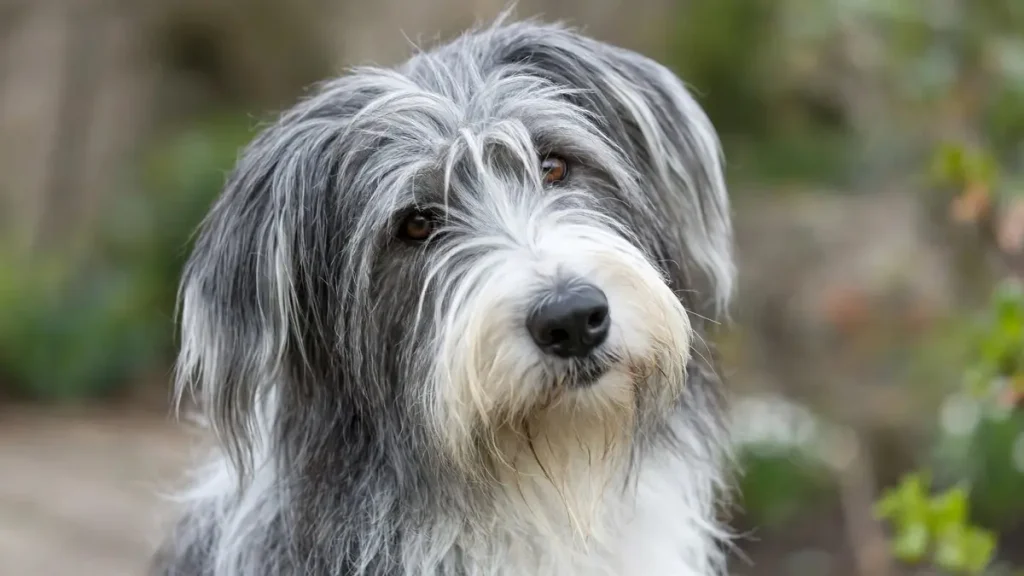
Bearded Collie at a Glance
| Height | 20–21 in (female), 21–22 in (male) |
| Weight | 45–55 lb |
| Lifespan | 12–14 years |
| Coat | Long, harsh outer coat over a soft undercoat |
| Colours | Black, blue, brown or fawn, with white |
| Exercise | At least 1 hour a day |
| Grooming | Daily brushing, 5–10 minutes; weekly comb-out |
| Best for | Active homes with someone there all day |
| Not for | Long days alone with no walker or daycare |
Figures from the American Kennel Club breed page.
A History Steeped in Herding
The Kennel Club traces dogs resembling the Beardie back about 500 years, working cattle and sheep in the Borders and Highlands of Scotland. The Polish origin story is the usual one: Mrs Willison traced the breed to three Polish sheepdogs brought to Scotland in 1514. The Bearded Collie Club of America calls most of these accounts, hers included, “sheer speculation”. What can be said is that a long-haired, hairy-faced herding dog developed in Scotland and was valued for working sheep and cattle.
The first breed standard was drawn up in 1912. By the 1940s, the breed was nearly gone, and the revival started with a mistake. In 1944, Mrs G. Olive Willison ordered a working Shetland Sheepdog from a Scottish farmer and received a Bearded Collie instead. She kept her, named her Jeannie, and registered her — the first Beardie registration since 1939. Hunting for a mate, she met a Beardie walking on Brighton beach, took him home when his owner emigrated, and registered him as Bailie of Bothkennar. Modern show lines run back to those two dogs.
A new breed club formed in 1955. The Kennel Club recognized the breed in 1959, and the AKC followed in 1976. The AKC’s popularity ranking puts the Bearded Collie 140th: uncommon, not rare.

Personality & Temperament
A Beardie is clever, loud, and built for company. It is not a dog that settles for a walk and a biscuit.
The AKC calls the breed bouncy and charismatic, and describes Beardies as independent decision-makers that can be willful. That is the whole breed in one line. They solve problems, which is charming when you hide a treat and less charming when they work out the gate latch. They also talk — yips, groans, and a running commentary that some owners find hilarious and others find exhausting.
They bore easily. The AKC’s care guide says training has to be kept interesting, and a bored Beardie invents work — usually barking, counter-surfing, or herding the family. They are still working dogs too, in herding trials, agility, obedience, search-and-rescue, and therapy.
Are Bearded Collies Good with Kids?
Yes, with two conditions. The AKC says well-socialized Beardies get on nicely with children. Neither caveat is optional.
First, the herding instinct. A Beardie may try to move small children by nipping at their heels. This is often herding behavior rather than aggression, but it still needs to be managed and redirected early. Never let heel-nipping become an accepted way of interacting with children.
Second, size and speed: a bouncy 45–55 lb dog can knock a toddler over without meaning to. Fine with school-age children. Supervise toddlers, and teach children not to grab the coat or beard.

Is a Bearded Collie a Good Fit for Your Home?
- Other pets: usually fine, especially when raised together. The herding instinct still applies to cats that run.
- Hours alone: the weak point. Bred to work beside a person all day, a Beardie with nothing to do will find something to do. Households that are empty through the working day usually need a walker or daycare to make this work.
- Flats: possible with a lot of walking, but hard. They are vocal, and a bored Beardie barks. A garden helps; a garden alone is not enough.
- Weather: they will ask to go out in the rain.
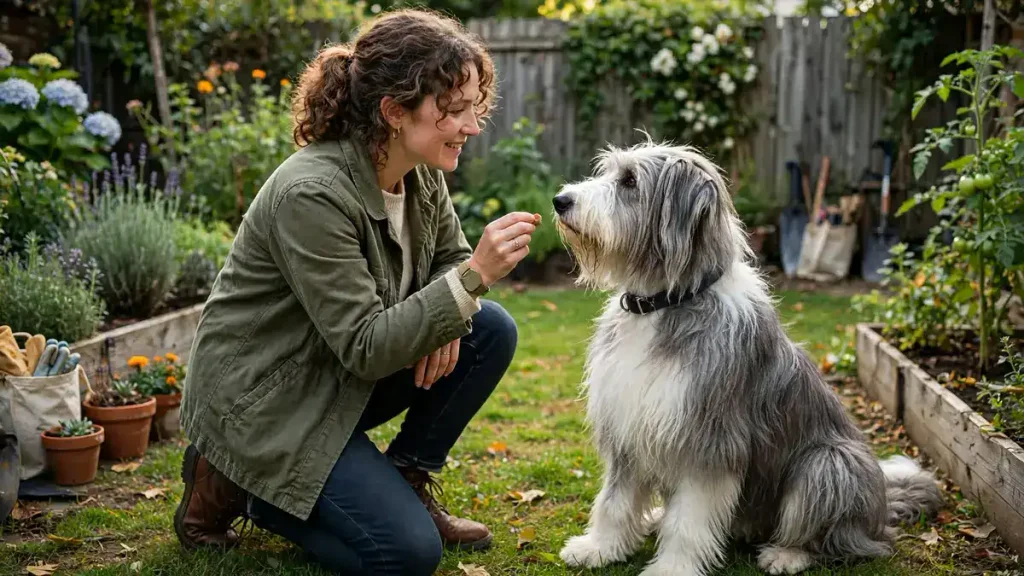
Bearded Collie Exercise and Feeding
An hour a day is the floor, not the target. The AKC calls Beardies energetic and boisterous. It says they need some activity every day: a run, a long hike, ball play, or a fenced yard with company.
Two shorter sessions beat one long one. A tired Beardie settles; an overtired one does not. Mental work counts as much as mileage: puzzle feeders, scent games, a new trick each week, an obedience class. A Beardie with a job is usually easier to live with. One without a job is a problem.
Feed a complete diet for its age and activity, measured, twice a day. Cornell’s vet school lists feeding once a day, or a large volume in one meal, as a risk factor for bloat. Beardies are not among the breeds Cornell names as predisposed, so treat this as general deep-chested caution, not a breed-specific warning.
Bearded Collie Grooming Requirements
The coat is the commitment. Expect daily brushing — 5 to 10 minutes to clear tangles — plus a weekly session of 30 to 60 minutes with a pin rake, brush, and comb. That is the AKC’s regimen, and more than most breed pages admit.
Mats start behind the ears, under the legs, and around the tail. Some owners also use a professional groomer every 6–8 weeks to hold the shape. Not a substitute for brushing at home. Everything else — the double coat, the shedding, line brushing, the “puppy cut” question — is covered in our guide to Bearded Collie shedding.

Bearded Collie Health Problems
A Beardie is sturdy, with a short list of things worth screening for. The Bearded Collie Club of America’s health statement asks breeders to test all stock, and it is specific about how often.
- Hip dysplasia — an OFA, PennHIP, BVA, OVC, or FCI evaluation, depending on the country.
- Eye examination — by an ACVO ophthalmologist, every year.
- Autoimmune thyroiditis — an OFA laboratory test every year until the dog is five, then every two years.
- Elbow dysplasia — an OFA evaluation, listed as optional.
Note the schedule: eye and thyroid results are dated, so a four-year-old certificate is out of date. Ask for current paperwork, not an assurance that the dogs are healthy. Addison’s is the one the breed’s foundation funds research into.
BeaCon, the Bearded Collie Foundation for Health, runs an open registry with data on more than 3,500 Beardies since 2000 — a better record of what the breed actually deals with than any list. Lifespan is 12–14 years.
This article is general information, not veterinary advice. Talk to your vet about your own dog.
Bearded Collie Training and Socialization
Beardies are trainable and stubborn in the same breath. They want to please, and they want to decide. Positive reinforcement works: food, play, praise. Harsh corrections do not — this is a sensitive breed that shuts down rather than argues.
Start early with name and recall, crate or pen training, lead walking, handling (paws, ears, mouth, brush), and meeting people, dogs and traffic. Keep sessions short and finish on a win. A Beardie that is bored stops working; a Beardie that is confused stops trying.

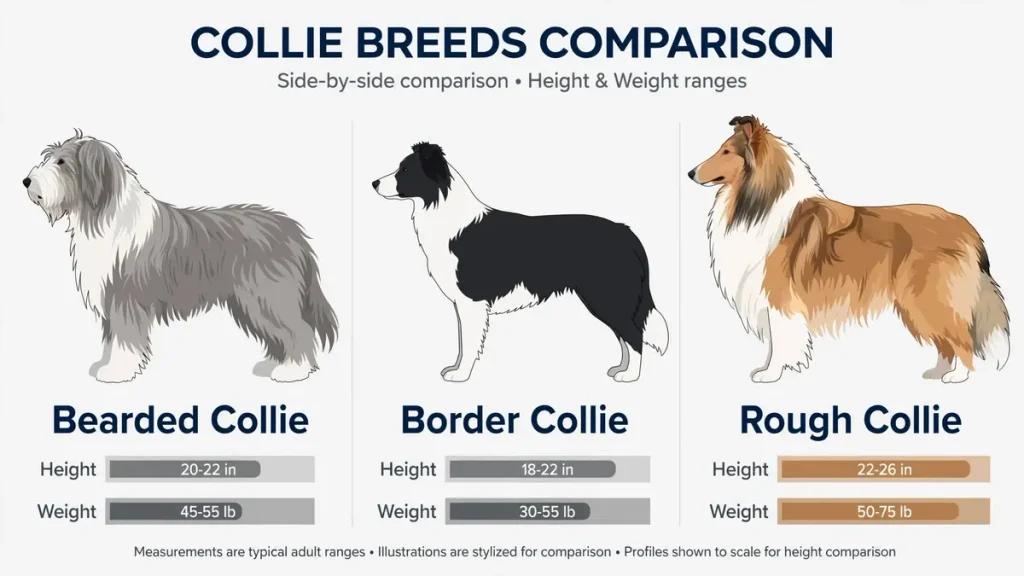
Bearded Collie vs Border Collie and Rough Collie
Four collie types come up in the same search.
| Attribute | Bearded Collie | Border Collie | Rough / Smooth Collie |
|---|---|---|---|
| Height | 20–22 in | 18–22 in | 22–26 in |
| Weight | 45–55 lb | 30–55 lb | 50–75 lb |
| Coat | Long, double | Medium, double | Long or short |
| Energy | High | Very high | Moderate |
| Trainability | High | Exceptional | High |
| Grooming | Daily + weekly | 2–3× weekly | Daily rough / weekly smooth |
| Best for | Active homes | Sport and work | Calm families |
Sizes from the AKC breed pages for the Border Collie and the Collie. The energy and trainability rows are our summary, not registry scores. The Border Collie is the most demanding of the three and needs a job, not a walk — our Border Collie guide covers what that looks like. The Rough Collie is the calmest and the biggest, and suits a quieter house. Individuals vary, and a well-bred Bearded Collie can be as driven as a Border Collie. If you want a collie in a smaller package, the Shetland Sheepdog is 13–16 inches and 15–25 lb. Our Collie vs Border Collie breakdown and the collie breeds hub cover the rest of the family.
What a Bearded Collie Costs
Grooming is the line item people underestimate. A professional groom every 6–8 weeks, on top of daily brushing, is a cost for the dog’s whole life rather than a puppy expense.
Budget for these, roughly in order:
- Professional grooming — every 6–8 weeks, for the dog’s whole life
- Pet insurance — cheapest taken out young
- Food — an active 45–55 lb dog eats more than you expect
- First-year vet costs — vaccinations, microchip, neutering
- An emergency fund — the item most owners skip
Puppy prices vary by country, bloodline, and health testing. We do not quote a figure that would be wrong by the time you read it. Ask three breeders in your region what they charge and what the health testing covers: the spread tells you more than any average.
Buying the dog is the cheap part. The eleven to fourteen years after that are not.
Is a Bearded Collie Right for You?
Get one if:
- Someone is home most of the day
- You want a dog to train, work, or compete with
- You will brush daily without resenting it
- You have an hour a day to give
Don’t if:
- The dog will be alone eight hours or more, with no walker or daycare
- You want a coat you can ignore
- You want a dog that lies down quietly
If you are looking for a low-maintenance pet, this isn’t the breed for you. Beardies are at their best with a job, a person, and a routine.

Finding a Bearded Collie
Start with the Bearded Collie Club of America for breeder referrals and health information. A breeder who has done the club’s screening tests sends the certificates without being asked twice. One who has not will change the subject.
Ask two more questions: what happens to a dog that does not turn out for showing, and can you meet the mother? A breeder who keeps their dogs in the house says yes to both. Then consider rescue. Breed rescue rehomes adults, and an adult’s temperament is already known.
FAQ
How big do Bearded Collies get?
20–22 inches at the shoulder, 45–55 lb, with females at the smaller end of both. A medium dog: smaller than a Rough Collie, larger than a Sheltie.
How long do Bearded Collies live?
12 to 14 years, average for a dog this size. A breeder who screens hips, eyes, and thyroid gives a puppy the best start.
Do Bearded Collies shed a lot?
Yes. They shed year-round and heavily twice a year, when the undercoat blows. Daily brushing keeps it manageable. Our Bearded Collie shedding guide covers the coat cycle in detail.
Are Bearded Collies hypoallergenic?
No. They have a double coat; they shed, and they produce dander like any other breed. No dog is truly hypoallergenic.
Are Bearded Collies good with children?
Yes, especially with school-age children. Supervise toddlers — a bouncy 45–55 lb dog can knock one over — and train out heel-nipping early.
Do Bearded Collies get on with cats?
Usually, particularly when they grow up together. The herding instinct still fires at a cat that runs, so introductions should be slow and supervised.
Can a Bearded Collie live in an apartment?
It can, but it is not ideal. They are vocal, they bore quickly, and they need an hour of real exercise wherever they live.
How much exercise does a Bearded Collie need?
At least an hour a day of vigorous activity, split into two sessions, plus mental work: puzzle feeders, scent games, training.
Are Bearded Collies easy to train?
They are trainable but independent. They learn fast and get bored fast, so short sessions, food, and play work better than repetition. Harsh corrections backfire.
Do Bearded Collies bark a lot?
Yes. They are vocal, and they “talk” through yips, groans, and barks. Some of it is communication, some is boredom, and the boredom is trainable.
Can Bearded Collies be left alone all day?
Not comfortably. They were bred to work beside a person all day, and long stretches alone tend to show up as barking, chewing, or pacing. Most working households need a walker or daycare.
Is a Bearded Collie good for a first-time owner?
Only if you have time. Training is manageable; the coat and the company requirement are what defeat new owners.
How much grooming does a Bearded Collie need?
Five to ten minutes of brushing daily and a 30 to 60 minute comb-out weekly. That is the AKC’s home routine. A professional groom every 6–8 weeks is a separate recommendation, not an AKC requirement.
Are Bearded Collies healthy dogs?
Generally yes. The breed club recommends hip, eye, and thyroid screening, with elbow optional, and BeaCon runs an open health registry.
How much does a Bearded Collie puppy cost?
Prices vary by country, breeder, and health testing, so we do not quote a figure. The purchase price is only a small part: budget for food, insurance, vet care, and a groom every 6–8 weeks for life.
Related Collie Family Guides


Sources
- American Kennel Club — Bearded Collie breed page (height, weight, lifespan, colors, recognition, grooming)
- The Kennel Club — Bearded Collie breed page (1912 standard, Willison revival, 1959 recognition)
- Bearded Collie Club of America (breeder referrals)
- Bearded Collie Club of America — Health
- Bearded Collie Club of America — History of the Bearded Collie (Jeannie, Bailie, the Polish origin question)
- Bearded Collie Club of America — Health Statement (PDF) (the tests and their schedule)
- BeaCon, the Bearded Collie Foundation for Health (open health registry, Addison’s research)
- Cornell Riney Canine Health Center — Gastric dilatation-volvulus (bloat)
- American Kennel Club — Border Collie
- American Kennel Club — Collie
- American Kennel Club — Shetland Sheepdog

Leave a Reply
You must be logged in to post a comment.