

A Rough Collie is a 50–75 lb herding dog with a long double coat and a gentle temperament. One fact matters before anything else: an estimated 55–70% of Collies have the MDR1 mutation, which can make certain medications dangerous.
Plan on 45–60 minutes of activity a day and a weekly brush down to the skin. That is the short version. The long version explains why the coat is a commitment and why the breed barks when it is bored. It also lists the four health tests to ask about before you pay a deposit.
The Rough Collie is the Lassie dog. It is also a working herding breed: the AKC keeps it in the Herding Group, and names herding among the sports Collies take to. That history explains most of what the breed needs. It wants a job for its mind, an hour or so of coat care each week, and people around for most of the day.
Key Takeaways
- ✅ Ask about MDR1 first. The Collie Health Foundation puts the share of Collies with the mutation at 55–70%. Ask for the actual DNA results: knowing your dog’s status lets a vet avoid dangerous drug choices.
- ✅ Brush weekly, down to the skin. The AKC names the two places that mat first: behind the ears and at the elbows.
- ✅ Feed two meals a day, not one. Feeding once daily is one of the risk factors Cornell lists for bloat.
- ⚠️ Plan for 45–60 minutes of daily activity. That is our estimate, not a breed-standard figure: the AKC publishes no hour requirement for the Collie.
- ⚠️ The coat is a real commitment. Budget an hour a week, more during a shed.
- ❌ Do not buy on looks alone. Ask to see the club’s four DNA test results on both parents, plus the puppy’s eye exam at 6–8 weeks.

Table of Contents
| Quick fact | Rough Collie |
|---|---|
| Height (US, AKC) | 24–26 in (male), 22–24 in (female) |
| Height (UK, Kennel Club) | 22–24 in (male), 20–22 in (female) |
| Weight | 60–75 lb (male), 50–65 lb (female). The UK standard gives no weight. |
| Lifespan | 12–14 years |
| Group | Herding (AKC) |
| Coat | Long double coat. The Smooth Collie is the same breed with a short coat. |
| Colors | AKC: sable and white, tricolor, blue merle, white. Kennel Club: three only; all-white is highly undesirable. |
| Exercise | About 45–60 minutes a day (our estimate) |
| Grooming | Brush weekly; bathe when needed, not on a schedule |
| Barking | Boredom brings barking. Not a dog to leave in the yard all day. |
| MDR1 mutation | Estimated 55–70% have the mutation (Collie Health Foundation) |
What Kind of Dog Is a Rough Collie?
The Rough Collie is a herding breed from the Scottish Highlands. Queen Victoria kept them at Balmoral, and that royal attention helped turn a farm dog into a national favorite. The AKC recognized the Collie as a breed in 1885. The Collie Club of America formed a year later, as the second parent club to join.
Most people know the breed from film. Lassie was played in the 1943 MGM film by a rough Collie called Pal. One dog did more for the breed’s popularity than any show ring ever has.
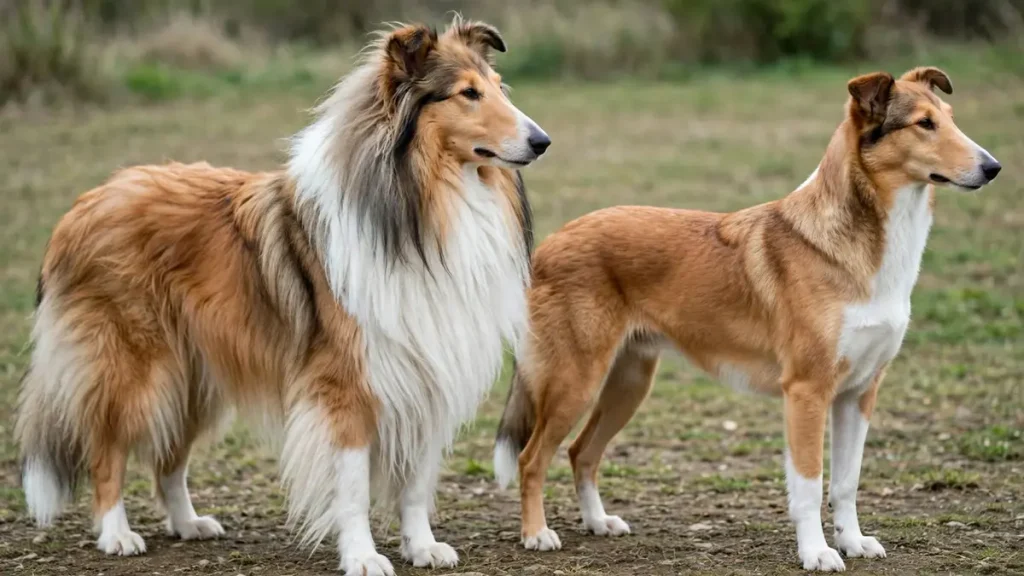
Here is the part that confuses buyers. Rough and Smooth Collies are one breed with two coat varieties. Same head, same temperament, same health risks. The Smooth just carries a short coat. If you are choosing between them, the Smooth Collie guide covers that side. The collie breed comparison puts all four collie types side by side.
The AKC calls the breed “a large but lithe herder standing anywhere from 22 to 26 inches tall.” Lithe is the useful word. A Rough Collie is tall and narrow rather than heavy, and that chest shape matters for the emergency covered below.
What Is a Rough Collie’s Temperament Like?
Gentle, sociable, and built to work with people. The AKC calls Collies “famously fond of children” and describes them as wonderful family pets that thrive on companionship and regular exercise.
They are biddable, too. The same breed page says young Collies learn happily and rapidly with gentle training. It lists obedience, agility, herding, barn hunt, and lure coursing as sports the breed takes to. A Collie that is never taught anything wastes a good brain. A bored one will find its own work.
That work often involves noise. The AKC’s guidance is blunt. A Collie “should not be relegated to the backyard for long periods of time, as with boredom comes barking.” This is not a breed that settles quietly behind a fence. It wants to be where you are. The AKC calls them “people dogs” for that reason.
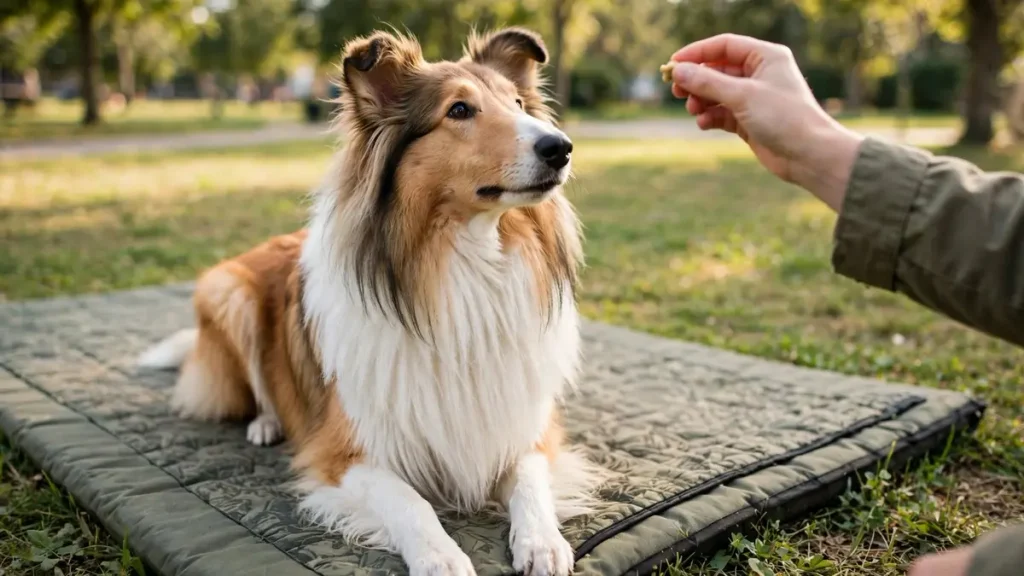
With children, the breed’s reputation is real, but the supervision rule still applies. Collies are herders. A herder’s instinct is to gather anything that moves, and a young Collie may try to head off a running child. Teach a stop cue and a settle mat early. Keep toddlers supervised around any dog. Do that, and the herding drive becomes a party trick instead of a problem.

How Big Does a Rough Collie Get?
Under the American standard, males stand 24–26 inches and weigh 60–75 lb. Females stand 22–24 inches and weigh 50–65 lb. That is a large dog by height and a medium one by weight. It is why the breed reads as elegant rather than heavy.
The British standard is smaller, and this matters if you live in the UK or Ireland. The Kennel Club gives dogs 22–24 inches (56–61 cm) and bitches 20–22 inches (51–56 cm). It publishes no weight range at all. A Collie measured against the British standard is not undersized for standing two inches shorter than an American one.
The coat colors are not identical in both standards. The AKC recognizes sable and white, tricolor, blue merle, and white. The Kennel Club recognizes three: sable and white, tricolor, and blue merle, and it calls all-white or predominantly white highly undesirable. Blue merle was once called “tortoise shell” in the breed’s early records, and it is the color that needs a warning.
Merle is a pattern, not a disease. Two merle parents, however, can produce double merle puppies. The AKC warns that the pattern “can also be associated with health problems, primarily deafness and blindness.” Its advice is plain: “it is not recommended to breed two merles together.” If you are buying a merle puppy, ask what color both parents are. Merle twice is the answer to walk away from.
How Much Exercise Does a Rough Collie Need?
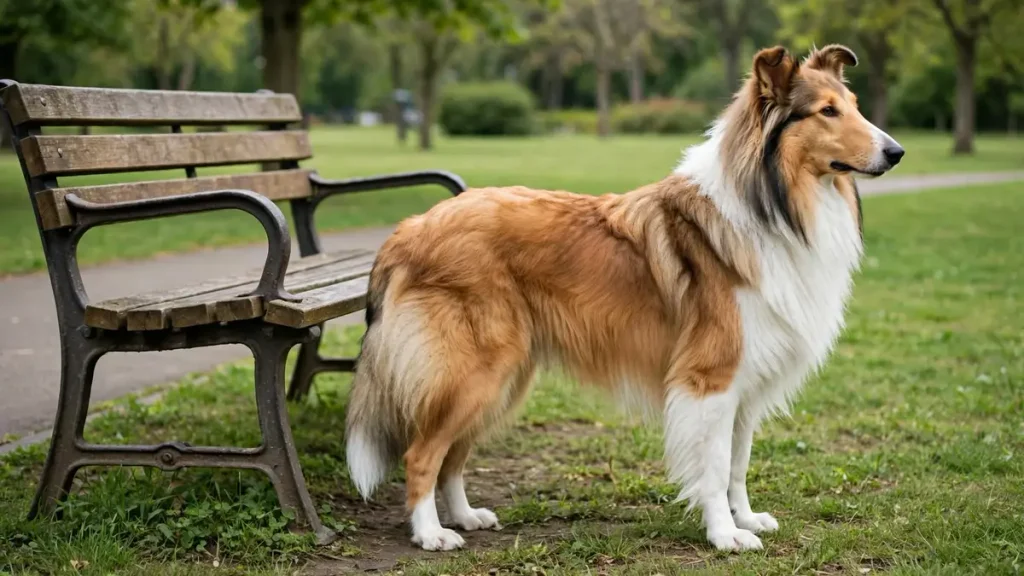
About 45–60 minutes a day, including a chance to run and play in a secure area. That figure is our practical estimate, not a breed standard. The AKC publishes no hour requirement for the Collie. It asks for aerobic exercise and the chance to run and play. Fetch, a fenced yard, and daily walks are the ways it suggests delivering that.
The type of exercise matters as much as the amount. A Collie walking politely on a lead for an hour has moved its legs and used almost none of its brain. Try a walk plus a short training session. A scent game or a controlled game of fetch works too, because both give the dog something to think about. Fetch alone winds some dogs up rather than settling them.
Two things go wrong when exercise is too thin. The dog barks, because boredom brings barking. And it invents jobs you did not ask for, such as patrolling the fence line or herding the cat. Both are easier to prevent than to fix.
How Often Do You Groom a Rough Collie?
Brush once a week, and more often when the coat is coming out. Bathe when the dog needs it, not on a fixed calendar. The Collie Club of America is direct about this: “A common misconception is that the Collie needs daily brushing or frequent bathing.” Its guidance for a Rough Collie in full coat is brushing “once a week or every two weeks.” A dog out of coat or in summer coat needs less.
The AKC adds one detail that matters more than the frequency. A weekly brushing “down to the skin” keeps the coat and skin healthy and stops mats. Brushing only the top layer looks tidy and does nothing. The mat forms underneath. Two spots mat first: behind the ears and at the elbows, so check those with a metal comb before you decide the coat is fine.
Shedding runs on a pattern. The Collie Club of America says spayed females and males shed once a year, and intact females shed according to their heat cycle. When a shed starts, brush more often. Daily at the peak is sensible if the coat is coming out in tufts.
| Grooming task | What to know |
|---|---|
| Brush to the skin Weekly | Once a week or every two weeks for a Rough Collie in full coat. Check behind the ears and elbows first. |
| Brush in a shed More often | Daily at the peak if the coat is coming out in tufts. Go back to weekly when it settles. |
| Bath When needed | The AKC’s general range for a medium-to-large coat is every four to six weeks. The Collie Club notes the breed carries little dog odor, so many indoor Collies go longer. |
| Nails Monthly | The AKC’s grooming guidance is monthly for nails and ears. |
| Ears Monthly check | Clean when they look or smell dirty, not on a fixed schedule. |
| Paws and sanitary trim When needed | Trim the hair between the pads when it grows long enough to affect grip or collect debris. |
| Professional groomer Optional | Worth it for a heavy shed or a dog that will not tolerate handling. |
Three tools do the job. A slicker brush handles the topcoat. An undercoat rake pulls the loose layer in shed season. A metal comb checks your work. A high-velocity dryer helps after a bath, but it is a nice-to-have rather than a requirement. For the mechanics of coat care on any long-haired breed, see our long-haired dog grooming guide.
Never shave a double coat to manage shedding. The coat insulates in both directions, and shaving can make regrowth patchy.
Do Rough Collies Shed a Lot?
Yes. There is a seasonal coat blow, with lighter shedding through the rest of the year. Spayed females and males usually drop the undercoat once a year. Intact females shed in relation to their heat cycle. For a few weeks, the coat comes out in tufts you can pick off the dog by hand.
Expect hair on fabric, in car seats, and along skirting boards. A Rough Collie is not a low-shedding breed, and no amount of grooming makes it one. Daily brushing during the shed shortens the mess. It does not prevent it.
What Health Problems Do Rough Collies Have?
The breed club recommends four genetic tests, and one of those conditions is common enough to plan around. The Collie Health Foundation names CEA, MDR1, PRA-rcd2, and DMS. The AKC lists the same four. No single result is a verdict, because each one needs reading alongside the puppy’s eye exam and the parents’ health history.
Hip screening is not one of the four. It is a separate conversation with the breeder. Ask whether both parents have had their hips scored by OFA or PennHIP, because no DNA test replaces an X-ray evaluation.
MDR1 is the one to know before you own a Collie. The multidrug resistance mutation changes the protein that pumps drugs out of the brain. VCA lists Collies at 70%, the highest rate of any breed. The Collie Health Foundation gives a range of 55–70%, because published figures differ between studies.
Dogs with the mutation can react badly to a short list of common medicines. That list includes loperamide (Imodium), some chemotherapy drugs, certain sedatives, and high doses of ivermectin. Having the mutation does not mean a dog will react to every drug on that list. The risk depends on the drug, the dose, and the genetic result.
The nuance matters, because the wrong version of this fact scares people off heartworm prevention. VCA states that at the low doses used to prevent heartworm, ivermectin “is safe even for pets with the ABCB1 (MDR1) mutation.” The danger is the much higher dose used to treat mange. Loperamide is the drug to avoid outright. Know your dog’s status, and tell every vet who treats it.
Collie Eye Anomaly (CEA) is an inherited developmental eye disease. Puppies are examined by a board-certified veterinary ophthalmologist at 6–8 weeks, and the AKC names that exam as the breed’s minimum health requirement. A DNA test exists. The Collie Health Foundation is explicit that the test “does not replace the need for a physical eye examination.”
Most affected dogs see normally. Severe cases involve a coloboma, a hole in the tissue at the back of the eye. That can lead to a detached retina and blindness. CEA cannot be reversed, and it does not generally get worse in a mildly affected dog.
PRA-rcd2 is a different eye disease, and a much harsher one. It is early onset. The Collie Health Foundation describes affected dogs as showing signs by six weeks and reaching complete blindness by 6–8 months. A DNA test sorts clear, carrier, and affected dogs.
Dermatomyositis (DMS) is an autoimmune condition affecting skin and muscle. It has a DNA test as well, and a result flags genetic risk rather than predicting the disease.
How long do Rough Collies live? The AKC lists 12–14 years. Genetics, body condition, preventive care, and day-to-day management move an individual dog within that band. Ask the breeder about the health and longevity of the puppy’s relatives, not only the parents’ test results.
| Test | What it protects against, and who runs it |
|---|---|
| MDR1 DNA | Severe drug reactions to loperamide, high-dose ivermectin, and others. Who: breeder on both parents; you on your own puppy. |
| CEA (CH) DNA + eye exam | Collie eye anomaly, coloboma, retinal detachment. The DNA test does not replace the exam. Who: DNA on the parents; ophthalmologist exam on the puppy at 6–8 weeks. |
| PRA-rcd2 DNA | Early blindness, complete by 6–8 months in affected dogs. Who: breeder on both parents. |
| DMS DNA | Autoimmune skin and muscle disease. Who: breeder on both parents. |
| Hips (OFA or PennHIP) | Hip dysplasia. Not one of the four club DNA tests — this one is scored on X-rays. Who: ask for both parents’ results. OFA gives final certification from 24 months; preliminary evaluations are available from 4 months. |
What Health Tests Should a Rough Collie Breeder Provide?
Ask for the paperwork, not the reassurance. A breeder who has tested will have certificates with dog names and registration numbers on them. These are the records worth asking to see before you pay a deposit:
- MDR1 DNA results for both parents.
- CEA DNA results for both parents, plus the puppy’s eye exam report from a veterinary ophthalmologist.
- PRA-rcd2 DNA results for both parents.
- DMS DNA results for both parents.
- Hip screening results — OFA or PennHIP — if the breeder has them.
- Written veterinary records for the puppy: vaccinations, worming, and any treatment given.
Verbal assurance that “the parents are healthy” is not a test result. Neither is a clearance from a different breed’s panel, which is a common mix-up when a breeder works with several types of collie.
Is Bloat Really a Risk for Collies?
Yes, and speed decides the outcome. Cornell puts survival with surgery above 80%, and that figure falls as treatment is delayed. Bloat, or gastric dilatation-volvulus, is a stomach that fills with gas, food, or fluid and then twists. Blood stops returning to the heart and the dog goes into shock. GDV can deteriorate rapidly. The AKC notes that without treatment, a dog can be in shock within an hour or two, and some go faster. Suspected bloat means a vet now, even if the dog is still standing.
The AKC’s breed guidance is explicit that Collies carry this risk, which is why it recommends splitting food across more than one meal a day.
Signs to act on immediately: an enlarged abdomen, retching without producing anything, heavy salivation, restlessness, and pain when the belly is touched. This is an emergency vet visit, not a wait-and-see.
Cornell lists the factors associated with higher risk. Large breed size and a deep chest are structural, and you cannot change them. The rest are management. They include a first-degree relative with GDV, eating too quickly, and being fed once a day or a large volume per meal. Older age, a nervous temperament, and vigorous exercise soon after eating are on the list too.
Raised food bowls are another point of disagreement. Cornell lists them among possible GDV risk factors. The AKC says research has not established that they increase risk. Unless your vet recommends an elevated bowl for a specific medical reason, there is no need to raise your Collie’s dish.
Recurrence is the reason surgery matters. Cornell puts recurrence as high as 80% without a gastropexy, and as low as 3–5% with one. That is why vets tack the stomach to the abdominal wall while the dog is already under.
How Do You Train a Rough Collie?
Start with a puppy class, then keep going with reward-based training. The AKC recommends puppy classes for socialization and notes that Collies do best with positive teaching methods. These are sensitive dogs. A harsh correction buys you a dog that works to avoid the correction, rather than one that offers behavior.
The American Veterinary Society of Animal Behavior goes further than “preferred” on this point. Its position statement says reward-based methods offer “the most advantages and least harm.” It also states that aversive methods, which rely on force, pain, or discomfort, “should not be used in canine training.“
Practically, that means short sessions. Keep them to ten or fifteen minutes, use food or toy rewards, and end on a success. Proof the behavior in new places. For barking, teach an alternative behavior and reward quiet. Shouting at a barking dog adds noise to noise.
Once the basics sit, give the dog a sport. Herding, agility, rally, barn hunt and lure coursing all suit the breed. A Collie with a job is a calmer Collie at home.
Is a Rough Collie Right for You?
Yes if you want a sociable dog, have an hour a week for the coat, and are home most days. No if you want a dog that lives happily alone in a yard. That is the decision in two sentences. The rest is detail.
| Fits well | Fits badly |
|---|---|
| Families who want a dog in the middle of daily life | Households out at work for ten hours a day |
| Owners who will brush weekly and enjoy it | Owners who want a wash-and-wear coat |
| Active people who walk, hike or run | Sedentary homes with a small yard and no walks |
| People who like training and dog sports | People who want a dog that self-entertains |
| Homes that can handle daily hair | Anyone hoping shedding can be eliminated |
| Owners ready to learn one drug-sensitivity rule | Owners who will not test for MDR1 or tell their vet |
On cost, be realistic about the shape of it rather than one number. Puppy prices move too much between countries to publish a figure we could stand behind. The structural costs are stable. Testing on the parents, an eye exam on the puppy, groomer visits or your own time, and insurance for a large breed all land in year one. A Rough Collie is expensive to skip grooming on, because mats that reach the skin become a vet bill.
Rough Collie or Smooth Collie?
Same breed, different coat. A Smooth Collie needs a fraction of the grooming and sheds short hairs into every fabric you own. A Rough Collie needs a weekly session and drops identifiable tufts instead. Temperament and health risks are identical, so the choice is about coat, not character. Our Smooth Collie guide covers that variety in detail. The collie breed hub compares all four collie types if you are still deciding. If you want one page of care advice across every type, start with the free collie care guide.
Frequently Asked Questions
How big does a Rough Collie get?
The AKC gives 24–26 inches and 60–75 lb for males, 22–24 inches and 50–65 lb for females. The Kennel Club standard is two inches smaller in both sexes and gives no weight.
How much exercise does a Rough Collie need each day?
Plan on 45–60 minutes a day, including a chance to run in a secure area. That is a practical estimate rather than a published breed requirement. The AKC asks for aerobic exercise and the chance to run and play.
Do Rough Collies shed a lot?
Yes, mostly in one annual burst. Spayed females and males shed once a year, and intact females shed after a heat cycle. The coat comes out in tufts for a few weeks, and lightly the rest of the year.
Are Rough Collies good with children?
The AKC describes Collies as “famously fond of children and make wonderful family pets.” Supervision still applies. Herding instinct means a young Collie may try to head off a running child, so teach a stop cue early.
Do Rough Collies bark a lot?
They bark when bored. The AKC warns that a Collie left in the yard for long periods will bark out of boredom. Give the dog company, exercise, and something to think about, and the noise drops.
Can a Rough Collie live in an apartment?
It can, if the exercise happens daily and the dog is rarely alone. The breed is a poor fit for a flat where nobody is home for ten hours. That is not about size. Collies are people dogs that bark when isolated.
What is the MDR1 mutation in Collies?
It is a gene mutation that changes how a dog clears certain drugs, and roughly 55–70% of Collies are affected. Affected dogs can react badly to loperamide, some chemotherapy drugs, certain sedatives, and high-dose ivermectin. Heartworm prevention at label doses is considered safe with veterinary guidance. A DNA test tells you your dog’s status.
What is Collie Eye Anomaly?
An inherited developmental eye disease. Puppies are checked by a veterinary ophthalmologist at 6–8 weeks, and a DNA test is available. Most affected dogs see normally. A severe case can involve a coloboma and a detached retina. It cannot be reversed.
How long do Rough Collies live?
12–14 years, according to the AKC breed listing. The breed is generally healthy. The main risks are the four inherited conditions the club screens for, plus bloat and hip dysplasia.
How much grooming does a Rough Collie need?
About an hour a week: one brushing session down to the skin, plus monthly nail trims. Bathe when the dog needs it rather than on a calendar. Brush more often during the annual shed.
What is the difference between a Rough Collie and a Smooth Collie?
Only the coat. They are one breed with two coat varieties, so temperament, size, and health risks are the same. The Smooth needs far less grooming. The Rough needs a weekly session and mats if you skip it.
Are Rough Collies good with cats and other dogs?
Many Collies live successfully with other dogs and cats, especially when introduced carefully and young. Herding and chasing instincts vary between individuals, so control the introduction and take prey drive seriously rather than assuming it away.
Should you shave a Rough Collie in summer?
No. A double coat insulates in both directions. Shaving removes the layer that blocks sun and can leave regrowth patchy. Brush out the undercoat instead, and clip only for medical need or severe matting.
Are Rough Collies suitable for first-time owners?
Often yes. They are biddable, sociable, and respond well to reward-based training. Three things decide it: whether you will brush weekly, whether the dog will have company, and whether you will learn the MDR1 rule. That last one needs passing on to your vet.
Related Collie Guides


Glossary
- Double coat: A soft undercoat for insulation plus longer guard hairs that shed water and block sun. It is why the breed sheds in bursts and why shaving backfires.
- CEA: Collie Eye Anomaly, an inherited developmental eye disease found mainly in herding breeds.
- MDR1 (ABCB1): A mutation in the gene that builds the pump that keeps certain drugs out of the brain. Dogs with it can suffer serious reactions at ordinary doses. Veterinary papers often use the gene name, ABCB1.
- Merle: A coat pattern of mottled patches. Two merle parents risk double merle puppies, which the AKC links to deafness and blindness.
- Gastropexy: Surgery that attaches the stomach to the abdominal wall to reduce the risk of it twisting again after a bloat episode. It does not stop the stomach from filling with gas.
Sources
- American Kennel Club — Collie breed information (height, weight, lifespan, colors, grooming, exercise, recommended health tests)
- American Kennel Club — Bloat (GDV) in dogs (signs, feeding frequency, oils in the first four ingredients)
- Cornell University College of Veterinary Medicine — Gastric dilatation volvulus (GDV) or bloat (risk factors, survival, recurrence with and without gastropexy)
- American Kennel Club — How often should you wash your dog? (bathing band, monthly nails and ears)
- American Kennel Club — Merle in dogs (double merle, deafness and blindness)
- VCA Animal Hospitals — Multidrug resistance mutation (MDR1) (70% in Collies, drug list, heartworm dose safety)
- VCA Animal Hospitals — Collie eye anomaly (exam at 6–8 weeks, coloboma, retinal detachment)
- Collie Health Foundation — Collie health statement (minimum testing panel, CEA exam, PRA-rcd2 onset)
- Collie Health Foundation — MDR1 mutation (55–70% prevalence, drug table)
- Collie Club of America — Collie Care (brushing frequency, shedding pattern, bathing)
- Collie Club of America — thecollieclub.org (breeder referral, club resources)
- Orthopedic Foundation for Animals — OFA FAQs (final hip certification from 24 months, preliminary evaluations from 4 months)
- The Kennel Club — Collie (Rough) breed standard (UK height)
- American Veterinary Society of Animal Behavior — Position statement on humane dog training
Health information on this page is general guidance, not veterinary advice. Collie drug sensitivity, eye disease, and bloat are conditions to discuss with your own veterinarian.

Leave a Reply
You must be logged in to post a comment.