
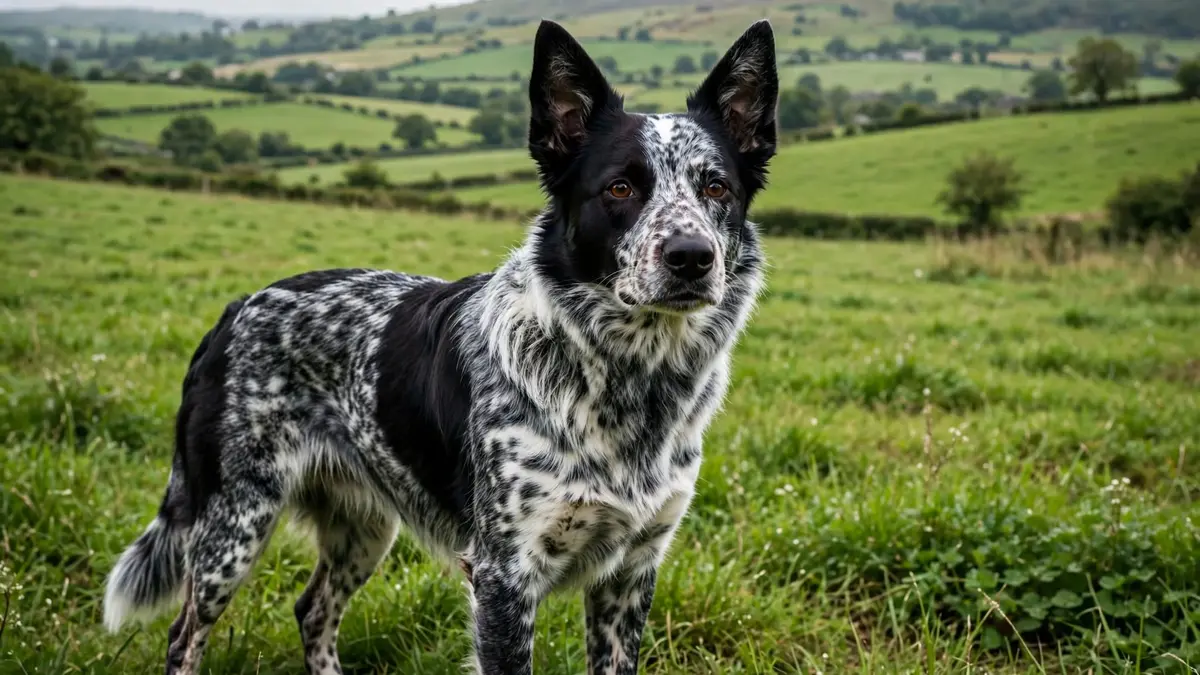
Border Heeler: The Energetic Border Collie & Australian Cattle Dog Mix
A Border Heeler is a Border Collie and Australian Cattle Dog mix. These medium-sized dogs may inherit high stamina, intelligence, and strong herding instincts from both parents. Their size, temperament, coat, and exercise needs can vary considerably from dog to dog.
A Border Heeler is a cross between a Border Collie and an Australian Cattle Dog (Blue Heeler). This mix may inherit exceptional stamina, intelligence, and herding drive from both parent breeds, which were developed for demanding stock work. Border Heelers can make remarkable working partners for experienced owners, but their temperament, energy, and exercise needs vary depending on the individual dog. This guide covers what to expect, including training, health, grooming, and whether a Border Heeler could suit your home.
Quick Facts
- ✅ High stamina — Both parent breeds can work long hours
- ✅ Loyal — Often bonds intensely with their person
- ✅ Often highly trainable — Both parent breeds are generally responsive to training
- ❌ Strong herding drive — May try to herd children, bikes, or other animals
- ❌ Can be strong-willed — Independent thinking is part of the package
- ❌ High exercise needs — Needs substantial daily activity; amount varies by dog
Border Heeler Quick Facts Table
| Trait | Details |
|---|---|
| Parent breeds | Border Collie + Australian Cattle Dog |
| Other names | Border Heeler, Cattle Collie |
| Size | Medium; roughly 17–22 inches (estimate) |
| Weight | Approximately 30–50 lbs (estimate) |
| Lifespan | 12–15 years (estimate) |
| Coat | Short to medium double coat; varies |
| Energy level | Often high to very high |
| Best for | Active homes prepared for a working-type dog |
Table of Contents
What Is a Border Heeler?
The Border Heeler is a cross between a Border Collie and an Australian Cattle Dog (often called a Blue Heeler or Queensland Heeler). Both parent breeds were developed for demanding stock work in harsh conditions — the Border Collie in the Scottish Highlands, the Cattle Dog in the Australian outback. That background means this mix may have considerable endurance.
This is not a standardized breed. Size, temperament, coat, and exercise needs can vary a lot, even between puppies in the same litter.
Border Heeler Temperament
The Border Heeler may combine the Border Collie’s herding instinct with the Australian Cattle Dog’s toughness, but individual temperament varies. Some may be intense and driven; others may be more moderate.
Common traits seen in this mix:
- High stamina — Many may have high stamina and enjoy having a purpose, whether it’s hiking, running, or farm work.
- Strong-willed — Both parent breeds are bred to make independent decisions, which can come across as stubbornness.
- Loyal — Many form intense bonds with their people. Some may be protective.
- Reserved with strangers — Early and ongoing socialization is important. Without it, some may become wary or reactive.
- May be pushy with other dogs — The herding instinct can extend to other pets. Some may try to control or chase other animals.
Border Heeler Size, Weight & Appearance
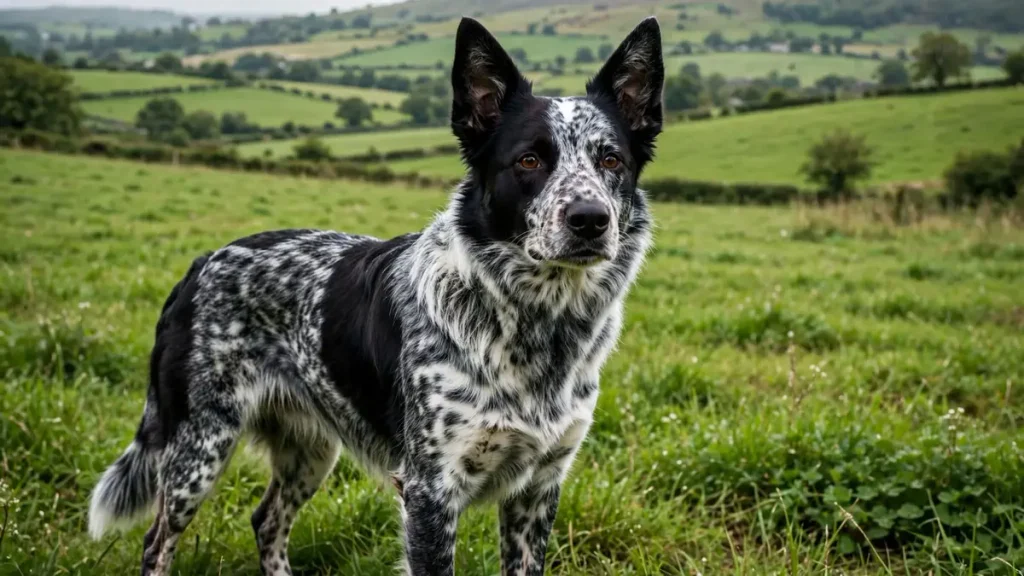
There is no standardized Border Heeler appearance. Coat colors vary widely — black and white (Border Collie-style), blue or red speckle (Cattle Dog-style), or a mix of both. Coat length ranges from short and smooth to medium with feathering. Ear shape varies too: some have prick ears like a Cattle Dog, others have semi-erect or floppy ears like a Border Collie.
Border Heeler Colors
Coat patterns may include black and white, blue or red speckling, and various combinations. Merle patterns can appear in dogs inheriting the relevant Border Collie genetics. Because this is a mixed breed, no single color or pattern is standard.
Adults are generally medium-sized with athletic builds. Estimated size is roughly 17–22 inches and 30–50 pounds, based on typical parent-breed sizes; individual dogs can fall outside this range.
How Much Exercise Does a Border Heeler Need?
Border Heelers are generally active dogs that need regular physical exercise and mental stimulation. However, there is no fixed daily requirement that works for every dog. The right amount depends on the dog’s age, health, fitness, and inherited working drive.
Many Border Heelers enjoy running, hiking, fetch, agility, herding trials, and scent work. Combine physical activity with training and rest. Without enough outlet, a bored dog may invent its own entertainment — digging, chewing, or repetitive behaviours.
See our high-energy BC guide for more on what it can take to keep a dog like this engaged.
Border Heeler Training
Many Border Heelers learn quickly and are responsive to training, but independence and motivation can vary. Reward-based training is a good starting point. Use treats, toys, or praise your dog enjoys. Avoid harsh or intimidating methods, which can create stress for sensitive individuals.
Key training tips:
- Start socialization early — expose your puppy to many people, places, and experiences in a positive way
- Use reward-based methods — adjust your approach to your dog’s confidence and motivation
- Teach impulse control: “leave it,” “place,” and “settle” are useful skills
- Channel herding instincts into structured activities like agility or herding lessons
- Be consistent — this dog may test boundaries if rules shift
For detailed protocols, see our BC obedience training guide.
Border Heeler Health & Lifespan
The Border Heeler has a typical lifespan of 12 to 15 years (estimate). The mix may inherit health conditions associated with either parent breed. Although crossbreeding can increase genetic diversity, it does not guarantee a healthier dog or eliminate inherited disease.
The conditions below are associated with one or both parent breeds, but reliable data on their frequency in Border Heelers specifically is limited. This list is not a prediction that your dog will develop these conditions. A veterinarian can help you decide which health checks are appropriate based on your dog’s history, symptoms and parentage.
| Condition | Parent-breed context | Notes |
|---|---|---|
| Hip dysplasia | Both | Common in active herding breeds; ask for screening results |
| Progressive Retinal Atrophy (PRA) | Border Collie | Discuss relevant eye and genetic screening with the breeder |
| Collie Eye Anomaly (CEA) | Border Collie | Genetic eye condition; screening recommended for the BC parent |
| Deafness | Cattle Dog | Congenital deafness can occur; discuss hearing testing with a veterinarian where appropriate |
| Elbow dysplasia | Both | Can appear in working lines; ask for screening |
| MDR1 mutation | Certain herding-breed lines | Testing relevance depends on the specific parent lines; discuss with a veterinarian |
Health Testing Before Getting a Border Heeler
If you’re considering a Border Heeler puppy, ask the breeder for documented health-testing results for both parents. Recommended screening depends on each parent’s breed-specific risks and should be discussed with a veterinarian or responsible breeder:
| Parent | Health checks to ask about |
|---|---|
| Border Collie | Hip and elbow evaluation, eye examination, relevant DNA tests for CEA and PRA where appropriate |
| Australian Cattle Dog | Hip and elbow evaluation, eye examination, discuss hearing testing with a veterinarian where appropriate |
Ask for actual documented results, not simply a verbal assurance that the dog was “vet checked.”
For more on what to expect, read our BC health guide.
Border Heeler Grooming & Care
Both parent breeds have double coats, but coat length and texture can vary, particularly on the Border Collie side. They shed year-round, with heavier seasonal shedding. Brush 2–3 times per week; dogs with longer or denser coats may need more frequent grooming. Nails need regular trimming, and ears should be checked weekly — especially if your dog works in brush or grass. Bathe when needed.
Border Heeler Puppies: What to Ask a Breeder
If you’re considering a Border Heeler puppy, evaluate the breeder carefully:
- Ask for documented health-testing results for both parents
- Meet the parents, if possible, and observe their energy levels and temperament
- Ask how the puppies are socialized before they go home
- Check that puppies have had veterinary checks and age-appropriate vaccinations
- Ask the breeder about the litter’s energy levels, temperament, and any health concerns
Rescue and adoption are also options, particularly for owners looking for an adult dog whose temperament and energy level are already more apparent.
Is a Border Heeler Right for You?
May be a good fit if:
- You have experience with active, working-type dogs
- You can provide substantial daily exercise and mental enrichment
- You have space and access to regular activity
- You want a dog for sports, herding, or a working role
- You’re prepared for a strong-willed, independent-thinking partner
Probably not a good fit if:
- You have limited time for exercise, training, or enrichment
- You cannot provide enough daily activity and suitable outdoor access
- You want a calm, low-energy dog
- You have small children without the ability to supervise interactions
- You’re regularly away for long periods without arrangements for exercise, toilet breaks, companionship, or enrichment
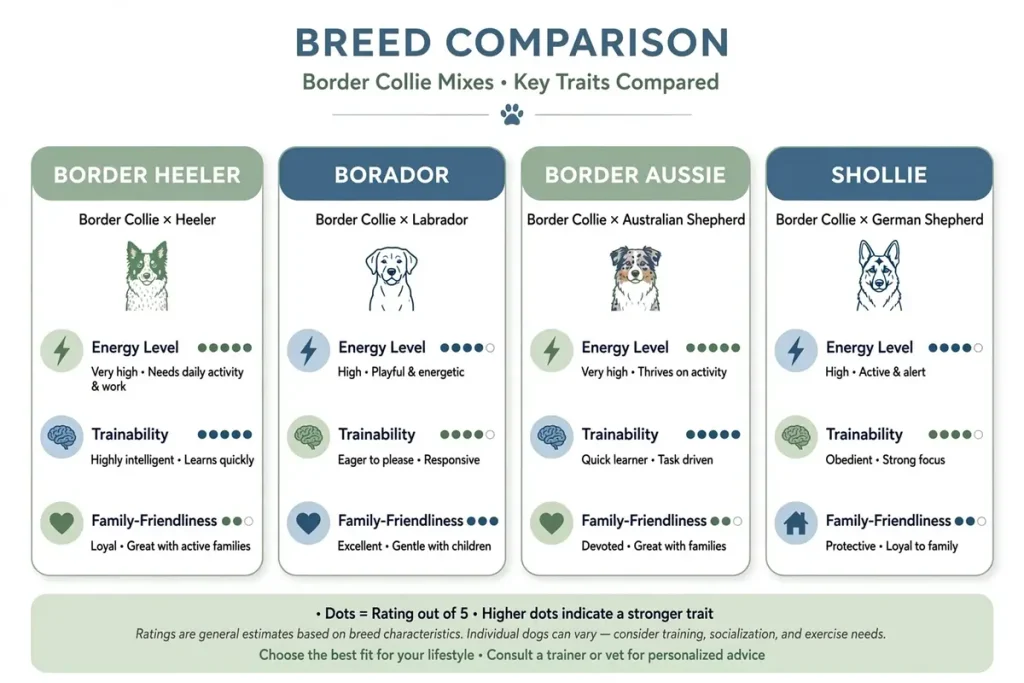
Comparison: Border Heeler vs. Other BC Mixes
This is a general comparison based on parent-breed tendencies — not a guarantee for any individual dog.
| Border Collie Mix | Energy | Trainability | With children | Best suited to |
|---|---|---|---|---|
| Border Heeler | Often high to very high | Varies; reward-based training helps | Supervision important; may herd | Active homes, experienced owners |
| Borador | Often high | Varies by individual | Supervision and training are important | Active homes |
| Border Aussie | Often high to very high | Varies by individual | Supervision and training are important | Active homes, working-type settings |
| Shollie | Often high | Varies by individual | Supervision and training are important | Active homes |
These are general parent-breed-informed comparisons, not guarantees. Individual dogs can differ considerably, even within the same cross.
Frequently Asked Questions
How big does a Border Heeler get?
Border Heelers are generally medium-sized, but there is no standardized size for this cross. A rough estimate is approximately 17–22 inches tall and 30–50 pounds, depending on the parents.
How long do Border Heelers live?
A rough estimate is 12 to 15 years, though there is no well-established breed-specific average for this cross.
Are Border Heelers good family dogs?
They can be for very active families, but suitability depends on the individual dog’s temperament. Some may herd or nip at young children, so supervision is important.
How much exercise does a Border Heeler need?
Border Heeler exercise needs vary. Some may need substantial daily activity; others may be more moderate. Build up gradually and watch your dog’s response. Mental stimulation matters as much as physical exercise.
Do Border Heelers shed a lot?
Shedding varies with coat type. Many shed moderately year-round with heavier seasonal shedding. Weekly brushing is a useful starting point.
Are Border Heelers good with other dogs?
Some may be selective or bossy around other dogs, especially if they have strong herding instincts. Introductions should be managed carefully.
Can Border Heelers live in apartments?
Some may adapt if their exercise, enrichment, and rest needs are met, but access to regular outdoor activity matters more than having a yard alone.
Can a Border Heeler be left alone?
Tolerance for alone time varies. Some may be fine with appropriate exercise and enrichment beforehand. Puppies need gradual training. Distress should not be treated as disobedience.
Are Border Heelers hypoallergenic?
No. Both parent breeds shed, and this mix is not considered hypoallergenic.
Glossary
- Heeler — Nickname for Australian Cattle Dog, from their technique of nipping at cattle’s heels to move them.
- Herding drive — Innate instinct to control the movement of other animals or people.
- CEA — Collie Eye Anomaly, an inherited eye condition that can affect Collie-type breeds.
- MDR1 — Gene mutation affecting drug sensitivity in some herding breeds.
- Prey drive — Natural instinct to chase moving objects, including small animals, bikes, or vehicles.
- Double coat — Two-layer coat with a dense undercoat and a longer outer coat, common in working breeds.
- Socialization — The process of exposing a puppy to new people, places, and experiences in a positive way to build confidence.
Sources
- AKC — Border Collie breed information
- AKC — Australian Cattle Dog breed information
- PetMD — Australian Cattle Dog health and care
- Orthopedic Foundation for Animals — Hip and elbow databases
- VCA Animal Hospitals — Living with a deaf dog
This guide is for informational purposes and is not a substitute for professional veterinary advice. Every dog is an individual, and health concerns vary. Always consult a licensed veterinarian for medical decisions, diagnosis, or treatment for your pet.
Leave a Reply
You must be logged in to post a comment.