
What Is a Borgi?
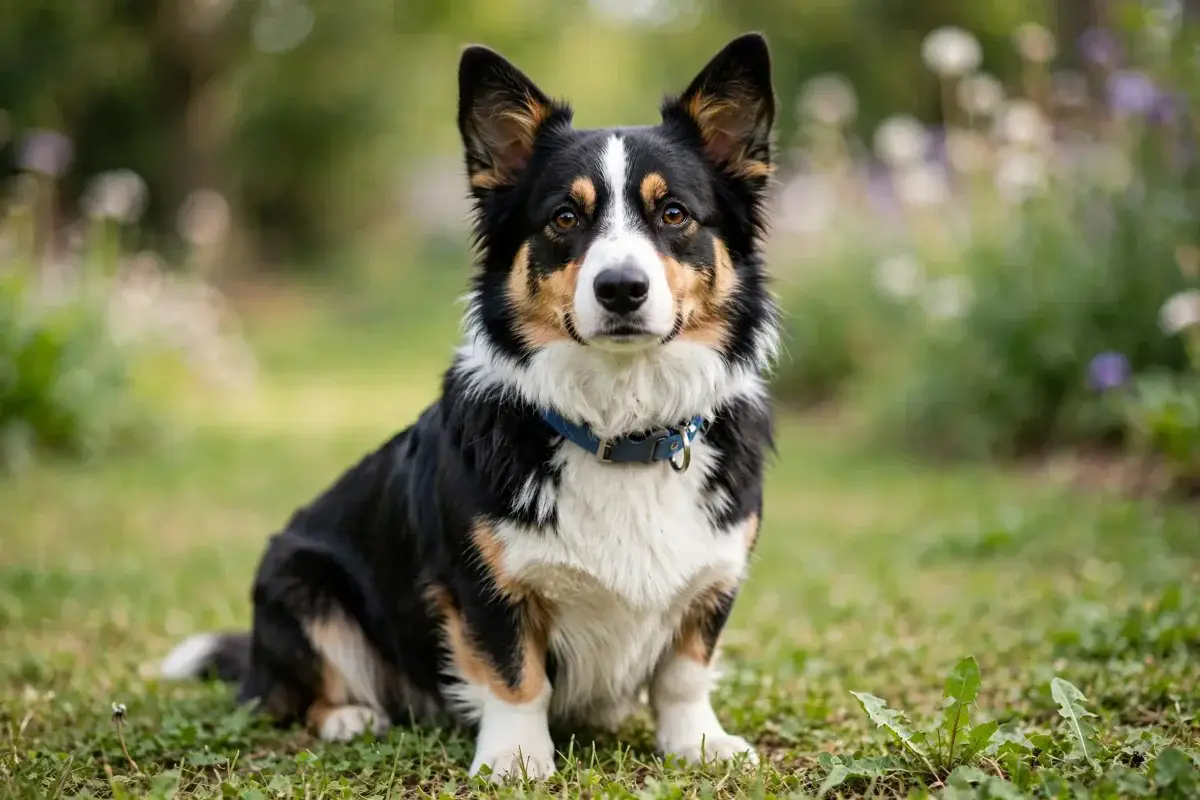
A Borgi is a mixed-breed dog crossed from a Border Collie and a Welsh Corgi, usually a Pembroke Welsh Corgi. Borgis are not a recognised standardised breed, so their adult size, coat, appearance and temperament can vary. Many inherit a sturdy build, herding instincts and high energy levels from their parents.
This guide explains Borgi size, temperament, exercise needs, shedding, lifespan, health risks, puppy prices and how to find a responsible breeder or rescue.
Research note: There is no published research establishing typical health outcomes, exercise requirements or lifespan for Borgis specifically. Figures for the cross are estimates based on its parent breeds and should not be treated as guaranteed characteristics.
Key Takeaways
- ✅ A Borgi is a Border Collie and Corgi cross. Short legs are common but not guaranteed.
- ✅ Expect roughly 45 to 90 minutes of activity a day, with real mental work on top.
- ⚠️ The Corgi body shape brings a genuine back risk. Ramps and weight control matter.
- ⚠️ Ask for hip, eye, and DNA results on both parents before you buy.
- ⚠️ Blue eyes can occur in Borgis, but eye colour alone cannot confirm whether a dog carries merle.
- ⚠️ This is not a low-shedding dog, and it is not a beginner’s first choice.
Table of Contents
Quick Facts Table
| Feature | Details |
|---|---|
| Parent breeds | Border Collie × Welsh Corgi (usually Pembroke) |
| Other names | Borgi, Border Corgi, Corgi Collie |
| Adult weight | About 20–35 lb. An estimate from the parents, not a breed standard. |
| Adult height | About 10–18 inches at the shoulder. The range is wide because leg length varies. |
| Estimated lifespan | Around 12–14 years, based on the parents. No mix-specific data exists. |
| Coat | Usually a double coat, with length, texture, and shedding varying between dogs. Sheds year-round with heavier spring and autumn periods. |
| Energy level | High. Needs daily exercise plus problem-solving work. |
| Best suited for | Active homes ready for training, and able to protect a long back |
Where the Two Parent Breeds Come From
The Border Collie comes from the border country between Scotland and England, where shepherds bred dogs to move sheep on command. The AKC lists the breed at 18–22 inches and 30–55 pounds, with a lifespan of 12–15 years. It is a working dog built for distance and quick decisions.
The Pembroke Welsh Corgi comes from Wales, where it was used as a cattle drover. It stands 10–12 inches, weighs up to 30 pounds, and lives 12–13 years. Short legs and a long body are the breed’s defining shape, and that shape is also its main health liability.
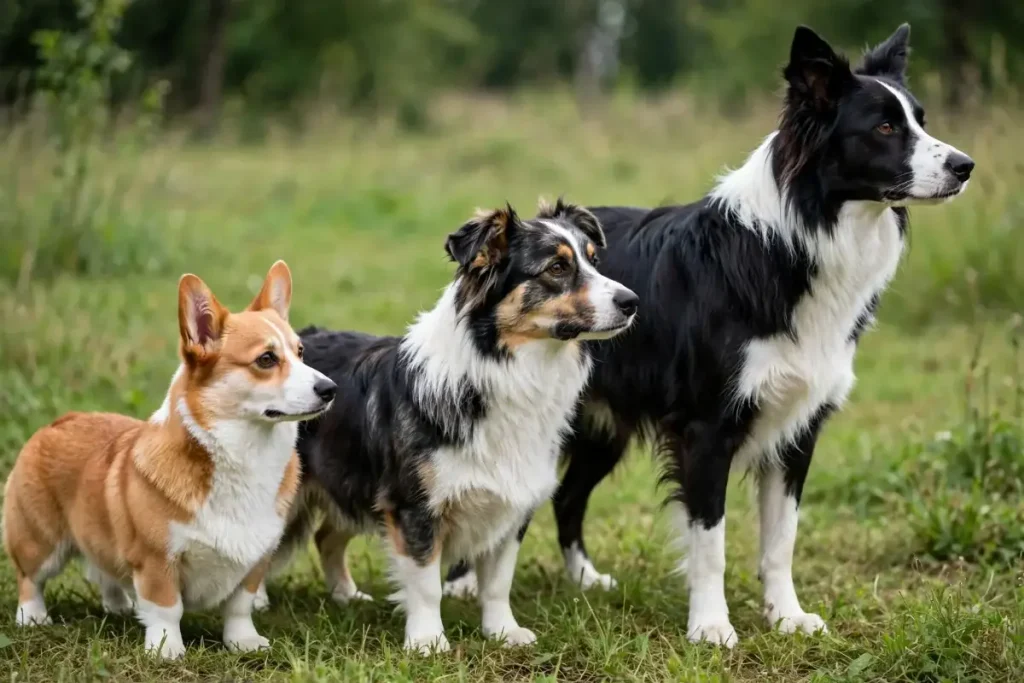
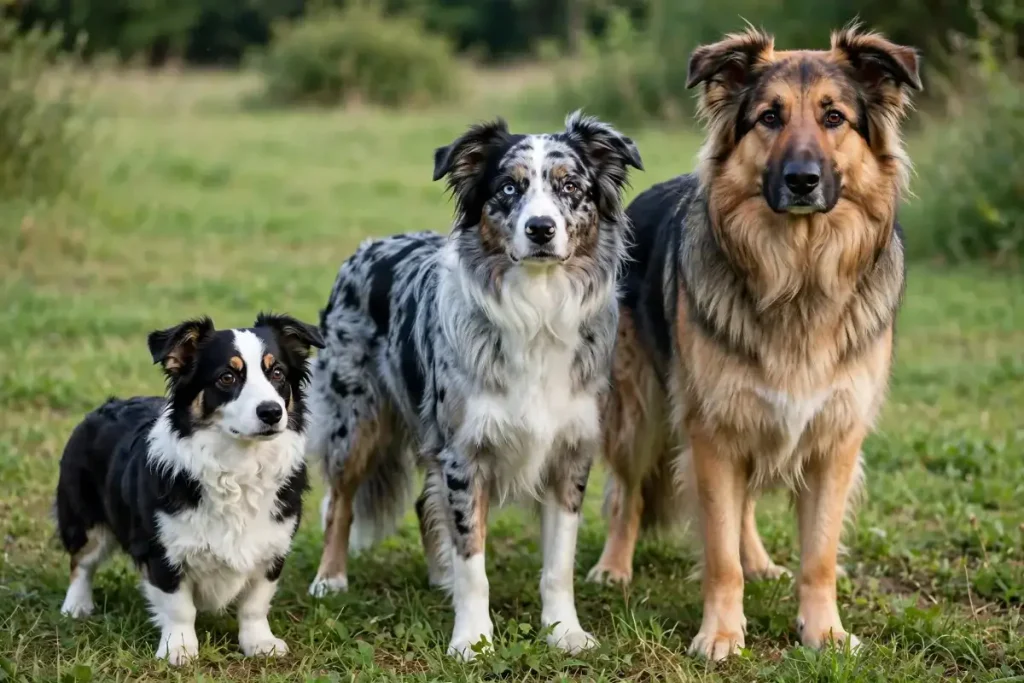
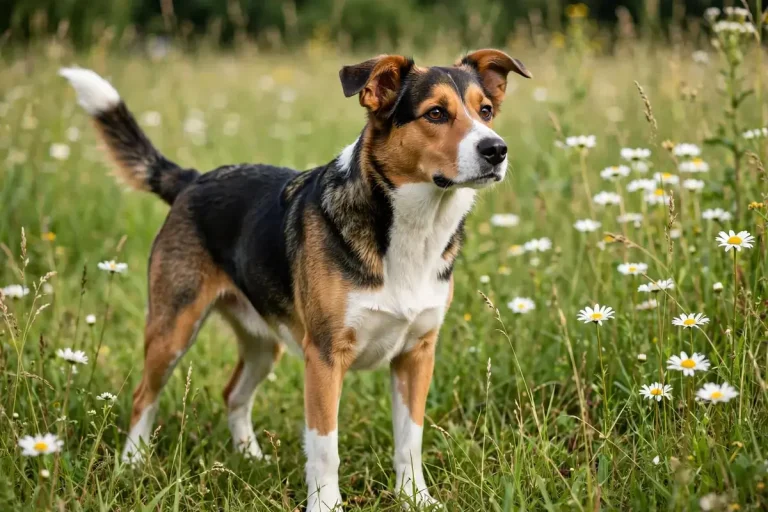
Put the two together, and you get a herding dog with a low centre of gravity. Some Borgis inherit short legs associated with Corgi ancestry. Some get a longer leg from the Collie side. Others look like a small, sturdy Collie. The temperament is just as variable, though most are busy, vocal, and quick to learn.
Borgi Size and Appearance
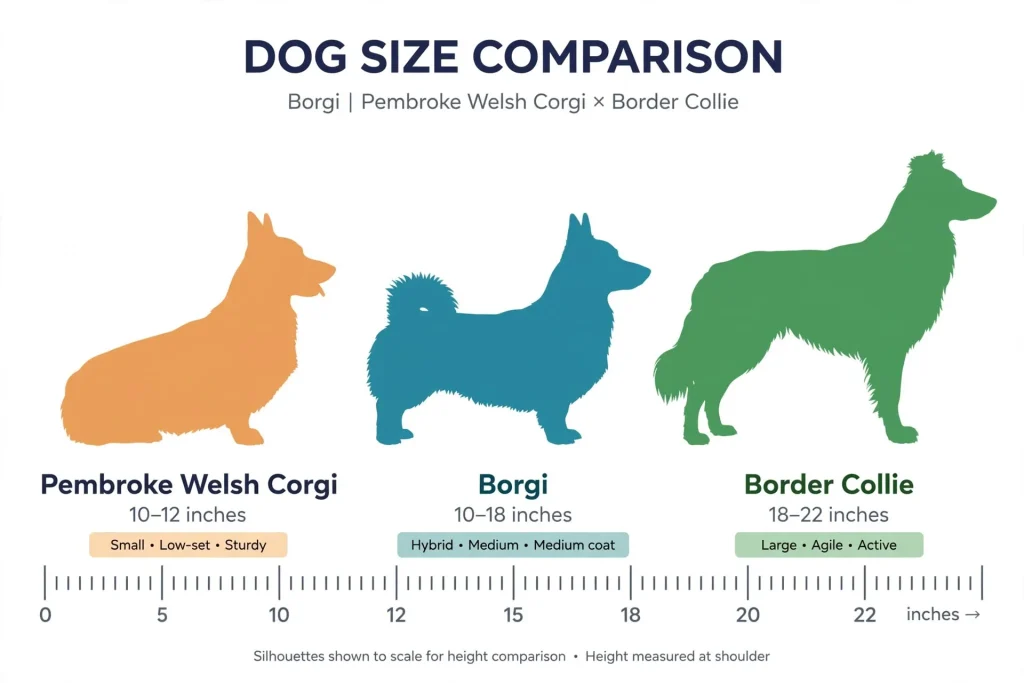
Adult size depends on which parent the dog takes after. Corgis tend to contribute a shorter stature and sturdy build, while Border Collies are generally taller and more athletic. Individual Borgis can vary considerably. Most land between the two, roughly 10–18 inches and 20–35 pounds.
| Trait | Corgi | Border Collie | Borgi estimate |
|---|---|---|---|
| Height | 10–12 in | 18–22 in | 10–18 in |
| Weight | Up to 30 lb | 30–55 lb | 20–35 lb |
| Lifespan | 12–13 years | 12–15 years | 12–14 years |
| Coat | Medium double coat | Medium to long double coat | Varies; often a double coat, short to medium |
| Build | Long body, short legs | Lean and athletic | Varies: often sturdy and low |
Do All Borgis Have Short Legs?
No. Borgis can inherit different leg lengths and body proportions from their parents. Short legs are associated with genetic variants linked to chondrodystrophy, which causes disproportionately short limbs. A puppy’s build depends on the variants it inherits, so not every Borgi will have the classic long-backed, short-legged shape (Cornell on IVDD risk).
That matters for more than appearance. A Borgi with a short-legged, long-backed build may have an increased risk of intervertebral disc disease (IVDD). Body condition, family history, and other genetic factors also influence risk. The health section below explains what owners can do to reduce avoidable strain and recognise warning signs.
Coat and Colours
Both parent breeds have double coats, so a Borgi will often inherit a double coat as well. Coat length, density, texture, and shedding can vary depending on the traits the puppy inherits. The outer coat can be short and dense or medium and softer. Colours can come from either side, and inheritance is not a simple division between the parents. You may see black and white, red and white, tricolor, or sable from the Collie side. The Corgi side brings red, sable, fawn, and black and tan. The combination depends on both parents.
Merle is a coat pattern found in some Border Collies. It can be associated with blue eyes or eyes of different colours, although not every merle dog has blue eyes. Eye colour alone cannot confirm a dog’s coat genetics. Our guide to Border Collie colours explains the patterns.
Breeding two merle dogs together can increase the chance of puppies inheriting two copies of a merle variant. That is associated with a higher risk of certain hearing and eye abnormalities. Responsible breeders should understand the parents’ coat genetics and avoid merle-to-merle matings. Blue eyes alone do not establish whether a dog carries a merle variant. If a Borgi has a merle coat or unusual eye colouring, ask the breeder about the parents’ coat genetics and appropriate testing. Do not assume eye colour alone tells you whether a dog carries merle.
Borgi Temperament
Both parents were bred to work with people, and both are smarter than the average pet dog. The difference is in how they work. Corgis were bred to drive cattle and can be independent and alert. Border Collies move sheep on cue and fixate on the job.
| Trait | Corgi side | Border Collie side | What a mix may show |
|---|---|---|---|
| Bred for | Droving cattle, guarding the farm | Moving sheep at distance | Herding drive with a guarding streak |
| Learning style | Independent, food-motivated, tests rules | Fast, focused, easily over-aroused | Quick to learn, quick to argue |
| Vocal | Alert barker | Barks at movement | Often noisy, especially at the door |
| Bond | Family-centred, sturdy | Intensely bonded to one handler | Affectionate and shadow-prone |
| Energy | Bursts, then a nap | All-day endurance | High, with a real need for mental work |
A Borgi may be affectionate, playful, and busy, particularly if it inherits strong working instincts from both parents. Many are vocal. Some are wary of strangers. Many benefit from structured activities and mental enrichment. A bored Borgi will often invent its own job, usually involving your shoes or your fence line.
Are Borgis Good Family Dogs?
Many are, with the right family. Both parents are herding breeds, which shapes how they play.
With children: Borgis may suit families with older children who understand how to interact safely with dogs. Herding instinct can turn into heel-nipping when children run, and a short-legged dog can still knock a toddler over. Supervise young children.
With other dogs: Often fine, especially with early socialization. Compatibility depends on the individual dogs, their history, and how introductions are managed. Some pairs need careful handling around food and toys.
With cats and small pets: Prey drive is real on both sides. Some Borgis learn to live calmly with a resident cat. Many never fully drop the chase, so supervise and separate.

How Much Exercise Does a Borgi Need?
There is no published exercise requirement for the cross. As a practical starting estimate based on the parent breeds, many healthy adult Borgis may need around 45 to 90 minutes of daily activity, plus mental work. Adjust the routine to the individual dog’s age, fitness, build, and health. The Corgi side brings stamina without much speed; the Collie side brings both.
A short-legged Borgi may not be suited to the same sustained running or high-impact activity as a longer-legged Border Collie. Adjust exercise to the individual dog’s build, fitness, and veterinary advice. Long hikes on rough ground, repeated stair runs, and jumping off high surfaces all load the spine and the joints.
- Physical: two or three brisk walks, fetch on flat ground, swimming in safe water
- Mental: puzzle feeders, scent games, trick training, obedience drills, nose work
- Sports: agility, rally, treibball, and scent work all suit a bright herding mix
Puppies need less. Free play and short walks are safer than forced mileage while the growth plates are still open. A puppy from a short-legged line should not be doing repeated, strenuous stair runs. Ask your vet what is appropriate for your dog’s build.
Our guide to Border Collie exercise needs covers how to structure a routine that tires the body and the brain.
Training a Borgi
The old advice calls these dogs stubborn. That is the wrong frame. A Borgi is not refusing to learn; it is asking why. Both parent breeds were bred to make decisions. A dog that thinks for a living will test a rule that does not make sense to it.
Reward-based training can help channel their intelligence and independence, as long as the reward is worth working for.
Start early. Socialize in puppyhood, following your vet’s advice on vaccines. New people, surfaces, sounds, and friendly dogs all help.
Use rewards. Treats, toys, and play. A Corgi is famously food-motivated; a Collie will work for a ball. Harsh corrections damage trust and make a pushy dog pushier.
Teach a settle cue. These dogs struggle to switch off. A place or settle command is as important as recall.
Redirect the herding. Teach “leave it” and a strong recall before the dog starts chasing bikes or children. Give the drive a legal outlet: fetch, treibball, or a herding instinct test.
Keep sessions short. Five to ten minutes, several times a day, beats one long drill.
Borgi Grooming and Shedding
Borgis often inherit a double coat from their parents, but coat density, length, and shedding vary. The Corgi coat is thick and weather-resistant; the Collie coat can be longer. Either way, expect loose hair most weeks, with heavier periods in spring and autumn.
Brushing: two or three times a week, daily during a coat blow. An undercoat rake does most of the work on a thick coat; a rubber mitt or stiff-bristle brush suits a shorter one.
Bathing: when the dog is dirty or smells. Over-bathing strips oils and irritates skin, so there is no need for a fixed weekly schedule.
Nails and ears: trim nails roughly monthly and check ears weekly. Pricked or semi-pricked ears need less attention than drop ears, but they still collect dirt.
Do not shave a double coat to keep the dog cool. It interferes with coat regrowth and skin protection. Use shade, water, and cooler walk times instead.
Borgi Health Problems
Both parent breeds can carry health risks that may be relevant to a Borgi. The conditions below are worth discussing with a breeder or veterinarian, but they are not a ranked list of likely Borgi illnesses. Individual risk depends on ancestry, family history, inherited variants, and physical build.
| Condition | Parent breed | What to know |
|---|---|---|
| Intervertebral disc disease (IVDD) | Corgi | A key concern in a short-legged Borgi with a long-backed build. Spinal discs can bulge or rupture and press on the spinal cord. Signs include back pain, wobbling, weakness, and difficulty walking. Severe cases may require surgery (Texas A&M on IVDD). |
| Hip dysplasia | Both breeds | A poor fit between the hip socket and the joint. Screening is by radiograph, graded through OFA (OFA hip dysplasia). |
| Elbow dysplasia | Corgi, Border Collie | Abnormal elbow-joint development that can lead to pain and arthritis. Elbow dysplasia is a recognised concern in dogs, including Corgis. Ask the breeder whether additional elbow screening is appropriate for the parents’ lines (OFA elbow dysplasia). |
| Degenerative myelopathy (DM) | Corgi | A progressive spinal cord disease that causes weakness in the hind legs. DNA testing identifies carriers, though a clear test does not guarantee the dog will never develop it (OFA on DM). |
| Von Willebrand’s disease | Corgi | A bleeding disorder caused by a missing clotting protein. Dogs can be tested, and it matters before surgery or breeding (VCA on von Willebrand’s). |
| Collie eye anomaly (CEA) | Border Collie | An inherited eye disorder present at birth, ranging from no visible problem to blindness. A veterinary ophthalmologist can diagnose it in young puppies (OFA on CEA). |
| MDR1 drug sensitivity | Border Collie lines | A gene variant that changes how some dogs process certain drugs. It is not universal in Border Collies, so relevance depends on the line (Cornell on MDR1). |
| Epilepsy | Both breeds | Recurrent seizures with no other cause. Usually managed with medication after a veterinary work-up. |
Protecting the Back
If your Borgi has short legs, the spine is the thing to manage. That means keeping weight down, using ramps instead of furniture jumps, limiting stairs where possible, and supporting the back legs when lifting. A lean dog carries far less load on a long spine than an overweight one.
These steps cannot guarantee that a dog will avoid IVDD, but maintaining a healthy weight and reducing repeated high-impact activity are sensible precautions. Seek urgent veterinary care if your dog develops sudden back pain, wobbling, weakness, or difficulty walking. Loss of bladder control is an emergency.
Health Testing: What to Ask a Breeder
There is no single health-testing standard for Borgis. Ask for documented screening appropriate to both parent breeds, including hip evaluations and eye examinations, plus DNA tests relevant to each parent’s breed and family history.
For the Corgi parent: ask about degenerative myelopathy (DM) and von Willebrand’s disease, and discuss any additional screening recommended for the dog’s family lines.
For the Border Collie parent: ask about hip and eye screening, including Collie eye anomaly (CEA) testing where appropriate. Other DNA tests should be selected according to the dog’s family history and relevant breed-health guidance.
The OFA CHIC program lists recommended tests for participating breeds and publishes available results. A CHIC number confirms that the required tests were completed and the results were made public. It does not mean every result was normal.
Ask to see the actual records rather than relying on a breeder’s claim that the parents are healthy. DNA tests detect specific variants, while veterinary examinations can identify abnormalities that a particular DNA test does not detect. Testing can reduce uncertainty, but it cannot guarantee that a puppy will remain healthy.
Borgi Lifespan
Around 12 to 14 years is the usual estimate for this cross, based on the parents: the AKC lists the Corgi at 12–13 years and the Border Collie at 12–15. There is no published lifespan study for the Borgi. Treat the number as a rough guide rather than an average that predicts any individual dog.
Body condition matters more than most owners expect, especially in a short-legged dog. For more on how vets think about longevity, see our guide to how long dogs live.
Borgi Puppies
Ask to see the paperwork behind the tests listed above, not just the claim that testing was done. A breeder who cannot explain the results is a breeder to walk away from.
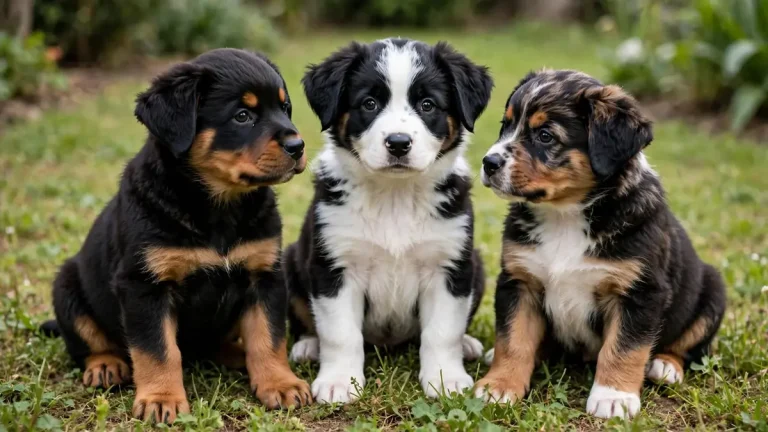
Ask how the puppies were socialized. Good early experiences include gentle handling and positive, age-appropriate exposure to household sounds, different surfaces, people, and safe environments. Puppies should approach new things at their own pace.
Look at the puppy’s build as well as its face. A short-legged puppy will need a different exercise routine and a different home layout than a longer-legged sibling.
For the wider picture on the breed’s brain and drive, our Border Collie temperament guide explains where the herding behaviour comes from.
How Much Does a Borgi Cost?
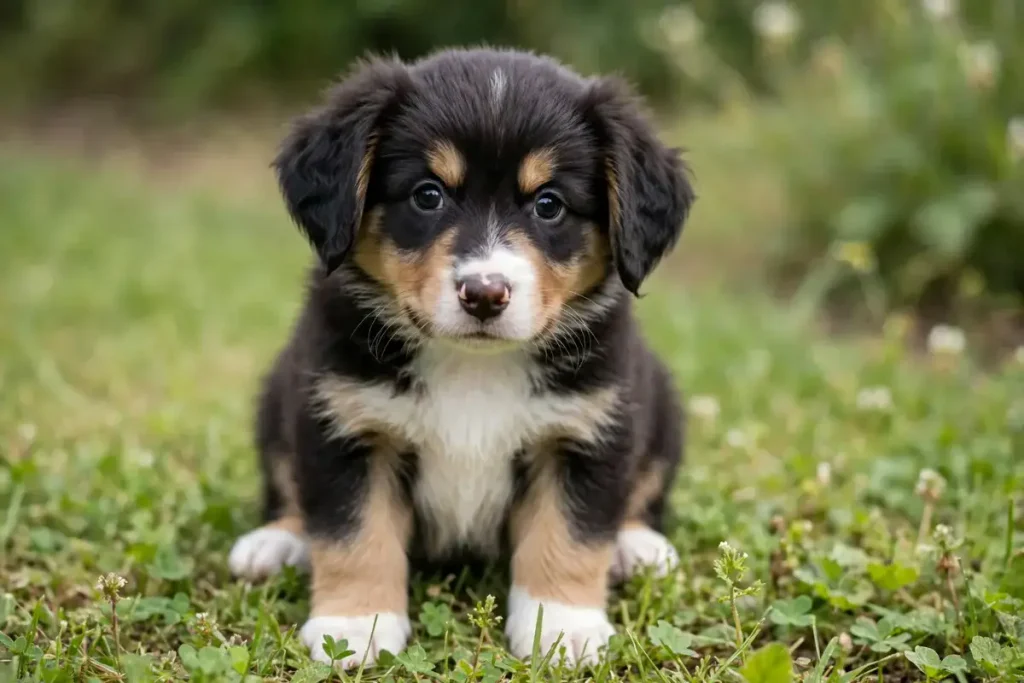
These are illustrative U.S. figures, not verified market averages or quotes. They are included to show the shape of the costs rather than a price list. Rescue costs far less than a planned litter, and readers outside the U.S. should treat the amounts as relative rather than local.
| Expense | Typical U.S. estimate |
|---|---|
| Planned breeder litter | $800–$2,500+ |
| Adoption or rescue | $150–$600 |
| Food | $300–$700 per year for a 20–35 lb dog |
| Veterinary care | $500–$1,000 per year, more if back or eye problems appear |
| Ramps and joint support | $100–$300 once, for a short-legged dog |
| Grooming tools | $50–$150 per year |
| Training classes | $100–$300 per course |
| Pet insurance (optional) | Varies by age, location, and coverage |
The first year costs the most. Add vaccines, spay or neuter, a crate, bedding, and a leash and harness. Our cost calculator can help you estimate yearly costs for your situation.
Borgi vs Corgi vs Border Collie
Every number here is a rough range rather than a fixed breed requirement. The mix sits between the parents, but any individual dog can land closer to one side, and exercise needs vary with age, health, and temperament.
| Trait | Borgi | Corgi | Border Collie |
|---|---|---|---|
| Height | 10–18 in | 10–12 in | 18–22 in |
| Weight | 20–35 lb | Up to 30 lb | 30–55 lb |
| Estimated daily activity, adult dogs | 45–90 min | 30–60 min | 90 min or more |
| Herding drive | Moderate to strong | Moderate: droving, guarding | Very strong |
| Best for | Active owners who want a smaller herding dog | Homes that want a sturdy companion | Owners with time for real work |
Borgi vs Other Border Collie Mixes
If you are comparing herding crosses, size and coat are the main dividers. The weight figures below are rough estimates based on the parent breeds, not fixed characteristics of any cross. These crosses are likely to shed, although the amount varies with the coat each dog inherits. All need daily activity and training.
| Trait | Borgi | Border Aussie | Shollie |
|---|---|---|---|
| Parents | Border Collie × Corgi | Border Collie × Australian Shepherd | Border Collie × German Shepherd |
| Rough adult weight | 20–35 lb | 30–55 lb | 40–80 lb |
| Coat | Short to medium double | Medium double | Medium to long double |
| Health focus | Back, hips, eyes | MDR1, hips, eyes | Hips, elbows, DM |
If you want a bigger herding cross, our Border Aussie guide and the Shollie guide cover those. If the appeal is a small dog that can still work, the Borgi is the closer fit.
Is a Borgi Right for You?
Good fit if you:
- Can give roughly 45 to 90 minutes of activity and training most days, adjusted to the dog
- Want a small-to-medium dog with a working brain
- Will use ramps and manage weight if the dog is short-legged
- Can train consistently and enjoy a dog that questions rules
- Are ready for daily hair and regular barking
- Have budget for hip, eye, and DNA screening on the parents
Poor fit if you:
- Want a calm lap dog with low exercise needs
- Live somewhere with lots of stairs and no way to manage them
- Are away from home most of the day, every day
- Cannot commit to training in the first year
- Expect a quiet dog
- Need a low-shedding breed
An apartment can work if the dog gets real exercise outside it every day. Our guide to Border Collies in apartments covers the routine, and our breed quiz is a quick check on whether a high-drive herding dog suits your week.
Finding a Borgi
Reputable Breeders
Ask what was tested on both parents and ask to see the records. Walk away from breeders who cannot name the tests they ran, refuse a visit, always have puppies available, or release puppies earlier than your local law and responsible-breeding guidance allow.
Ask about merle pairings specifically. Responsible breeders should not mate two merle dogs, because puppies that inherit two copies of the merle variant face a higher risk of hearing and eye abnormalities.
Adoption and Rescue
Borgis may be available through general shelters, Corgi rescues, Border Collie rescues, and mixed-breed rescues. Availability varies by location, so check listings regularly. The organisations below are U.S.-based; readers elsewhere should search for their national breed club and local shelters. An adult dog makes it easier to assess leg length, coat, and energy level before you commit.
Try the Pembroke Welsh Corgi Club rescue listing, Corgi Aid, and the AKC’s Border Collie rescue directory. Local shelters and Petfinder are also worth checking regularly, since many mixed-breed dogs are placed through general rescue organisations rather than breed-specific groups.
Frequently Asked Questions
What is a Borgi?
A cross between a Border Collie and a Welsh Corgi. It is a mixed breed with no standard, so size, coat, and temperament vary.
How big do Borgis get?
Most land around 10–18 inches and 20–35 pounds. That is an estimate from the parent breeds, not a breed standard.
Do all Borgis have short legs?
No. Leg length depends on the puppy’s inherited genetics and overall build. Some Borgis have the short legs and long back associated with Corgis, while others have longer legs.
How much exercise does a Borgi need?
Roughly 45 to 90 minutes a day plus mental work, adjusted to the dog’s build. A short-legged Borgi should not be doing long runs or repeated stair sprints.
Are Borgis good with kids?
Many are good with older children. Herding instinct can include heel-nipping when children run, so supervision matters with young children.
Are Borgis good apartment dogs?
Yes, if the dog gets real exercise outside the building every day and learns a quiet cue. Barking is the usual complaint.
Do Borgis shed a lot?
Yes. Both parents have double coats, and the mix sheds year-round with heavier periods in spring and autumn.
Are Borgis hypoallergenic?
No. They shed hair and dander like both parent breeds.
How long do Borgis live?
Around 12 to 14 years is the usual estimate, based on the parents. No published study tracks the cross specifically.
What health problems can affect a Borgi?
Back disease (IVDD) matters most in short-legged dogs. Others to discuss with a breeder include hip and elbow dysplasia, degenerative myelopathy, von Willebrand’s disease, and Border Collie eye conditions. Risk depends on the individual dog’s ancestry rather than being evenly spread.
How much does a Borgi cost?
A planned litter typically runs $800–$2,500 or more in the U.S., and adoption runs $150–$600.
Can a Borgi have blue eyes?
Yes, though it is uncommon. Blue eyes are associated with the merle coat pattern, but eye colour alone cannot confirm a dog’s coat genetics. Ask the breeder about the parents’ colours.
Related Border Collie Guides
Glossary
IVDD: Intervertebral disc disease, where a spinal disc presses on the spinal cord. Common in short-legged, long-backed breeds.
Chondrodystrophy: A genetic condition affecting cartilage and bone development that can cause disproportionately short limbs. Certain genetic variants associated with it also increase the risk of some forms of IVDD.
Merle: A coat pattern with irregular patches of diluted pigment. It can be associated with blue eyes. Dogs inheriting two copies of a merle variant have a higher risk of certain eye and hearing abnormalities.
DM (degenerative myelopathy): A progressive spinal cord disease causing hind-leg weakness. DNA testing identifies carriers.
Von Willebrand’s disease: An inherited bleeding disorder caused by low or missing clotting protein.
CEA (collie eye anomaly): An inherited eye disorder present at birth in Border Collies and related breeds.
MDR1: A gene variant that changes how some dogs process certain medications.
CHIC: The OFA’s Canine Health Information Center program, which lists the tests each breed club recommends.
Sources
- AKC — Border Collie breed page: akc.org/dog-breeds/border-collie — Size, lifespan, and recommended screening.
- AKC — Pembroke Welsh Corgi breed page: akc.org/dog-breeds/pembroke-welsh-corgi — Size, lifespan, health conditions, and club-recommended tests.
- Cornell University — Chondrodystrophy and IVDD (CDDY/IVDD): vet.cornell.edu — How the variant affects limb length and disc risk.
- Texas A&M Veterinary Medicine — IVDD in dogs: vetmed.tamu.edu — Signs, staging, and treatment of disc disease.
- OFA — Hip dysplasia: ofa.org/diseases/hip-dysplasia — Screening and grading.
- OFA — Degenerative myelopathy: ofa.org/diseases/degenerative-myelopathy — DNA testing and what results mean.
- OFA — Collie eye anomaly: ofa.org — Genetics, diagnosis, and DNA results.
- OFA — CHIC program: ofa.org/programs/chic-program — Breed-specific recommended testing.
- VCA Hospitals — Von Willebrand’s disease in dogs: vcahospitals.com — Diagnosis and management.
- Cornell University — MDR1 drug sensitivity: vet.cornell.edu — How the variant affects drug response.
- AKC — Degenerative myelopathy in dogs: akc.org — Overview of the disease and testing.
How this guide was researched: Parent breed facts come from the AKC breed pages, and health guidance from veterinary teaching sources, OFA, and VCA. There is no published research on the Borgi itself, so size, lifespan, and exercise figures are labelled as estimates. This article does not claim first-hand ownership of a Borgi.
Medical Disclaimer: This article is for informational purposes only and is not a substitute for professional veterinary advice. Always consult a qualified veterinarian about your dog’s health, nutrition, and care.

Leave a Reply
You must be logged in to post a comment.