
What to Know Before Getting a Rottweiler Border Collie Mix
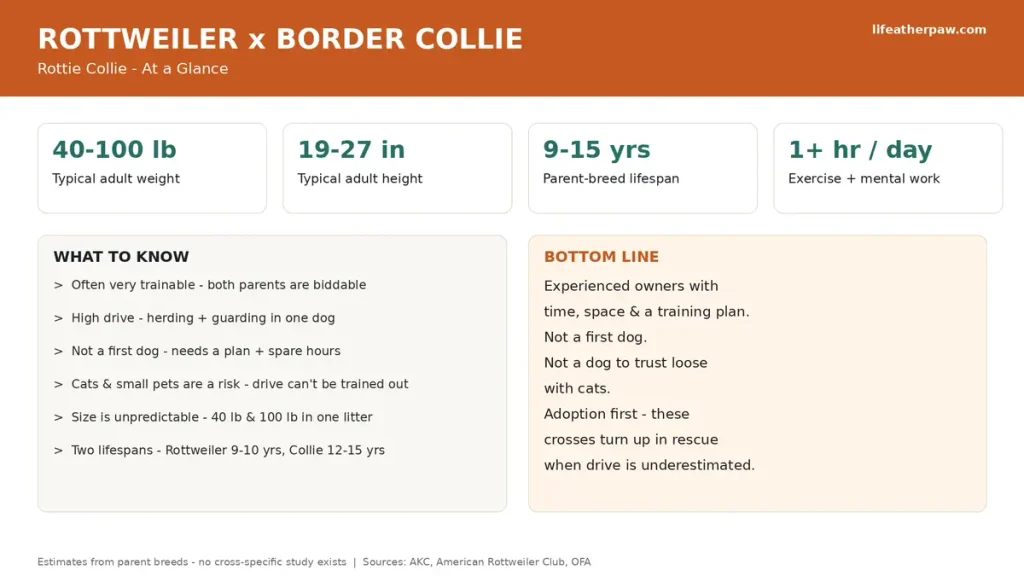
A Rottweiler Border Collie mix is a cross between a guarding breed and one of the highest-drive herding breeds. Most weigh between 40 and 100 pounds and need an hour or more of real work a day. This is not a first dog. It suits experienced owners with time to train, and it carries real risk around cats and other small pets.
This is a mixed breed, not a standardised one. Individual dogs vary a lot in size, coat, temperament, energy and health, even within one litter. Most of what we know about this cross comes from the two parent breeds. Studies of the cross itself are rare, so treat every range below as an estimate, not a guarantee.
Quick Facts
- ✅ Often very trainable — both parents are biddable, but drive varies between dogs.
- ⚠️ High drive — herding instinct and guarding instinct can land in the same dog.
- ⚠️ Not a first dog — the mix needs an owner with a plan and spare hours.
- ❌ Cats and small pets are a risk — training manages prey drive, it does not remove it.
- ⚠️ Size is unpredictable — a 40 lb adult and a 100 lb adult can come from one litter.
- ⚠️ Two very different lifespans — the Rottweiler side is short-lived, the Border Collie side is not.
| Question | Short answer |
|---|---|
| Other names | Rottie Collie, Rottweiler–Border Collie cross |
| Parent breeds | Rottweiler (Working group) × Border Collie (Herding group) |
| Recognised by the AKC? | No. The AKC does not list this cross as a breed. |
| Adult weight | Typical 40–100 lb. The two parents span 30–135 lb. |
| Adult height | Typical 19–27 in. The two parents span 18–27 in. |
| Lifespan | Parent-breed range 9–15 years. No cross-specific estimate exists. |
| Exercise | Around an hour or more a day, plus mental work |
| Grooming | Depends on coat: 10 minutes twice a week to daily brushing |
| Best for | Experienced owners with time, space and a training plan |
What Is a Rottweiler Border Collie Mix?
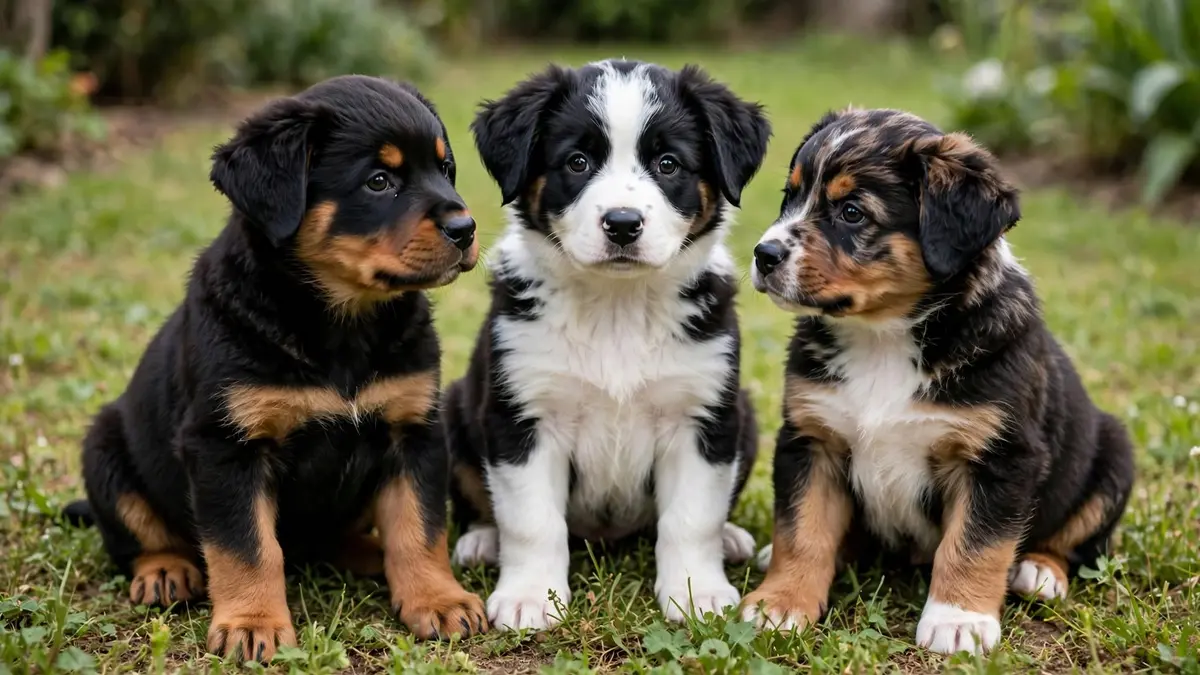
A Rottie Collie is one Rottweiler parent and one Border Collie parent. That is the whole definition. No kennel club recognises the cross, so there is no breed standard, no agreed size, and no registry that tracks health.
The pairing is unusual. It combines two working breeds with very different builds and instincts. The result can be a capable, energetic dog, but nothing guarantees that a puppy inherits the traits a buyer wanted.
The two parents were bred for opposite jobs. A Rottweiler was a drover and guard. A Border Collie was bred to move sheep at a distance, all day, on a handler’s whistle. Put those instincts in one dog, and you may get a dog that watches everything and finds jobs of its own.
Litters vary more than most buyers expect. A pup can take the Rottweiler’s build, coat, and calm. Another can take the Border Collie’s frame, coat, and stare. Most are somewhere in between, and you cannot tell which at eight weeks.
Rottweiler vs. Border Collie vs. Rottie Collie
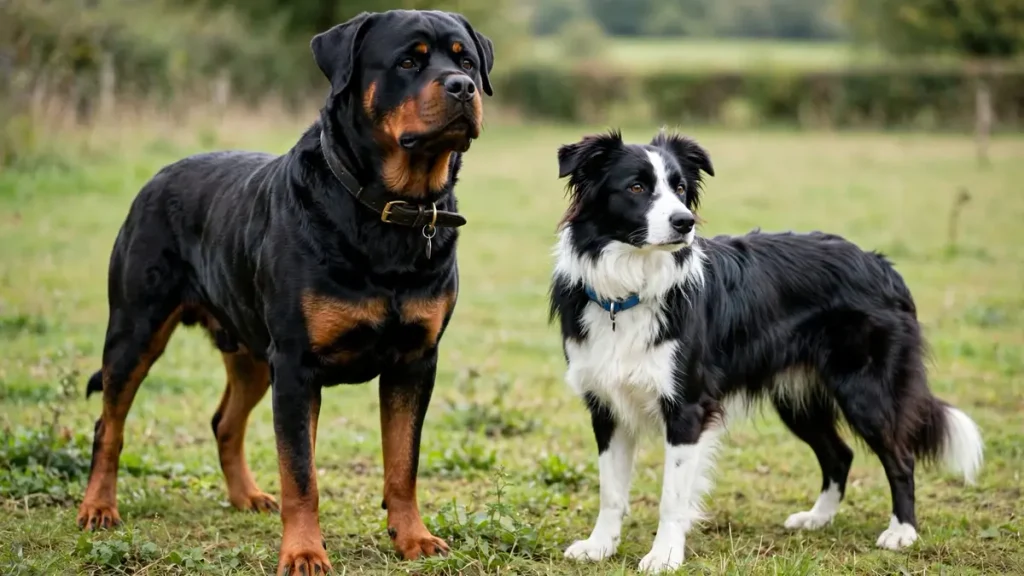
The two parents differ on almost every number that matters to a buyer. Below are the registry figures, then the cross.
| Feature | Rottweiler | Border Collie | Rottie Collie |
|---|---|---|---|
| AKC group | Working | Herding | Not recognised |
| AKC description | “loyal/loving / confident guardian” | “energetic / affectionate / smart” | — |
| Weight | 95–135 lb (male), 80–100 lb (female) | 30–55 lb | 40–100 lb (typical) |
| Height | 24–27 in (male), 22–25 in (female) | 19–22 in (male), 18–21 in (female) | 19–27 in (typical) |
| Lifespan | 9–10 years | 12–15 years | 9–15 years (no cross data) |
| Coat | Short double coat, black with tan | Double coat, medium to long, many colours | Either, or a blend |
| Bred to | Drive cattle, guard property | Herd sheep at a distance | Neither job is guaranteed |
Figures from the AKC Rottweiler and AKC Border Collie breed pages. The cross figures are estimates drawn from the parents’ ranges, not measured data.
Rottweiler Border Collie Mix Size and Appearance
The parent breeds give you a baseline, but their measurements cannot tell you how big a mixed-breed puppy will grow. A Rottweiler male stands 24 to 27 inches and weighs 95 to 135 pounds. A Border Collie male stands 19 to 22 inches and weighs 30 to 55. Females of both breeds run smaller.
Taken together, the parents give a reference range of about 18 to 27 inches and 30 to 135 pounds. The typical estimate is narrower, around 19 to 27 inches and 40 to 100 pounds. Use the typical figure when you buy a crate, a car harness, or a lead. A puppy from a large Rottweiler sire can finish above 100 pounds, and one from a small Border Collie dam can stay near 40.
Adult size depends on the individual parents and on what the puppy inherits. Meeting both parents helps, but it cannot guarantee your dog’s adult measurements. Sex matters too: males of both parent breeds run larger.
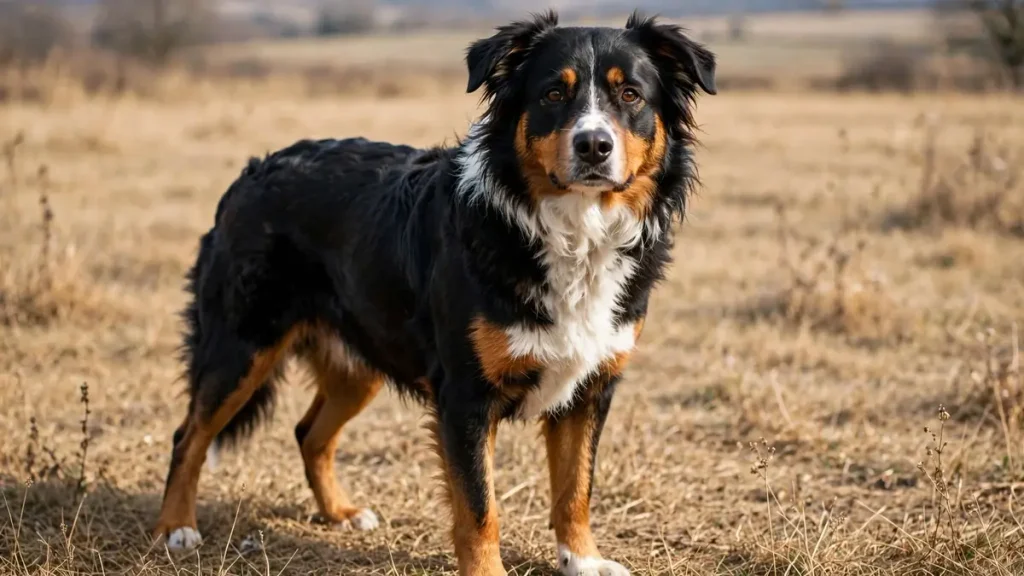
The coat is a coin flip. A Rottweiler passes on a short, flat double coat in black with tan points. A Border Collie passes on a longer double coat in a wide range of colours, including black and white, tricolour, sable, red, and merle. A cross can inherit either, or something in between.
Merle deserves a paragraph of its own. Border Collies are registered by the AKC in blue merle, red merle, and sable merle, so a merle Rottie Collie is possible. Merle is a gene variant that behaves as incompletely dominant, so a merle puppy must have a merle Border Collie parent. If that parent carries one copy, about half the litter is merle. If it carries two, every puppy is merle.
Breeding two merles together is the case to avoid. About a quarter of those puppies inherit two copies and become double merles. The AKC describes double merles as having “much more white” than a normal merle. It notes the colour “can also be associated with health problems, primarily deafness and blindness.” A 2006 study found that dogs carrying two copies show a range of hearing and eye abnormalities (Clark et al.). The AKC advises against the pairing.
In this cross, that risk does not arise. A merle Border Collie bred to a non-merle Rottweiler cannot produce a double merle, because a puppy needs a merle gene from both parents. Merle also comes in several variants, and they do not all behave the same way.
Ears, tail, and build vary between littermates. Some pups have the Rottweiler’s folded ears and heavy head. Others get the Border Collie’s semi-erect ears and lighter frame. Neither is wrong, and neither predicts temperament.
Rottweiler Border Collie Mix Temperament
There is no breed-wide temperament for this cross, because there is no breed. What you get is a set of possibilities.
From the Rottweiler side: calm confidence, a strong bond with family, and wariness of strangers. Rottweilers were bred to guard, so some individuals are reserved with people they do not know. That reserve can tip into over-protectiveness in a dog that was never socialised.
From the Border Collie side: intensity, quick learning, and a stare. The AKC calls the Border Collie “a remarkably bright workaholic.” It warns the breed may be “a bit too amazing for owners without the time, energy, or means to keep it occupied.” That sentence describes the risk in this cross better than anything written about the mix itself.
Put together, the likely picture is an alert dog, attached to its people, fast to learn, and busy. Some are steady. Some are nervy. A few are both, depending on the day.
Two traits cause most of the trouble. The first is suspicion of strangers, which is manageable with early, careful exposure. The second is chase drive, which is not manageable the same way. More on that below.
Are Rottie Collies Good Family Dogs?
For the right family, yes. For a household with toddlers and a cat, probably not.
With children. Some may live happily with older children who understand dog body language, but there is no reliable temperament prediction for this cross. A large, energetic dog with herding instinct may chase or knock over a running child. Toddlers move fast, fall over, and grab. Supervise every interaction, and teach the child to leave the dog alone while it eats or sleeps.
With other dogs. Introductions matter more than the sex of either dog. Two confident, guarding-type dogs in one house can clash. Temperament matters more than sex. Many Rottie Collies live happily with a second dog.
With cats and small pets. This is the honest answer: some can live with a cat, and some cannot, and you cannot reliably tell which from a puppy photo. A dog with strong prey drive will chase, and a chase can end badly. The AKC is blunt about the mechanism. “Regardless of any training you do, you will never wholly eliminate prey drive in dogs.”
If you have a cat, read the Border Collie socialization guide and plan on gates, a leash indoors, and a trainer. If you have a small dog, our guide to introducing a Rottweiler to a small dog covers the meeting itself. Cat and dog introductions work differently, so do not use dog advice for a cat.
Rottweiler Border Collie Mix Exercise Needs
No published exercise requirement exists for this cross. Anyone quoting exact minutes is guessing. What the parent breeds tell you is that the need is high and the type matters.
Plan on roughly an hour or more of activity a day, spread across the day. Treat that as a starting point, not a target the dog has to hit. Some individuals want closer to two hours, and a young adult from working lines may want more.
Physical exercise alone will not settle this dog. The Border Collie half needs problems to solve. That means scent games, puzzle feeders, training sessions, and a job: fetch, agility, treibball, or a long sniffing walk where the dog makes decisions.
Two walks and a garden do not count as a job. A dog that gets two walks and no thinking work often finds its own entertainment, and that usually means chewing, digging, barking, or herding the family.
Puppies need less. Growing joints should not take long forced runs or stair repeats. Free play, short walks, and training are enough while the dog is still growing, and your vet can tell you when to add distance.
For structured ideas, see the Border Collie exercise guide and the dog brain games list.
Prey Drive and Herding Instinct in a Rottie Collie
This is the section that decides whether the dog fits your home. Read it before you fall for a puppy.
Herding draws on the predatory sequence: stalk, stare, chase. Border Collies were selected to use those stages to move livestock, and to stop when the handler asks. Some still grip, especially under stress. Rottweilers were bred to drive cattle and guard. A cross may inherit elements of both styles, and the exact combination cannot be predicted.
In a house, that shows up as chasing cats, rabbits, birds, bicycles, cars, and children. It shows up as nipping at heels. It shows up as a dog that cannot be called off a squirrel. Our guide to why Border Collies herd explains the instinct in more detail.
Training helps, but understand what it does. The AKC states plainly that prey drive is never wholly eliminated. What training buys you is a reliable interruption and a dog that checks in. That is a management win, not a cure.
So build the house around the dog. Use a gate between dog and cat. Keep the dog leashed in the garden until recall is solid. Muzzle-train early if you plan to walk in areas with livestock or wildlife. Teach a rock-solid “leave it” and a “come” that works at distance.
Never leave a Rottie Collie alone with a cat, a rabbit, or a small dog. Not because the dog is vicious, but because the sequence is fast. The MSD Veterinary Manual calls predatory aggression the most dangerous type, because “there is usually no warning”. It also notes that young children and small animals are at risk, because their size and behaviour mimic prey.
If you want a dog you can trust loose around small animals, treat this cross as a poor fit. That is a safety recommendation for the household, not a claim that every individual will chase. Nor is it a training failure: management is what keeps small animals safe.

Training a Rottweiler Border Collie Mix
This cross learns quickly, which is both the good news and the trap.
Fast learners rehearse mistakes fast too. A Rottie Collie that discovers barking gets the door opened will practise that every day. A dog that learns to pull toward a cat will get better at it. Train the behaviour you want before the dog invents one you don’t.
Use positive reinforcement. Food, play and praise work faster than correction on a dog this sensitive to its handler. Keep sessions short. Five to ten minutes, several times a day, beats one long session.
Recall is the priority skill. Practise it indoors, then in the garden on a long line, then in a park with distractions. Never call a dog to punish it. Never call it when you are not certain it will come.
Socialisation is the other half. The AKC notes that the most influential socialisation period generally runs from 5 to 16 weeks. That window closes before most owners finish their first puppy class. Expose the pup to people, surfaces, sounds, traffic, and other dogs while it is still small, and keep each experience positive.
Do not wait for the vaccine course to finish before you start. Ask your vet which low-risk places are safe in the meantime, and carry the pup where it cannot walk yet. Socialisation also does not stop at 16 weeks. The AKC notes “socialization lasts the entire life of a dog,” so keep adding new experiences as the dog grows.
For the training basics, our Border Collie obedience training guide covers the same methods this cross responds to.
Rottweiler Border Collie Mix Grooming and Feeding
Grooming depends entirely on the coat the dog inherits. Ask to see both parents before you buy, then plan for the heavier of the two.
A Rottweiler-type coat is short and easy. A weekly brush and a bath when the dog is dirty will do. A Border Collie-type coat is longer, with a dense undercoat that sheds twice a year. That coat needs brushing two or three times a week, and daily during a shed.
Shedding is normal for both coat types. Short coats shed short hairs that stick to fabric. Long coats shed in clumps that collect in corners. Neither is hypoallergenic.
Bathing needs a schedule you can defend. For medium-to-large coats, the AKC says “a bath could be needed from weekly to every four to six weeks.” That assumes the coat is brushed in between. A dog that swims or rolls in mud needs more. A dog that lives indoors and stays clean needs less.
Ear cleaning is the one most owners overdo. The AKC notes that monthly ear cleaning benefits most pets. Weekly cleaning of a healthy ear can irritate the canal. Check the ears weekly by looking and smelling, and clean when there is wax or debris.
Trim nails every few weeks, and brush teeth several times a week. Both are easier to start on a puppy than to introduce at two years old.
Food matters more than brand. Pick a complete diet that meets the AAFCO nutrient profiles for your dog’s life stage — that is the standard printed on most pet food labels — and feed to keep the dog lean. Extra weight loads joints that are already at risk in a large cross.
Grain-free and high-protein foods are not automatically better. The FDA investigated a possible link between certain diets and a heart condition called dilated cardiomyopathy, and has not established that any diet causes it. Ask your vet before you change diets, especially for a grain-free or raw option.
Rottweiler Border Collie Mix Health Problems
A cross can inherit any condition either parent carries. That does not mean it will. It means the risk exists and the paperwork matters.
The table below lists what each parent breed is known for, with the source. None of these is a prediction about your dog.
| Condition | Parent side | What to know |
|---|---|---|
| Hip dysplasia | Rottweiler (also Border Collie) | A joint development problem graded by OFA. The Rottweiler club requires a hip evaluation before breeding. |
| Elbow dysplasia | Rottweiler | Same family of joint problem, in the elbow. Also an OFA-graded requirement for Rottweiler breeding stock. |
| Subaortic stenosis (SAS) | Rottweiler | A heart defect. The Rottweiler club requires a cardiac exam, preferably by a cardiologist using echo. |
| JLPP | Rottweiler | A nerve and throat condition with a DNA test. The club requires at least one clear parent in every breeding. |
| Osteosarcoma and other cancers | Rottweiler | The Rottweiler club lists several cancers among the breed’s common conditions. No screening prevents them. |
| Epilepsy | Rottweiler | Listed by the Rottweiler club, which notes there is no specific screening test. |
| Collie eye anomaly (CEA) | Border Collie | Recessive and present at birth. OFA notes severity ranges from no visible problem to complete blindness, and a mildly affected dog can produce a severely affected puppy. |
| Progressive retinal atrophy (PRA) | Border Collie | A group of inherited conditions that damage the retina and cause gradual vision loss. DNA tests exist for some forms. |
| MDR1 drug sensitivity | Border Collie | Rare in the breed — the ABCA foundation reports under 1% in the US. Dogs with two copies can react badly to certain drugs. Dogs with one copy can pass the mutation on without looking any different, so a DNA test tells you which your dog is. |
| Bloat (GDV) | Both (deep-chested build) | A twisted stomach is a surgical emergency. Learn the signs: retching with nothing coming up, a swollen belly, restlessness. |
Sources: American Rottweiler Club, OFA, Border Collie Foundation, VCA.
Health Screening to Ask About
If you buy from a breeder, ask for the test results. Not a verbal yes. Ask for the actual certificates.
The lists differ by parent, and that is the point. A breeder who tests only the Border Collie side has given you half an answer.
| Parent side | Screening to ask about |
|---|---|
| Rottweiler | Hip evaluation (OFA, from 24 months); elbow evaluation (OFA, from 24 months); eye exam by a board-certified ophthalmologist, filed as a CAER number (the club also accepts the older CERF registry); the club requires re-certification every three years; cardiac exam for SAS; JLPP DNA test |
| Border Collie | Hip evaluation (OFA or PennHIP); eye exam by a board-certified ophthalmologist; CEA DNA test; MDR1 status |
| Both | Written results you can read; the CHIC number for each parent; family history; a vet review of the paperwork before you pay a deposit |
A CHIC number is issued by the OFA once a dog completes every test its parent club requires, and the results are public. It is the fastest check on a breeder’s claim. It is not a pass certificate. A dog can hold a CHIC number with abnormal results, so ask to see each result, not just the number.
Requirements also differ between clubs and between countries, and they change. Check the club’s current page rather than trusting a list you read last year.
Rottweiler Border Collie Mix Lifespan
This cross has two lifespans in its family tree, and no study of the cross itself.
The AKC gives the Rottweiler 9 to 10 years and the Border Collie 12 to 15. A Rottie Collie may fall within that 9 to 15-year range, but treat it as an estimate drawn from two breeds rather than a measured figure. Which end depends on size, build, and luck rather than on a rule.
That spread is the single biggest argument for asking about the grandparents. A dog that takes after the Rottweiler side is likely to live a shorter life than one that takes after the Border Collie side. You cannot predict an individual dog’s lifespan from its looks.
For the full picture, see our guide to Rottweiler Border Collie mix lifespan.
Rottweiler Border Collie Mix Puppies
Puppies are where the guesswork starts. At eight weeks, you can see coat and build. You cannot see adult size, and you cannot see drive.
Ask the breeder what the litter’s parents do. A working Border Collie and a show Rottweiler produce a different puppy from two pets. Ask what the pups have been exposed to, and ask to meet the mother.
Start socialisation the day the puppy comes home. The early weeks matter most, and the work continues for life. The Training section above covers how to do it safely.
Enrol in a puppy class and ask about its cleaning policy. If the pup starts mouthing hands and ankles, our guide to Rottweiler puppy biting covers what works and what makes it worse.
✅ Is a Rottweiler Border Collie Mix Right for You?
Be honest about your week before you answer. The dog will be fine either way. The question is whether your household will be.
This cross is a good fit if you:
- Have owned a working or guarding breed before
- Can give an hour or more a day, most days, plus mental work
- Have a secure garden, or a plan for leashed exercise
- Will train from puppyhood and keep training as the dog ages
- Have no cats or small pets, or can manage them separately for life
- Want a dog that is part of the family rather than kennelled outside
This cross is probably not a fit if you:
- Are buying your first dog
- Work long days away from home
- Live in a flat with no easy access to open space
- Want a dog that settles after one walk
- Have a cat, rabbit, or small dog you want to live together
- Want a dog you can leave with anyone
None of these is a moral failing. They are compatibility questions, and getting them wrong is how dogs end up in rescue at eighteen months.
Similar Crosses
If you like the idea of this cross but the drive worries you, these are the usual alternatives.
| Cross | What it brings |
|---|---|
| Borador (Labrador × Border Collie) | Adds a retriever’s size, appetite, and willingness to work for food |
| Shollie (German Shepherd × Border Collie) | Adds a German Shepherd’s size and a guarding instinct much like the Rottweiler’s |
| Borgi (Corgi × Border Collie) | Corgi side cuts the height without cutting the drive |
| Coltriever (Border Collie × Golden Retriever) | Adds a Golden Retriever’s retrieve drive and eagerness to work with people |
For work ideas that suit any of these, see Border Collie working roles.
Where to Find a Rottweiler Border Collie Mix
Adoption first. These crosses turn up in shelters and in breed-specific rescues because owners underestimate the drive, not because the dogs are bad.
Search local shelters, then Border Collie and Rottweiler rescues. A rescue that fosters in homes can tell you how the individual behaves around cats, children, and other dogs. A breeder cannot give you that about an eight-week puppy.
If you buy, ask for the health results listed above and expect a wait. Choose a breeder who has both parents on site and tests both sides. Walk away from anyone producing puppies from two merle parents, which the AKC advises against.
Walk away from any listing that cannot name the puppy’s parents or show you their test results.
Frequently Asked Questions
What is a Rottweiler Border Collie mix?
It is a cross between a purebred Rottweiler and a purebred Border Collie. The AKC does not recognise it as a breed, so there is no standard for size, coat or temperament.
How big does a Rottie Collie get?
Most weigh 40 to 100 pounds and stand 19 to 27 inches. A pup from a large Rottweiler sire can finish above 100 pounds.
How much exercise Rottie Collie need?
Around an hour or more a day, plus mental work. Some need closer to two hours. No published requirement exists for the cross.
Are Rottweiler Border Collie mixes good with kids?
Some do well with older children who understand dogs, though there is no reliable prediction for the cross. Toddlers are a poor match without constant supervision, because a chasing dog can knock a small child down.
Are Rottweiler Border Collie mixes good with cats?
Some are, some are not, and a puppy cannot tell you which. Prey drive is never fully trained out, so plan on gates and supervision for the dog’s whole life.
Do Rottie Collie shed a lot?
Most shed to some degree. A Border Collie-type coat sheds heavily twice a year. A Rottweiler-type coat sheds short hairs year-round.
How often should you bathe Rottie Collie?
The AKC’s range for medium-to-large coats is weekly to every four to six weeks, depending on how dirty the dog gets. Over-bathing strips the coat’s oils.
Are Rottweiler Border Collie mixes easy to train?
They learn fast, which is not the same thing. A fast learner also practises bad habits quickly, so consistency matters more than talent.
Are Rottweiler Border Collie mixes good for first-time owners?
No. The combination of guarding instinct, herding drive and size makes this a poor first dog. Get experience with a similar breed first.
Do Rottweiler Border Collie mixe make good guard dogs?
Many are naturally alert and reserved with strangers, which is most of what a pet dog needs. Trained protection work is a different matter and needs a professional.
Are Rottweiler Border Collie mixes aggressive?
There is no reliable prediction for this cross. Some dogs inherit the Rottweiler’s wariness of strangers; others are outgoing. Genes, early experience, health and training all shape behaviour. Socialisation and steady training help, but neither one guarantees a dog will never show aggression.
How long do Rottie Collies live?
Probably between 9 and 15 years. The AKC gives the Rottweiler 9 to 10, and the Border Collie 12 to 15, but no study covers the cross, so treat the range as an estimate.
What health problems do Rottie Collies have?
Hip and elbow dysplasia, heart defects, JLPP, and some cancers come from the Rottweiler side. Eye conditions and MDR1 come from the Border Collie side.
Can a Rottweiler Border Collie mix live in an apartment?
Some can, if you commit to daily outdoor exercise and training. Space is less important than time. A bored Rottie Collie in a big garden is worse off than a worked one in a flat.
Can a Rottweiler Border Collie mix be left alone?
Many learn to stay alone for short periods, but tolerance varies. Both parent breeds bond closely with their people. Build the time up slowly, leave something to chew, and film the dog rather than assuming it settles. Some dogs develop separation problems even with good training.
Are Rottweiler Border Collie mix hypoallergenic?
No. Both parent breeds shed and produce dander. No cross between them is hypoallergenic.
What does a double merle mean?
A dog that inherited the merle gene from both parents. Double merles are mostly white and can be deaf or blind. The AKC advises against breeding two merles together.
How much does a Rottie Collie cost?
Prices vary too widely for an average to mean anything. Adoption fees are far lower than breeder prices, and health testing is the cost that predicts trouble.
Related Mixed Breeds Guides



Glossary
CEA (collie eye anomaly). An inherited eye condition in collie-type breeds, present from birth. Severity varies widely.
CHIC number. An OFA number confirming a dog has completed the health tests its parent breed club requires. It does not mean every result was normal.
GDV (bloat). Gastric dilatation-volvulus. The stomach fills with gas and can twist. It is a surgical emergency.
JLPP. Juvenile laryngeal paralysis and polyneuropathy. A nerve condition in Rottweilers with a DNA test.
MDR1. A gene mutation that changes how a dog handles certain drugs. Rare in Border Collies but worth testing.
Merle. A coat pattern that lightens patches of the coat. Dominant and risky when two merle dogs are bred together.
Sources
- American Kennel Club — Rottweiler breed page
- American Kennel Club — Border Collie breed page
- American Kennel Club — Merle in Dogs
- American Kennel Club — How Often Should You Bathe Your Dog?
- American Kennel Club — How to Manage Prey Drive
- American Kennel Club — Puppy Socialization Timing
- American Rottweiler Club — Breed Health
- Border Collie Foundation — Genetic Diseases
- Orthopedic Foundation for Animals — Collie Eye Anomaly
- VCA Hospitals — Bloat
- MSD Veterinary Manual — Behavior Problems of Dogs
- Clark et al. (2006) — Merle coat patterning, PNAS
- Border Collie Foundation — Understanding the MDR1 Gene
- FDA — Investigation into Certain Diets and Canine DCM
Medical disclaimer. This guide is for information only and is not a substitute for veterinary advice. Health risks vary by individual dog and by line. Talk to your vet about screening, diet, and exercise for your dog.

Leave a Reply
You must be logged in to post a comment.