

Quick Answer
Yes, most Border Collies can swim, but not every Border Collie is a confident or willing swimmer. Their athletic build can help them move through water, but swimming ability varies between individual dogs. Introduce your Border Collie gradually, never force them into water, supervise every swim, and teach them how to exit safely.
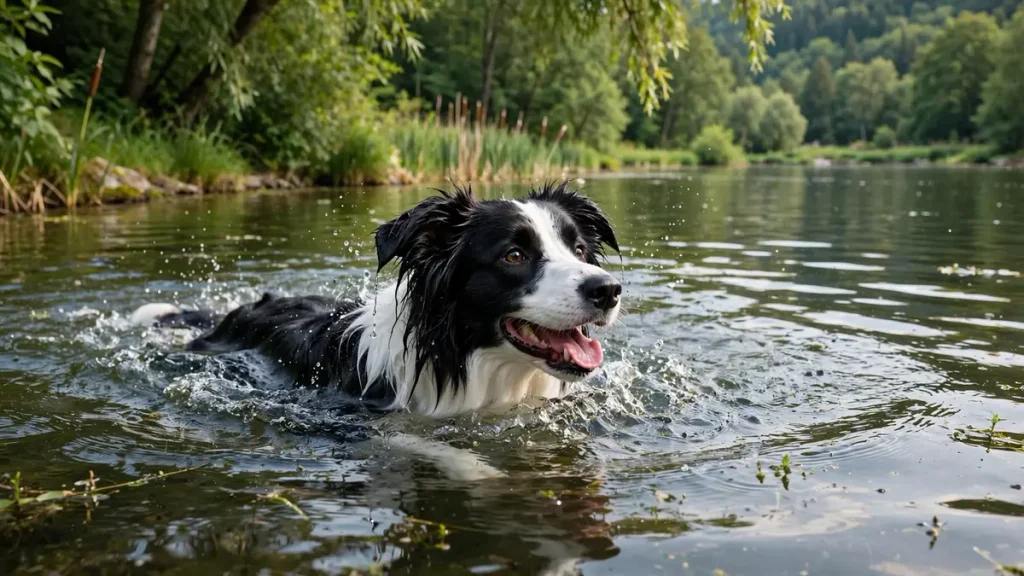
So, are Border Collies good swimmers? Many Border Collies can become capable swimmers, but they aren’t a breed specifically developed for water work, and individual confidence varies.
Border Collies are famous for their brains, speed, and herding instinct — not for splashing around. But many owners are surprised to discover that their Collie loves the water. Their lean, athletic build can help them swim efficiently, while their weather-resistant double coat provides protection from the elements. However, neither trait guarantees that an individual Border Collie will enjoy swimming or be a confident swimmer — personality plays a big role.
This guide covers swimming ability, training tips, water safety (life vests, ears, algae, currents, exits), post-swim coat care, and when swimming isn’t the right choice.
Key Takeaways
- ✅ Most Border Collies can swim — athletic build helps, but individual confidence varies
- ✅ Swimming is excellent low-impact exercise — easy on joints, great for high-energy dogs
- ✅ Early, positive exposure helps — start shallow, use treats and toys, never force
- ❌ Not all are natural swimmers — some need training and may never love water
- ❌ Always supervise and teach exits — even strong swimmers can tire or panic
- ❌ Rinse and dry thoroughly after swimming — moisture can contribute to skin irritation
At a Glance
| Question | Short answer |
|---|---|
| Can Border Collies swim? | Yes, most can |
| Are they natural swimmers? | Not specifically bred for swimming |
| Do all Border Collies like water? | No |
| Do they need a life jacket? | Recommended for beginners/open water |
| Can they swim in pools? | Yes, with supervision |
| Can they swim in lakes? | Yes, if conditions are safe |
| Can they swim in rivers? | Yes, but currents create extra risk |
| Can they swim in the sea? | Yes, with extra precautions |
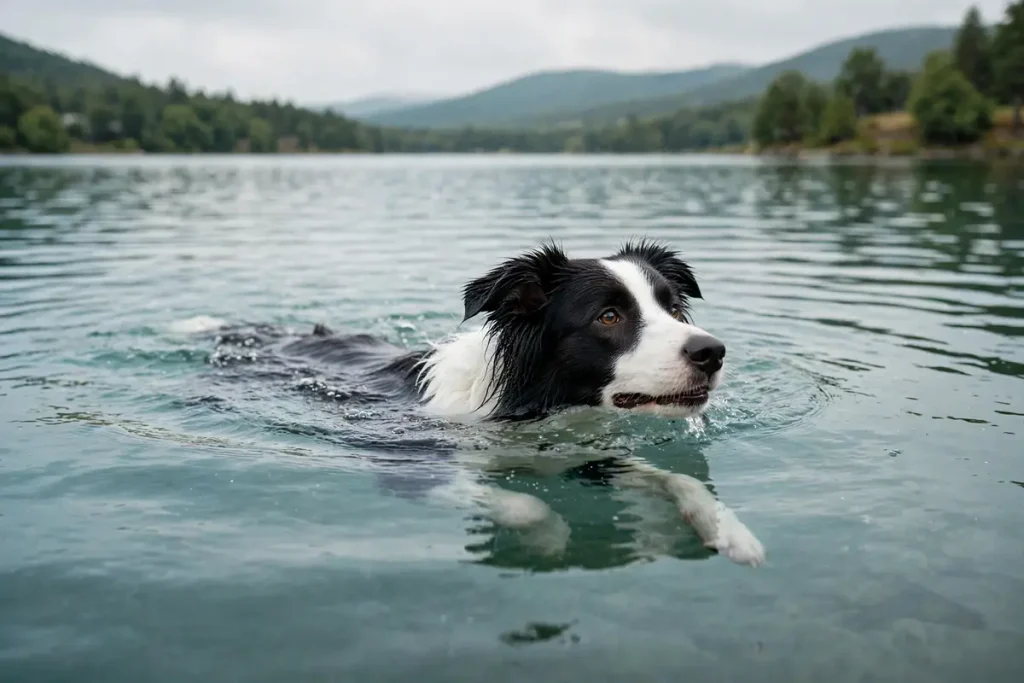
Table of Contents
Are Border Collies Natural Swimmers?
Border Collies don’t have the same history of selection for water retrieving as breeds such as Labradors and other water-retrieving dogs. According to The Kennel Club breed standard, they were bred primarily for herding livestock rather than water work. However, their physical traits give them an advantage in the water.
Their weather-resistant double coat protects from the elements, though it doesn’t make every Border Collie a strong or confident swimmer. Border Collies do not have the shortened, flat-faced anatomy seen in brachycephalic breeds like Pugs or French Bulldogs, which can make swimming and breathing more challenging.
That said, swimming ability varies widely between individuals. Some Border Collies jump into any body of water without hesitation. Others need weeks of patient training. A small number may never enjoy swimming at all.
The AKC notes that dogs vary considerably in swimming ability; introduce first-time swimmers gradually, use flotation devices, and never force dogs into the water or leave them unsupervised.
Do Border Collies Like Water?
It varies. Some love it, others tolerate it, and some avoid it entirely. Early positive exposure can help puppies develop confidence, but every dog learns at a different pace. The AKC recommends gradual introduction, shallow water, positive reinforcement, and allowing the dog to progress at its own pace.
Were Border Collies Bred to Be Water Dogs?
No — Border Collies were bred to herd livestock, not to work in water. This is an important distinction when comparing them to breeds like Labradors, Golden Retrievers, Newfoundlands, and Portuguese Water Dogs, which were specifically developed for water-related work.
For a detailed comparison of these two breeds, see our Border Collie vs Labrador Retriever guide.
| Breed | Typical Relationship with Water |
|---|---|
| Border Collie | Often capable; varies individually |
| Labrador Retriever | Strong water/retrieving heritage |
| Golden Retriever | Strong retrieving and water-working heritage |
| Newfoundland | Strong historical association with water work and rescue |
| Portuguese Water Dog | Specifically developed for water work |

Health Benefits of Swimming for Border Collies
For this highly active breed, swimming can provide useful variety alongside regular land-based exercise.
Low-Impact, Full-Body Workout
Swimming is a low-impact form of exercise that can provide a substantial workout without the repeated impact of running on hard surfaces. This makes it especially valuable for:
- Border Collies with arthritis or hip dysplasia — swimming can provide low-impact exercise for some dogs with joint problems, though an exercise plan should always be approved by your veterinarian
- Puppies that are old enough and comfortable around water, with close supervision
- Senior dogs who need gentler options — for more about what to expect as your Border Collie ages, see our Border Collie Exercise Guide
- Overweight dogs beginning a weight-loss program
Mental Stimulation
Swimming engages a Border Collie’s brain in a different way than running. Navigating water, retrieving floating toys, and learning to paddle builds coordination and confidence.
Cooling Off
Swimming can be a useful way to exercise your Border Collie during warm weather, but it doesn’t eliminate the risk of overheating. Avoid strenuous exercise during hot conditions, provide shade and fresh drinking water, and watch for signs of heat stress.
How to Teach a Border Collie to Swim
Training a hesitant Border Collie requires patience, positive reinforcement, and a gradual approach. Never force a dog into water — this can create lasting fear.
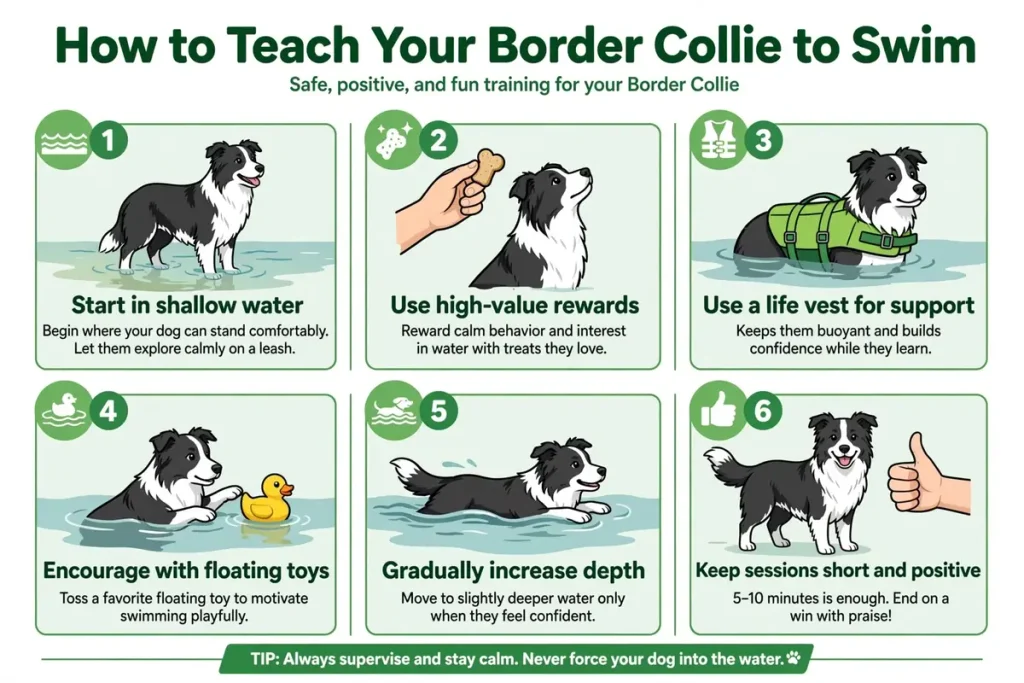
- Start in shallow, calm water. A kiddie pool, the edge of a calm lake, or a gentle beach entry works best. Let your dog wade in at their own pace.
- Use high-value rewards. Treats, praise, and favourite toys all help build positive associations. Reward every small step — even just getting their paws wet.
- Lead by example. If it is safe to do so, wade into shallow water yourself and let your dog watch. Never encourage a hesitant dog to follow you into water that is too deep.
- Use a floating toy. Once your dog is comfortable wading, place or toss a favourite floating toy within easy reach and gradually increase the distance as their confidence improves.
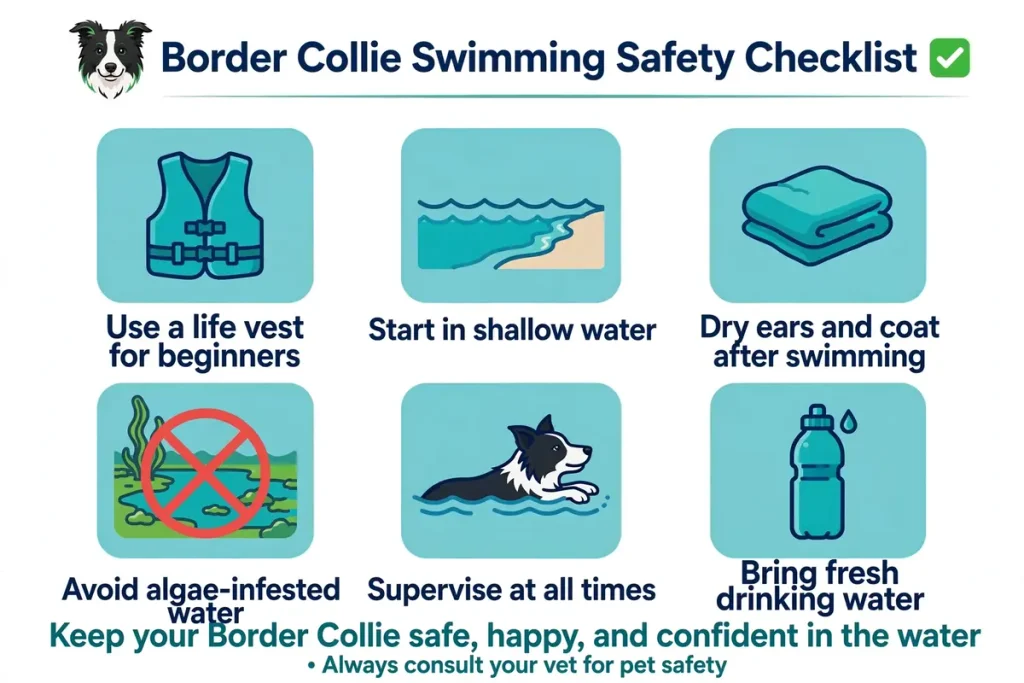
- Use a well-fitted life vest. A dog life vest provides buoyancy and confidence, especially in the early stages.
- Gradually increase depth. Once your dog is comfortable wading, move a little deeper. Only increase depth when your dog is relaxed and paddling comfortably. Stay close and provide support if needed.
- Keep sessions short and positive. End on a high note before your dog gets tired or frustrated.
Teach Your Border Collie How to Get Out of the Water
A dog that can swim isn’t necessarily a dog that knows how to escape a pool. This is one of the most important and most overlooked safety steps. The AKC recommends teaching dogs where the exit is and practising getting out.
- Identify the exit before swimming begins. Show your dog the steps, ramp, or shoreline entry.
- Practice repeatedly in shallow water before moving deeper.
- For pools: Teach your dog to use the pool’s steps, ramp, or another dog-accessible exit. Don’t assume a standard pool ladder will be easy for your dog to use.
- For lakes: Choose areas with a gentle, sloped shoreline so your dog can walk out easily.
- Never assume your dog can find the exit, especially in unfamiliar water.
Life Vest Fitting Tips
A properly fitted life vest should be snug but not tight. A well-fitted flotation device is recommended for first-time swimmers, puppies, boating, open water, deep water, and dogs with limited swimming ability or other conditions that make swimming more difficult, when swimming has been approved by their veterinarian. Measure your dog’s chest girth (behind the front legs) and neck, and follow the manufacturer’s size guide. The vest should have a handle on top for easy lifting, bright colours for visibility, and a buckle underneath that won’t slip off. Check the vest regularly during swimming to make sure it hasn’t shifted or become loose. A life jacket is a safety aid, not a substitute for supervision. For more on Border Collie training essentials, see our Border Collie breed guide.
Water Safety: What Every Owner Should Know
Never leave your Border Collie unattended around water. Even experienced swimmers can become exhausted, disoriented, injured, or caught in currents. The AKC recommends close human supervision around water at all times. Stay close enough to intervene immediately.
Ear Infections
Moisture left in the ear canal can increase the risk of ear irritation and, in susceptible dogs, contribute to ear infections. Signs include head shaking, scratching at the ears, odour, or discharge. Dry your dog’s ears thoroughly after every swim using a soft towel or a vet-recommended drying solution.
Blue-Green Algae (Cyanobacteria)
Some cyanobacterial toxins can cause severe illness or death very quickly after exposure. Harmful blooms are more common during warm conditions and can occur in lakes, ponds, and other bodies of water. Never let your dog swim in water that looks discoloured, has surface scum, or smells unusual. However, toxic algae isn’t always obvious to the naked eye — don’t assume water is safe simply because it looks clear. Check local water-quality warnings before allowing your dog to swim, particularly during warm weather. Signs of poisoning include vomiting, diarrhoea, weakness, drooling, seizures, and difficulty breathing. If you suspect exposure, rinse your dog immediately and contact a veterinarian or emergency veterinary service without delay, even if symptoms haven’t appeared yet. The AKC advises rinsing dogs after contact and contacting a veterinarian immediately.
Water Intoxication (Hyponatremia)
Dogs can ingest excessive water during intense swimming or repeated retrieving, which can disrupt the body’s electrolyte balance and cause dangerous water intoxication. The AKC warns of water intoxication during water play. Signs can include lethargy, weakness, vomiting, bloating, loss of coordination, and in severe cases, seizures. Dogs that repeatedly dive or snap at toys underwater may be at greater risk of swallowing water during play. Avoid repetitive ball throwing that encourages gulping. Give regular breaks and provide fresh drinking water.
Cold Water and Hypothermia
Even with their double coat, Border Collies can get cold. Signs that your dog may be becoming dangerously cold include persistent shivering, lethargy, weakness, or unusual muscle stiffness. Limit swim time in cold water and dry your dog thoroughly afterward. If your dog remains cold or continues shivering after being removed from the water, contact your veterinarian.
Saltwater Ingestion
Discourage your Border Collie from drinking seawater, even though accidentally swallowing a small amount is common during swimming. A small amount may cause mild stomach upset, while larger amounts can cause dangerous salt toxicity. The AKC warns against allowing dogs to drink too much seawater. Bring plenty of fresh drinking water.
Exhaustion
Border Collies have tremendous drive and may push themselves past their limits. Watch for heavy panting, slowing down, difficulty keeping their head above water, or repeatedly trying to leave the water. Take frequent breaks.
Strong Currents and Rough Waves
Avoid rivers with fast currents, ocean rip currents, and lakes with sudden drop-offs. Don’t judge river safety by how calm the surface looks — currents can be much stronger below the surface or around bends and obstacles. Stick to calm, shallow areas where you can reach your dog quickly.
Chlorine and Salt Water
Both can irritate skin and eyes. Always rinse your Border Collie with fresh water after swimming in a pool or the ocean.
Can Border Collies Swim in Pools?
Yes, Border Collies can swim in pools, but they should always be supervised and taught how to get out safely. Don’t assume your dog can find pool steps or a ladder on their own — practise the exit route before venturing into deeper water. Rinse the coat with fresh water after swimming to remove chlorine and dry the ears and undercoat thoroughly.
Can Border Collies Swim in Lakes?
Yes, Border Collies can swim in lakes, but choose calm water with an easy entry and exit. Avoid areas with strong currents, suspected algae blooms, or steep drop-offs. Check local water-quality warnings before allowing your dog to swim, particularly during warm weather. Bring fresh drinking water and never let your dog drink directly from the lake.
Can Border Collies Swim in Rivers?
Border Collies can swim in rivers, but rivers can be more dangerous than calm lakes because of currents, sudden depth changes, submerged debris, and difficult exits. Don’t judge river safety by how calm the surface looks — currents can be much stronger below the surface or around bends and obstacles. Avoid fast-moving water and choose a calm, shallow area where you can easily reach your dog.
Can Border Collies Swim in the Sea or Ocean?
Yes, but ocean swimming requires extra caution. Watch for rip currents, waves, changing tides, rocks, and debris, and always choose a safe entry and exit point. Avoid swimming near fishing hooks, lines, or other discarded equipment. Rinse thoroughly afterward to remove salt and discourage drinking seawater. Bring fresh drinking water. For more on managing your Border Collie’s overall exercise needs, see our Border Collie Exercise Guide.
Post-Swim Coat Care
A Border Collie’s double coat requires attention after swimming. The dense undercoat can stay damp for hours.
- Rinse with fresh water to remove chlorine, salt, algae, and debris.
- Towel dry thoroughly, squeezing out as much water as possible. Avoid rubbing vigorously, which can cause tangles.
- Use a high-velocity dryer if available — these blow water out of the undercoat quickly.
- Make sure the coat is thoroughly dried, especially the dense undercoat. Pay particular attention to areas that stay damp, such as behind the ears, around the collar, and within the dense undercoat. Prolonged moisture can contribute to skin irritation and hot spots.
- Brush after drying to remove tangles and distribute natural oils.
For detailed coat care instructions, see our Border Collie Grooming Guide.
Fun Water Activities for Border Collies
Once your Border Collie is a confident swimmer:
- Fetch with floating toys — most Border Collies love this
- Dock diving — some Border Collies enjoy dock diving and can do well in the sport because of their athleticism, trainability, and toy drive
- Water agility — floating platforms, hoops, and tunnels in shallow water
- Stand-up paddleboarding (SUP) — some Border Collies learn to balance on a board
- Canoeing or kayaking — always with a life vest
Border Collie Swimming Safety Checklist
Before Swimming
- ☐ Fresh drinking water available
- ☐ Properly fitted life vest (if needed)
- ☐ Safe entry and exit identified
- ☐ Weather and water conditions suitable
- ☐ Water conditions checked (currents, algae, visibility)
- ☐ Local water-quality warnings checked (if lake or pond)
- ☐ Towel ready for drying
During Swimming
- ☐ Stay within arm’s reach
- ☐ Dog remains responsive and comfortable
- ☐ Watch for fatigue
- ☐ Take regular breaks
- ☐ Prevent excessive water drinking during fetch
After Swimming
- ☐ Rinse with fresh water
- ☐ Dry ears thoroughly
- ☐ Dry undercoat completely
- ☐ Check paws and skin for irritation
- ☐ Monitor for unusual symptoms for several hours
When Not to Let Your Border Collie Swim
- After surgery or injury — wait for your vet’s clearance
- During illness — dogs with vomiting, diarrhoea, or fever should rest
- In very cold weather — hypothermia risk outweighs benefits
- In water with suspected contamination, algae, sewage/runoff, or other obvious pollution
- In strong currents, rough waves, or areas without an easy exit
- When your dog cannot reliably reach an exit
- If your dog is afraid — forcing can create a permanent phobia
- When the dog is already exhausted
- In extreme heat — strenuous exercise in hot conditions is risky regardless of water access
- With open wounds or skin infections — water can introduce bacteria
When to Call Your Vet
Contact your veterinarian if your Border Collie:
- Has been exposed to suspected blue-green algae — contact a veterinarian or emergency veterinary service immediately, even if symptoms haven’t appeared yet
- Shows signs of ear infection after swimming (head shaking, scratching, discharge, odour)
- Has vomiting, diarrhoea, weakness, or seizures after swimming in a lake or pond
- Has swallowed a large amount of seawater and is vomiting repeatedly
- Is shivering persistently after being in cold water
- Seems exhausted and unable to recover after swimming
- Has skin irritation or hot spots that develop after swimming
- Shows signs of water intoxication — lethargy, bloating, vomiting, loss of coordination
FAQ
Are Border Collies natural swimmers?
Many are capable swimmers, but not all are instinctive. Their athletic build helps, but individual personality and early exposure matter more.
Do Border Collies like water?
It varies. Some love it, others tolerate it, and some avoid it entirely. Never force a reluctant dog.
Are Border Collies afraid of water?
Some are, but Border Collies aren’t inherently afraid of water. Individual temperament and previous experiences matter. A dog that hasn’t been exposed to water may simply be uncertain, while a negative experience can create a lasting fear. Never force a fearful dog into the water.
How do I teach my Border Collie to swim?
Start in shallow water, use positive reinforcement, never force them, consider a life vest, and teach them how to get out safely. See the training section above for the full guide.
Do Border Collies need a life vest?
For beginners, in deep water, during boating, or for dogs with limited swimming ability — yes, a well-fitted life vest is strongly recommended by the AKC.
How long can a Border Collie swim?
There is no universal time limit. Start with short sessions and give frequent rest breaks. Stop before your dog becomes exhausted. Heavy panting, slowing down, struggling to keep their head above water, or repeatedly trying to leave are signs it’s time for a break.
Can Border Collies swim in pools?
Yes, with supervision. Teach your dog where the exit is and rinse thoroughly after to remove chlorine.
Can Border Collies swim in lakes?
Yes, in calm water with easy entry and exit. Be aware of algae, pollution, and drop-offs. Check local water-quality warnings.
Can Border Collies swim in rivers?
Yes, but rivers carry additional risks — currents, submerged debris, and steep banks. Choose calm, shallow areas.
Can Border Collies swim in the sea or ocean?
Yes, but watch for rip currents, waves, and changing tides. Rinse after to remove salt and discourage drinking seawater.
Can Border Collies swim in cold water?
Briefly, but watch for shivering. Hypothermia is a real risk. Dry thoroughly afterward.
Can Border Collies get ear infections from swimming?
Moisture in the ear canal can increase the risk. Dry ears thoroughly after every swim.
Can Border Collie puppies swim?
Puppies can be introduced to water gradually, but they need close supervision, shallow water, appropriate warmth, and short sessions. A properly fitted life vest can provide additional support. Never force a puppy into water.
Is swimming good for Border Collies with hip dysplasia?
Swimming can provide low-impact exercise for some dogs with joint problems. Always have an exercise plan approved by your veterinarian.
Can Border Collies do dock diving?
Some Border Collies enjoy dock diving and can do well in the sport because of their athleticism, trainability, and toy drive.
Why does my Border Collie not like swimming?
Possible reasons: negative past experience, fear of the unfamiliar, or simply personal preference. Never force them — there are many other ways to exercise a Border Collie.
Can Border Collies get water intoxication?
Yes — dogs can ingest excessive water during intense swimming or retrieving. Avoid repetitive fetch that encourages gulping water. Give regular breaks and provide fresh water.
Glossary
Double coat — A coat with a dense, soft undercoat for insulation and a coarser outer coat for weather resistance. Requires thorough drying after swimming to prevent skin irritation.
Water intoxication (hyponatremia) — A potentially dangerous condition caused by drinking excessive water, which can disrupt the body’s electrolyte balance.
Life jacket / life vest — A flotation device designed to help a dog stay afloat and remain visible in the water. Recommended by the AKC, especially for beginners and open water.
Cyanotoxin — A toxin produced by certain cyanobacteria (blue-green algae) that can cause severe illness or death in animals.
Brachycephalic — A term for flat-faced breeds (French Bulldogs, Pugs) that can have difficulty breathing during exercise, including swimming.
Dock diving — A dog sport in which dogs jump from a dock into water to retrieve a toy, judged on distance or height.
Hot spot (acute moist dermatitis) — A painful, inflamed area of skin that can develop when moisture, licking, scratching, or other irritation damages the skin barrier.
Hypothermia — A dangerously low body temperature caused by prolonged exposure to cold water.
Rip current — A narrow, powerful current that moves away from the shoreline and can quickly carry swimmers into deeper water.
Sources
- American Kennel Club — How to Teach Your Dog to Swim
- American Kennel Club — Breeds That Are Born to Swim
- American Kennel Club — Water Intoxication in Dogs
- American Kennel Club — Can Dogs Drink Salt Water?
- American Kennel Club — Blue-Green Algae Poisoning in Dogs
- Merck Veterinary Manual — Algal Poisoning of Animals
- The Kennel Club — Border Collie Breed Standard
Medical & Safety Disclaimer: This article provides general educational information based on veterinary and breed resources, including the AKC, Merck Veterinary Manual, and The Kennel Club (see Sources above). It is not a substitute for professional veterinary advice. If your dog shows signs of illness, injury, or distress after swimming, contact your veterinarian immediately.
Leave a Reply
You must be logged in to post a comment.