

Golden Retrievers and Labrador Retrievers are both friendly, loyal, and highly intelligent family dogs.
Golden Retriever vs Labrador Retriever: which is better?
Golden Retrievers and Labrador Retrievers are both highly trainable, affectionate sporting breeds, but they differ in coat, energy, temperament, and typical lifestyle fit. Labradors generally have a shorter, easier-care coat and can be especially energetic and food-motivated. Golden Retrievers have longer feathering and are often described as softer and more handler-focused. Neither breed is universally better—the right choice depends on your household, activity level, and tolerance for grooming and shedding.
Golden Retriever vs Labrador: Which Is Better?
Choose a Golden Retriever if you want:
- A slightly softer/less exuberant temperament
- A dog that may settle more easily indoors
- A longer feathered coat
- A highly people-oriented companion
Choose a Labrador if you want:
- A shorter, easier-care coat
- A particularly energetic outdoor companion
- Strong food motivation for reward-based training
- A dog suited to retrieving, swimming and active sports
If you’re unsure: either breed can be an excellent family dog. Focus on the individual dog’s temperament, health, breeding line, and your ability to meet its needs.

Table of Contents
Golden Retriever vs Labrador Retriever: Key Differences
| Feature | Golden Retriever | Labrador Retriever |
|---|---|---|
| Energy | High | Very high |
| Grooming | Higher | Lower |
| Shedding | Heavy | Heavy |
| Trainability | Excellent | Excellent |
| With children | Excellent | Excellent |
| Exercise | ~60+ min/day | ~60–90+ min/day |
| Lifespan | ~10–12 years | ~10–12 years |
| Weight | Similar | Similar/slightly heavier |
| Best for | Families, therapy work | Active families, sporting homes |
How We Compared Golden Retrievers and Labradors
We compared the breeds across temperament, exercise, grooming, trainability, family compatibility, health, lifespan, and ownership costs. Breed characteristics are based on recognized breed standards and veterinary/academic sources, while individual dogs can vary considerably.

Physical Differences: How to Tell Them Apart
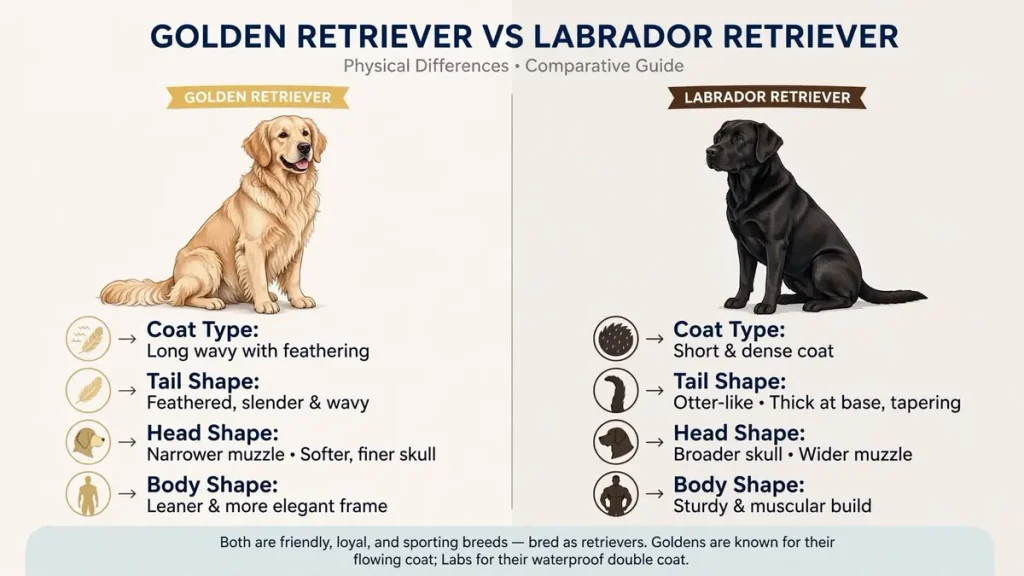
At first glance, it is easy to confuse the two. Both are medium-to-large retrievers with friendly faces and wagging tails. But look closer, and the differences are obvious.
Golden Retriever vs Labrador Retriever: Physical Differences
| Feature | Golden Retriever | Labrador Retriever |
|---|---|---|
| Coat color | Cream to golden | Yellow, black, chocolate |
| Coat type | Long, wavy, feathered | Short, dense, water-resistant |
| Body shape | Leaner, more elegant | Sturdy, more athletic |
| Tail | Feathered, saber-like | Thick, otter-like (round) |
| Head shape | Narrower muzzle | Broader skull, wider muzzle |
| Ears | Set higher, shorter | Set back, heavier |
Coat is the dead giveaway. Goldens have long, flowing feathering on their tails, legs, and chest. Labs have short, dense fur that lies flat against their body.
The tail never lies. The Labrador’s thick “otter” tail and Golden’s feathered tail are excellent visual identifiers. AKC also specifically highlights the structural differences between the breeds.
Size Comparison: Height, Weight & Build
Both breeds are similar in size, but Labradors generally have a more substantial, compact appearance, while Goldens often appear longer and more flowing because of their coat and body proportions.
Golden Retriever vs Labrador Retriever: Size Comparison
| Metric | Golden Retriever | Labrador Retriever |
|---|---|---|
| Male height | 56-61 cm (22-24 in) | 56-62 cm (22-24.5 in) |
| Female height | 51-56 cm (20-22 in) | 54-59 cm (21.5-23.5 in) |
| Male weight | 29-34 kg (65-75 lbs) | 29-36 kg (65-80 lbs) |
| Female weight | 25-30 kg (55-65 lbs) | 25-32 kg (55-70 lbs) |
Build difference: Labs look more substantial. They have a thicker neck, broader chest, and heavier bone structure. Goldens look leaner and more elegant, with a finer bone structure.
Coat & Grooming Needs: Who Sheds More?
Both breeds shed. A lot. Prepare for fur.
This is not a which sheds less comparison. It is a which sheds differently comparison.
Labrador Retriever: Short, dense double coat. Weekly brushing is usually sufficient for routine maintenance, with additional brushing during periods of heavy shedding.
Golden Retriever: Longer double coat with feathering. Regular brushing helps prevent tangles and removes loose undercoat. Many Goldens benefit from brushing several times a week, particularly during heavy shedding periods.
Best choice for lower grooming maintenance
Labrador

Temperament: The Key Difference
This is where the two breeds truly separate.
Labrador Retriever: Labradors are often outgoing, enthusiastic, and highly social. Many enjoy greeting people and are eager to participate in whatever their owners are doing.
According to the American Kennel Club breed standard, Labs are “kindly, outgoing, tractable, and eager to please.” Labradors can remain physically exuberant and immature well into young adulthood, although the age at which an individual dog settles varies.
Golden Retriever: Goldens are often described as gentle, people-oriented, and responsive to their handlers. Individual temperament varies considerably depending on genetics, socialization, and training.
The AKC describes Golden Retrievers as “reliable, trustworthy, and friendly.” Golden Retrievers often combine an active temperament with a good ability to settle at home when their exercise and mental stimulation needs are met. Individual dogs vary, and some Labradors can be equally relaxed indoors.
Temperament winner: Depends on your preference. Want an energetic social butterfly? Get a Lab. Want a gentle, sensitive companion? Get a Golden.

Energy Levels & Exercise Requirements
Both breeds need significant exercise. Neither is a couch potato.
Golden Retriever vs Labrador Retriever: Energy Levels & Exercise Requirements
| Factor | Golden Retriever | Labrador Retriever |
|---|---|---|
| Daily activity needs | High | High |
| Typical playfulness | High | Very high |
| Retrieving drive | High | High |
| Indoor settling | Often good with adequate exercise | Often good with adequate exercise |
| Mental stimulation | Important | Important |
Trainability: Which Is Easier to Train?
Stanley Coren’s well-known ranking of working and obedience intelligence places Golden Retrievers fourth and Labrador Retrievers seventh. However, these rankings measure particular aspects of trainability rather than overall canine intelligence.
Both are highly trainable, but they are motivated differently.
Labrador: Food-motivated and eager to please. Labs will do almost anything for a treat. They are quick learners but easily distracted. Their enthusiasm can work against them — they get excited and forget their manners.
Golden Retriever: People-pleasing is in their DNA. Goldens are more focused during training sessions. They are less distracted and more patient. Goldens are commonly seen in therapy, assistance and service roles because of their trainability, sociability and willingness to work with people.
There is no meaningful overall intelligence winner. Both breeds are highly trainable and eager to work with people. Stanley Coren’s working-and-obedience ranking places Golden Retrievers ahead of Labradors, but that ranking measures obedience and working performance rather than every form of canine intelligence
Family Compatibility: Which Is Better With Kids?
Both breeds are legendary for their patience with children.
Golden Retriever: Goldens are the classic family dog. They are patient, gentle, and tolerant. Goldens are often patient and gentle with children, but young children should always be supervised around dogs and taught to interact respectfully. Their sensitivity makes them excellent with children of all ages.
Labrador Retriever: Labs are also fantastic with kids, but their energy can be overwhelming for very young children. A bouncy 70-pound Labrador can accidentally knock over a toddler. With older kids who love to play fetch and run, Labs are the perfect playmate.
Best choice for families
Both
Good With Other Pets?
Both breeds were developed to work closely with people and generally have sociable, cooperative temperaments. Many individuals also enjoy living with other dogs, although early socialization and individual temperament matter.
Both breeds can live successfully with cats and other dogs, but individual prey drive, socialization, training, and the temperament of the other animal are more important than breed alone.

Health & Lifespan Comparison
No breed comparison is complete without looking at health. Both breeds have significant health concerns that prospective owners should know about.
Lifespan:
– Golden Retriever: 10-12 years
– Labrador Retriever: 10-12 years
Golden Retriever vs Labrador Retriever: Health Conditions
| Health concern | Golden | Labrador |
|---|---|---|
| Hip dysplasia | Important concern | Important concern |
| Elbow dysplasia | Important concern | Important concern |
| Cancer | Major breed concern | Important concern |
| Eye disease | Important concern | Important concern |
| Obesity | Important concern | Particularly important |
| EIC | Can occur | Recognized inherited condition |
Cancer is a major health concern in Golden Retrievers. Older breed mortality research has reported cancer as a leading cause of death, but the exact risk varies between populations and studies. Prospective owners should discuss family health history and recommended health screening with responsible breeders.
Labrador health risk: Labradors can have particularly strong food motivation, and some carry genetic variants associated with increased food intake and body weight
What Health Tests Should a Golden Retriever or Labrador Breeder Provide?
Golden Retriever
- Hip evaluation
- Elbow evaluation
- Cardiac exam
- Ophthalmologist evaluation
- NCL5 DNA test
Labrador Retriever
- Hip evaluation
- Elbow evaluation
- Ophthalmologist evaluation
- EIC DNA test
- CNM DNA test
- PRA-prcd DNA test
- D-locus DNA test
Questions to Ask a Golden Retriever or Labrador Breeder
- Can I see the parents’ health-test results?
- What hip and elbow evaluations have the parents received?
- Have the parents had recommended eye examinations?
- Which breed-specific DNA tests were performed?
- What are the parents’ temperaments like at home?
- Have previous puppies from these parents developed significant health problems?
- What support do you provide after the puppy goes home?

Feeding & Diet Differences
Both breeds need high-quality dog food, but there is one big difference.
Some Labradors carry a POMC gene variant associated with increased food motivation and higher body weight. This does not mean every Labrador has the variant or that affected dogs literally cannot feel full. Portion control and maintaining a healthy body condition are particularly important for the breed.
Golden Retriever: Golden Retrievers can also gain excess weight, so portion control and regular exercise are important. Labradors have particularly well-documented genetic and behavioral risk factors related to food motivation.
There is no universal number of cups that every Golden Retriever or Labrador should eat. Feeding amounts depend on the dog’s weight, age, activity level, health, and the calorie density of the food. Start with the feeding guide on the food label and adjust portions based on your dog’s body condition and your veterinarian’s advice.
Which breed may be easier in an apartment?
Golden Retriever may have a slight advantage for some apartment owners because individual Goldens are often easier to settle indoors. However, neither breed is automatically unsuitable for apartment living. Exercise, training, mental stimulation, and the dog’s individual temperament matter more than having a yard.
Golden Retriever: Adapts better to apartment life if exercised properly. They are calmer indoors and more likely to settle down.
Labrador: Struggles more in apartments. Their high energy and tendency to bounce off walls (literally) make small spaces challenging.
Cost of Ownership Comparison
Golden Retriever vs Labrador Retriever: Cost of Ownership Comparison
| Expense | Golden Retriever | Labrador Retriever |
|---|---|---|
| Purchase price | $1,500–$3,500 | $1,000–$2,500 |
| Food (annual) | $600–$900 | $700–$1,000 |
| Grooming (annual) | $600–$1,200 | $300–$600 |
| Vet care (annual) | $500–$1,000 | $500–$1,000 |
| Pet insurance (annual) | $500–$800 | $400–$700 |
| Total first year | $4,000–$7,000 | $3,000–$5,500 |
U.S. estimates — actual costs vary by country.
Goldens are more expensive primarily because of grooming costs.
Ownership costs vary dramatically by location and lifestyle. The figures below are illustrative estimates rather than fixed breed costs.
Quick Comparison Table
Golden Retriever vs Labrador Retriever: Quick Comparison
| Factor | Golden Retriever | Labrador Retriever |
|---|---|---|
| Energy level | High | Very high |
| Grooming effort | High — regular brushing, more during shedding | Medium (weekly) |
| Trainability | Excellent | Excellent |
| Good with kids | Excellent | Excellent |
| Good with pets | Generally good | Generally good |
| Shedding | Heavy | Heavy |
| Lifespan | 10-12 years | 10-12 years |
| Health concerns | Cancer, hips | Hips, obesity |
| Best for | Families, therapy work | Active owners, hunting |
| Apartment friendly | Possible with exercise | Difficult |
How to Choose: Which Breed Is Right for You?
Answer these questions honestly:
Choose a Golden Retriever if:
– You want a gentle, sensitive companion
– You do not mind brushing 3-4 times per week
– You have young children
– You want a dog that will settle down on the couch
– You are looking for a therapy or service dog prospect
Choose a Labrador Retriever if:
– You are an active person who loves hiking, running, or swimming
– You want a dog who is always up for adventure
– You prefer a low-maintenance coat
– You have older, active children
– You want a versatile hunting or sporting companion

Golden Retriever vs Labrador: Which Is Calmer?
If having a dog that can relax at home is important to you, Golden Retrievers usually have a slight advantage. Goldens are often described as calmer and more settled indoors, while Labradors tend to remain more physically exuberant and playful.
That does not mean every Golden is calm or every Lab is hyperactive. Age, genetics, training, exercise, and whether the dog comes from working or show lines can make a major difference.
Golden Retriever: Often better suited to owners who want an active dog that can also settle at home.
Labrador Retriever: Often better suited to owners who enjoy a more energetic, playful dog and can provide plenty of physical and mental stimulation.
Calmer breed: Golden Retriever, but individual temperament matters more than breed stereotypes.
Golden Retriever vs Labrador for First-Time Owners
Both breeds can be excellent choices for first-time dog owners because they are intelligent, people-oriented, and generally responsive to training.
A Golden Retriever may have a slight advantage for someone who prefers a softer, more sensitive temperament and a dog that is often easier to settle indoors. However, Goldens require considerably more coat care.
A Labrador may be the better choice for a first-time owner who enjoys an active lifestyle and wants a dog with a simpler coat. The trade-off is that young Labs can be extremely energetic and may require extra work on jumping, impulse control, chewing, and settling.
Choose a Golden Retriever if you prefer:
- A softer, people-oriented temperament
- A dog that may be easier to settle indoors
- A highly trainable companion
- A family or therapy-dog prospect
- Regular brushing as part of your routine
Choose a Labrador if you prefer:
- A highly energetic and playful companion
- Outdoor activities such as hiking, swimming, and retrieving
- A shorter, easier-to-maintain coat
- A food-motivated dog that responds well to rewards
- A versatile sporting companion
Best choice: Depends on your priorities. Golden Retrievers may suit owners who prefer a softer temperament, while Labradors may suit owners who prefer a more energetic dog and simpler coat care.

Golden Retriever vs Labrador Puppies: Which Is Easier?
Golden Retriever and Labrador puppies can both be challenging. Neither breed should be considered an automatically easy puppy.
Both may go through stages involving:
- Chewing
- Mouthing and biting
- House-training accidents
- Jumping up
- Stealing objects
- Short attention spans
- High energy
- Difficulty settling
Labrador puppies are often particularly enthusiastic and physically exuberant. Golden puppies can also be energetic, but many owners find their people-oriented nature helpful during training.
The most important factors are consistent training, appropriate socialization, adequate sleep, age-appropriate exercise, and good management of the home environment.
Puppy winner: There is no clear winner. Individual temperament and your training approach matter more than breed alone.
Working-Line vs Show-Line Golden Retrievers and Labradors
One factor that can dramatically change the experience of owning either breed is the dog’s breeding line.
Working- or field-bred Goldens and Labradors may have stronger retrieving instincts, greater drive, and higher exercise requirements than some dogs bred primarily for conformation or companionship.
This is particularly important if you are comparing two dogs based only on breed stereotypes.
A field-bred Labrador, for example, may be significantly more intense than a calmer Labrador from another breeding program. The same principle applies to Golden Retrievers.
When choosing a puppy, ask the breeder about the parents’ temperament, energy level, working ability, health testing, and typical behavior in the home.
Bottom line: Breed matters, but the individual dog’s genetics and upbringing matter too.
Which Breed Is More Affectionate?
Both Golden Retrievers and Labradors are affectionate, people-oriented breeds. Neither has a monopoly on being loving.
Goldens are often especially attached to their families and may prefer staying close to their owners throughout the day. Labradors are also highly social and frequently show affection through play, physical contact, and enthusiastic greetings.
If you want a dog that follows you from room to room, either breed could fit.
Best choice: Tie — individual personality matters more than breed.
Which Breed Is Better for an Active Family?
Both breeds can thrive with active families, but Labradors often have the edge when the lifestyle involves particularly energetic activities.
Labradors are well suited to activities such as retrieving, swimming, hiking, and other forms of active play. Golden Retrievers also enjoy these activities and can make excellent outdoor companions.
The better choice depends on the family’s activity level and the dog’s individual temperament.
For very active households: Labrador Retriever may have the edge.
For active households wanting a balance between activity and settling at home: Golden Retriever may be the better fit.
Golden Retriever vs Labrador Pros and Cons
Golden Retriever Pros
- Friendly and people-oriented
- Highly trainable
- Often gentle with families
- Excellent companion for many households
- Commonly suited to therapy and assistance work
- Can enjoy both active outings and relaxed family time
Golden Retriever Cons
- Heavy shedding
- Requires more coat maintenance
- Can be prone to important health problems
- Sensitive individual dogs may respond poorly to harsh training
- Puppies and adolescents can still be very energetic
Labrador Retriever Pros
- Highly trainable
- Friendly and outgoing
- Excellent sporting and outdoor companion
- Shorter, easier-to-maintain coat
- Usually very food-motivated
- Excellent choice for active families
Labrador Retriever Cons
- Can be extremely energetic when young
- Strong appetite can contribute to weight gain
- Heavy shedding despite the short coat
- Can be boisterous and accidentally knock over small children
- Requires consistent training and exercise
Which Breed Should You Choose?
There is no universal winner between a Golden Retriever and a Labrador Retriever.
Choose based on the life you can realistically provide rather than choosing the breed you think is “better.”
Choose a Golden Retriever if you want a friendly, people-oriented dog with a softer temperament and you are comfortable with regular grooming and shedding.
Choose a Labrador Retriever if you want an energetic, playful outdoor companion and prefer a shorter, lower-maintenance coat.
And remember: the individual dog matters. Age, genetics, breeding line, socialization, training, health, and personality can all influence how a particular Golden or Labrador behaves.
Conclusion: The Final Verdict
There is no wrong choice between these two breeds. Both are wonderful family dogs that will fill your home with love, slobber, and fur.
Pick the Golden Retriever if you want a gentle, sensitive soul who will be your shadow. You do not mind extra grooming. You want a dog that may be easier to settle around a busy family home.
Pick the Labrador Retriever if you want an energetic adventure partner who never says no to a game of fetch. You prefer a low-maintenance coat. You have an active lifestyle and can provide exercise daily.
Golden Retrievers and Labrador Retrievers are both excellent choices for active families, but they suit slightly different lifestyles. Labradors may appeal more to owners who want a highly energetic dog with a short, easy-care coat, while Golden Retrievers may suit people who prefer a softer, more people-focused temperament and don’t mind additional coat care.
Ultimately, breed is only part of the decision. Age, genetics, breeding line, health testing, socialization, training, and individual temperament can strongly influence the dog you bring home.
Not sure yet? Take our Dog Breed Quiz to find your perfect match, or check out our Dog Cost Calculator to budget for your new family member.
Want more breed comparisons? Read our Border Collie vs Labrador and Border Collie vs Golden Retriever guides.
Disclaimer: This article is for informational purposes only and does not replace professional veterinary advice. Always research breeders carefully and consider adoption as your first option.
FAQ: Golden Retriever vs Labrador
Which is calmer, a Golden Retriever or Labrador?
Golden Retrievers are often considered slightly calmer indoors, while Labradors tend to be more exuberant and energetic. However, age, training, exercise, genetics, and breeding line can have a major effect on an individual dog’s temperament.
Which breed needs more exercise, a Golden Retriever or Labrador?
Both need substantial daily physical and mental stimulation. Labradors are often particularly energetic, especially when young or bred for field work, but individual Goldens can also have very high exercise needs.
Are Golden Retrievers or Labradors easier to groom?
Labradors are generally easier to groom because they have a short, dense coat. Golden Retrievers have longer feathering that requires more frequent brushing to help prevent tangles and mats. Both breeds shed heavily.
Which breed is better for apartment living?
Either breed can potentially live in an apartment if its exercise, training, and mental stimulation needs are met. A Golden Retriever may be easier to settle indoors, but access to a yard is not a substitute for regular exercise.
Which breed is more affectionate?
Both breeds are highly affectionate and people-oriented. Goldens may be more likely to stay close to their owners, while Labradors often express affection through enthusiastic greetings and play. Individual personality matters more than breed.
Which breed is easier to train?
Both breeds are highly trainable. Golden Retrievers may have a slight advantage for owners who prefer a softer, handler-focused dog, while Labradors are often extremely food-motivated and respond very well to reward-based training.
Which breed is better with cats?
Both breeds can live successfully with cats, particularly when properly socialized and introduced. Individual prey drive, temperament, training, and the cat’s personality all matter, so breed alone cannot guarantee compatibility.
Which breed is better for active families?
Both can be excellent choices. Labradors may have an advantage for families that want a particularly energetic dog for retrieving, swimming, hiking, and outdoor activities. Goldens can also thrive in active families while often being happy to relax with their people afterward.
Are Golden Retrievers and Labradors good for children?
Both breeds can be excellent family dogs. However, children should always be supervised around dogs, and young children should be taught to interact calmly and respectfully. A large, excited dog of either breed can accidentally knock over a small child.
Do Golden Retrievers and Labradors get along with other dogs?
Generally, yes. Both breeds are typically social and can get along well with other dogs when properly socialized. Individual temperament and the quality of introductions are more important than simply choosing one breed over the other.
Which breed is more prone to obesity?
Labradors have a particularly well-documented tendency toward food motivation and obesity. Portion control, regular exercise, appropriate treats, and maintaining a healthy body condition are important for both breeds.
Which breed is more expensive to own?
Golden Retrievers can cost more for grooming because of their longer coats, but actual ownership costs vary considerably by location, food, veterinary care, insurance, grooming needs, and the individual dog.
Can a Golden Retriever and Labrador live together?
Yes. Golden Retrievers and Labradors can make excellent companions for one another. Their similar size, sociable nature, and activity requirements can make them a good match, although each dog’s individual temperament should be considered.
Should I get a Golden Retriever or Labrador puppy?
Choose the puppy whose expected temperament, energy level, health background, and breeding line fit your lifestyle. Don’t choose based solely on appearance. Ask breeders about health testing, the parents’ temperaments, and the type of home the puppies are being raised in.
Which breed is smarter?
There is no reliable overall intelligence winner. Both Golden Retrievers and Labradors are highly trainable and eager to work with people. Stanley Coren’s well-known ranking placed Goldens ahead of Labs for working and obedience intelligence, but that measures a specific aspect of canine performance rather than overall intelligence.
Which breed sheds more?
They shed about the same amount. Golden fur is longer and more visible. Lab fur is shorter and sticks into fabric. It is a tie.
Which breed lives longer?
Both breeds commonly live around 10–12 years, although individual lifespan varies substantially with genetics, health, weight, preventive care and other factors.
Which breed is better for first-time owners?
Both breeds can work well for first-time owners. A Golden may suit someone who prefers a somewhat softer temperament, while a Labrador may suit someone who wants a highly energetic dog and prefers a shorter coat.
Are Golden Retrievers or Labradors easier to care for?
Labradors are generally easier to groom because their coats are shorter, while Golden Retrievers require more regular brushing and coat maintenance. However, both breeds need substantial exercise, training, veterinary care and mental stimulation. The easier breed depends on which responsibilities fit your lifestyle.
Glossary & Key Terms: Golden Retriever vs Labrador
Bloat (GDV): A potentially life-threatening condition in which the stomach becomes distended and may twist. Large and deep-chested dogs can be at risk, so owners should learn the warning signs and seek emergency veterinary care when appropriate.
Body condition score (BCS): A system veterinarians use to assess whether a dog is underweight, at an ideal weight, overweight, or obese based on body fat and physical appearance.
Conformation: The physical structure and appearance of a dog in relation to its breed standard. Conformation breeding is different from breeding specifically for field or working performance.
Double coat: A coat consisting of a soft undercoat and a protective outer coat. Both Golden Retrievers and Labrador Retrievers have double coats.
Elbow dysplasia: A group of developmental problems affecting the elbow joint that can cause pain, lameness, and arthritis.
Exercise-induced collapse (EIC): An inherited condition found in some Labrador Retrievers in which affected dogs can develop weakness or collapse following intense exercise.
Field line: A breeding line selected primarily for working abilities such as retrieving, endurance, trainability, and performance in field activities. Field-bred dogs can have different energy levels and physical characteristics from show-bred dogs.
Hip dysplasia: A developmental abnormality of the hip joint that can cause pain, reduced mobility, and arthritis.
Obesity: Excessive body fat that can negatively affect a dog’s health, mobility, and lifespan. Labradors are particularly prone to weight gain, making portion control important.
POMC variant: A genetic variant involving the pro-opiomelanocortin (POMC) gene that has been associated with increased food motivation and obesity risk in some Labradors.
Positive reinforcement: A training approach that rewards desired behavior, such as with food, toys, praise, or access to something the dog enjoys.
Retrieving instinct: A natural tendency to chase, carry, and return objects. Retrieving ability is an important characteristic of both Golden Retrievers and Labrador Retrievers.
Show line: A breeding line selected substantially for conformation and appearance according to breed standards. Show-bred dogs can have different physical characteristics and energy levels from field-bred dogs.
Socialization: The process of carefully exposing a puppy or dog to people, animals, environments, sounds, handling, and experiences in a positive and appropriate way.
Therapy dog: A trained dog that visits settings such as hospitals, care facilities, schools, or other environments to provide comfort and companionship. Therapy dogs are different from service dogs.
Undercoat: The softer, shorter layer of fur beneath a dog’s outer coat. It provides insulation and contributes to seasonal shedding.
Working and obedience intelligence: A concept popularized by researcher Stanley Coren that relates to a dog’s ability to learn and perform commands. It does not represent every aspect of canine intelligence.
Working line: A breeding line selected for performance, working ability, drive, and other functional traits rather than primarily for appearance.
Key Terms to Know
If you’re deciding between these breeds, the most important terms to understand are energy level, trainability, socialization, body condition score, double coat, field line, show line, hip dysplasia, obesity, and retrieving instinct.
Understanding these concepts can help you look beyond simple breed stereotypes and choose the individual dog that best matches your lifestyle.
Leave a Reply
You must be logged in to post a comment.