
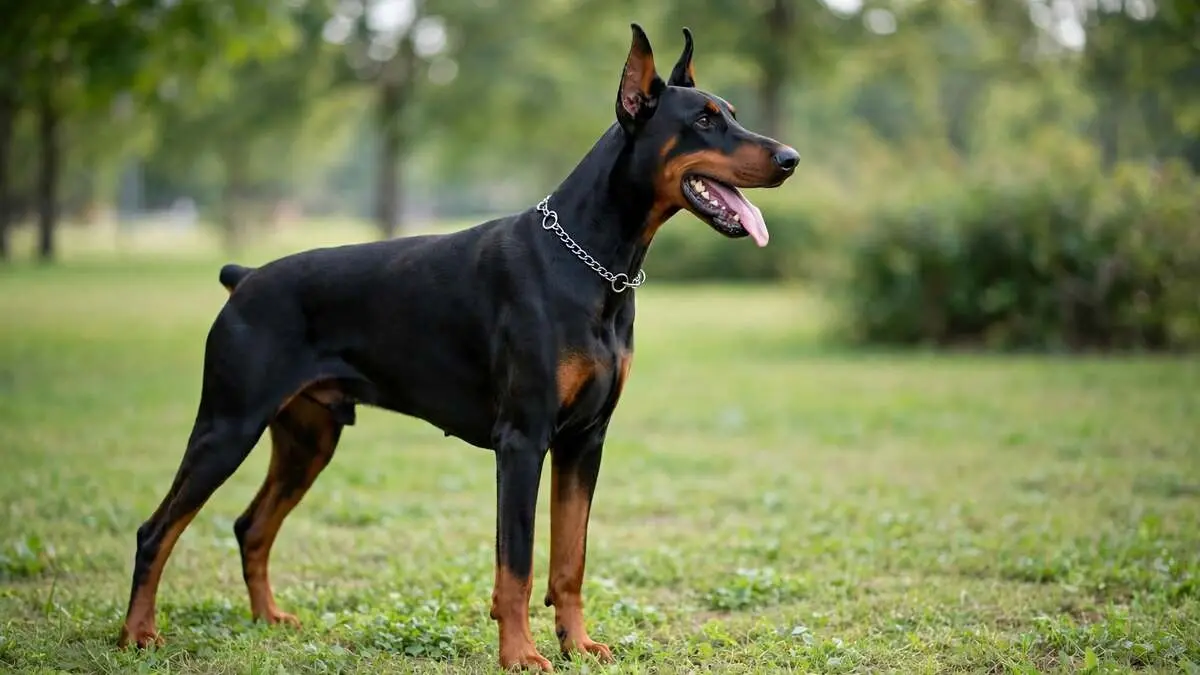
A Doberman Pinscher is a large, short-coated working dog. Males stand 26 to 28 inches and weigh 75 to 100 pounds. Females are smaller, at 24 to 26 inches and 60 to 90 pounds. The AKC gives the breed a life expectancy of 10 to 12 years. It was developed as a personal protection dog, and it is still naturally alert, watchful, and protective of its family. This is a loyal, fearless animal that needs training, exercise, and human company every single day.
Key Takeaways
- ✅ Built for work. The breed standard describes the Doberman as energetic, watchful, determined, alert, fearless, loyal, and obedient.
- ✅ Easy coat. The AKC calls the breed “mostly a wash-and-wear” type. A daily brush and regular nail trims cover most of it.
- ⚠️ Heart disease is the breed’s main concern. One European study of 412 Dobermans reported a cumulative prevalence of 58.2%.
- ⚠️ Bloat can kill a dog in hours. Learn the signs and know your nearest emergency clinic before you need it.
- ⚠️ A badly raised Doberman is a hard dog to live with. The AKC says the breed can become “pushy, destructive, and unmanageable if not raised properly.”
- ❌ White Dobermans are not a rare color. The breed club treats albinism as a genetic fault and asks owners not to breed these dogs.
Table of Contents
| Quick fact | Doberman Pinscher |
|---|---|
| AKC group | Working |
| Height (standard) | 26–28 in male 24–26 in female |
| Weight (AKC page) | 75–100 lb male 60–90 lb female |
| Lifespan | 10–12 years (AKC) 9.1 years at birth in a 2023 Doberman health-survey analysis |
| Coat type | Short, smooth, close-lying. Sheds regularly |
| Standard colors | Black, red, blue, fawn (Isabella) All with rust markings |
| Barking level | Medium (AKC breed profile) |
| Good with young children | Yes, with supervision |
| Good with other dogs | With supervision |

What Is a Doberman Pinscher?
The Doberman Pinscher is a German breed of working dog. It is a square, compact dog with a deep chest, a long wedge-shaped head, and a short coat. It was bred to protect people, and that purpose still shapes how the dog behaves.
The Doberman belongs to the AKC’s Working Group, alongside the Rottweiler, Boxer, and Great Dane. The AKC calls it one of the world’s finest protection breeds, and it has a long record of police and military work.
Where the Breed Comes From
The Doberman comes from Apolda, in Thuringia, Germany, around 1890. The breed takes its name from Louis Dobermann of Apolda. He was a tax collector who needed a dog to protect him on his rounds.
The breed was built from old short-haired shepherd stock, crossed with the Rottweiler, the Black and Tan Terrier, and the Smooth-Haired German Pinscher. Those are the breeds the AKC lists as its foundation. Guarding, working all day, and reacting fast are the traits the modern standard still asks for.
The Doberman Pinscher Club of America was founded in 1921 and is the breed’s AKC parent club. The breed also served as a military dog, and a life-size bronze of one, “Always Faithful”, stands in the war dog cemetery on Guam.
You can read more about that side of the breed in our guide to Dobermans as legendary guard dogs. Our roundup of working dog breeds covers the group.
Size and Build: What the Standard Says
The official AKC standard sets height by sex. Dogs should stand 26 to 28 inches at the withers, with an ideal of about 27½ inches. Bitches should stand 24 to 26 inches, with an ideal of about 25½ inches.
The standard describes a square dog. Height, measured from the ground to the withers, should equal the length from the forechest to the back of the thigh. The body is muscular, the ribs well sprung, the belly tucked up and the chest deep to the elbow.
The standard’s opening line calls the Doberman “a dog of medium size”. The AKC’s own breed page lists it among the largest dog breeds. Read the two together and, in everyday terms, the Doberman is a large dog. It is the biggest of the medium breeds, and clearly smaller than a Great Dane or a Mastiff.
The weight figures of 75 to 100 pounds for males and 60 to 90 pounds for females come from the AKC breed page. The standard itself sets height only. Treat the show-ring weight as a guide to condition, not a target to hit. A working or family Doberman can be fit and healthy a few pounds either side of those numbers.
How Long Do Dobermans Live?
The AKC gives a life expectancy of 10 to 12 years. That is the figure most people quote, and it is a reasonable planning range. Our dog lifespan by breed table puts it beside 100 other breeds.
The same 2023 analysis reported a second figure. The life expectancy of a Doberman at birth is 9.1 years. That comes from a different population, using a different measurement, so the two numbers do not contradict each other. One is a typical range. The other is an average calculated from birth, and averages include dogs that die young.
The same study is a reminder of why the average sits where it does. Heart disease caused 28% of deaths in the breed, and cancers 14%.
Neither figure predicts your dog. Screening does not change a dog’s genes. It does mean a heart problem is found earlier, when your vet has more options for managing it. Nothing guarantees a longer life.
Temperament: What the Standard and the Club Actually Say
The AKC standard uses seven words: “Energetic, watchful, determined, alert, fearless, loyal and obedient.” That is the target the breed is judged against.
The standard also makes a point of what the breed should never be. It says the judge “shall dismiss from the ring any shy or vicious Doberman.” A fearful dog is a failure of the breed, not a feature of it.
The AKC’s breed description puts the same idea in warmer language. It calls the Doberman “sleek and powerful, possessing both a magnificent physique and keen intelligence”, and “incomparably fearless and vigilant”.
Where the stereotype goes wrong is the assumption that the dog is born dangerous. A well-bred, well-raised Doberman is watchful with strangers and deeply attached to its own people. That is a long way from random aggression. Our guide on whether Dobermans turn on their owners looks at the medical and training reasons a dog might bite. We also cover the myths in depth in our piece on Doberman personality and the stereotypes around it.
The AKC lists the breed as good with young children. It attaches one caveat to every breed on its site: dogs should always be supervised around young children. The Doberman’s size and speed are the reason that note matters here more than it does for a spaniel.
A Doberman can knock a toddler over without meaning any harm. It can also guard a toy or a doorway if nobody teaches it otherwise. Children need to be taught how to handle a big dog, and the dog needs to learn that grabbing and hugging are safe.
With other dogs, the AKC lists the breed as good “with supervision”. That is the right framing. Many Dobermans live happily with other dogs. Some are less tolerant of certain dogs, and two of the same sex can take more management.
Colors the Standard Accepts
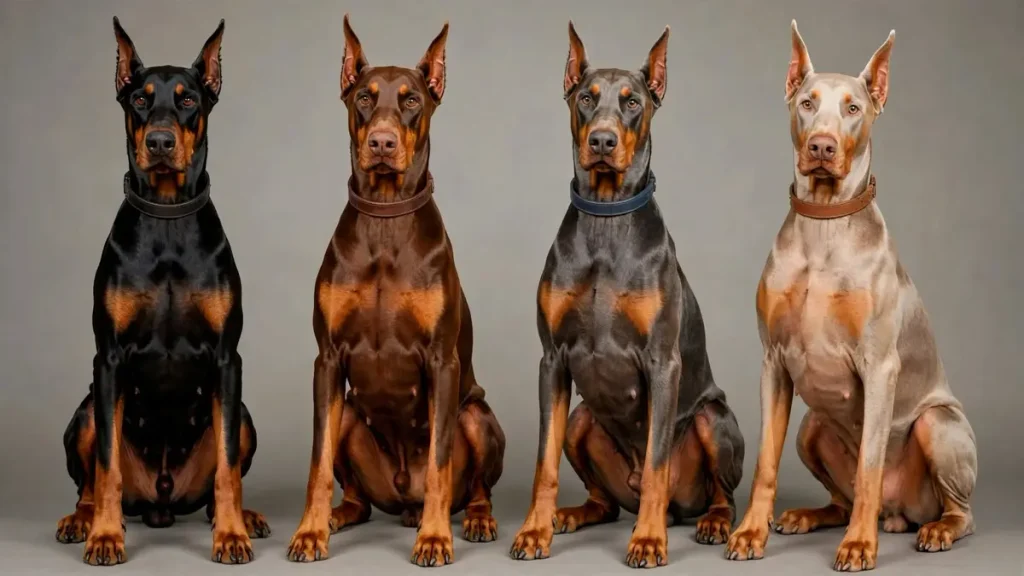
The standard allows four colors: black, red, blue, and fawn (Isabella). Every one of them comes with rust markings. The markings should be sharply defined, above each eye, on the muzzle, throat and forechest, on all legs and feet, and below the tail.
| Color | Status under the AKC standard |
|---|---|
| Black with rust | Allowed |
| Red with rust | Allowed |
| Blue with rust | Allowed |
| Fawn (Isabella) with rust | Allowed |
| White or cream, pink nose, pale eyes | Not an allowed color. Disqualifying fault |
| Any other color or pattern | Not an allowed color. Disqualifying fault |
A small white patch on the chest is allowed, as long as it does not exceed ½ square inch. Anything bigger is a fault. The standard’s disqualifying wording is plain: “Dogs not of an allowed color.”
White Dobermans are sold as rare and special. They are neither. The breed club calls the trait albinistic, and it is blunt about it. “White (Albino) is not a color; it is a lack of color caused by a defective gene.” The DPCA’s policy says white dogs should not be bred. That includes their parents and their littermates.
The club also tracks the trait. Dobermans that descend from the first registered albino carry a “Z” on their AKC papers. Breeders can DNA test a colored dog to find out whether it carries the gene.
The health costs are real. The DPCA says albino Dobermans are very sensitive to sunlight. Many have vision problems from abnormal retina development. They are also prone to skin cancer and skin lesions. If someone offers you a “rare white” puppy at a premium price, walk away.
Ears, Tails, and the Cropping Question
The standard describes a dog with cropped ears carried erect, and a tail docked at about the second joint. A Doberman with natural ears and a full tail is still a Doberman. It simply does not match the description the standard gives.
Cropping and docking are cosmetic procedures. Rules on them differ widely between countries, and some places restrict or ban them. Check your local guidance and ask the breeder directly what they do, rather than assuming.
Where a Doberman Can Live
The AKC is direct about this. The Doberman “should always live inside the home with his people, rather than outdoors.” A dog left in a yard or a kennel is not living the life the breed was built for. It usually develops problems because of it.
The same page says a large fenced area where the dog can run is “vital” for its physical and mental well-being. That does not have to be your own yard. It does have to exist somewhere the dog can reach most days.
An apartment is workable, but it takes planning. The dog will not exercise itself in a small space, so every walk and every training session has to be deliberate. Stairs, elevators and shared hallways add daily management. The AKC rates the breed’s barking level as medium, so noise is usually manageable, but a bored Doberman will find its voice.
Exercise: How Much and What Kind
The AKC calls the Doberman “an energetic athlete who needs a lot of exercise and free play.” It recommends long daily walks or hikes, and room to run.
No published study gives a Doberman an exact number of minutes per day, so treat any figure you see online as a starting point. What matters is that the dog gets out more than once, gets to move properly, and gets to use its brain.
A sensible pattern is a long walk in the morning, a shorter session later, and some training or scent work in between. Running suits a physically mature, healthy dog, so build the distance up slowly rather than starting with it. Fetch, hikes, swimming and dog sports all suit the breed. Mental work tires a working dog faster than a slow stroll does, which is why brain games for dogs do so much for this type.
Heat comes first. A short-coated dark dog with a deep chest works hard in warm weather. In summer, shift exercise to early morning or evening and carry water. Growing puppies come second. Do not run a young Doberman hard while it is still growing. Ask your vet about appropriate exercise and body condition during growth.
Training a Doberman
The AKC describes the breed as “very intelligent, learn easily, respond quickly”. That is good news and a warning at the same time. A dog that learns quickly also learns the wrong things quickly.
The same page does not soften the risk. Dobermans “are very strong dogs and can become pushy, destructive, and unmanageable if not raised properly.” Socialization from puppyhood is called imperative, and obedience training along with it.
In practice, that means puppy classes, structured obedience work, and a household that sets rules the dog can understand. Reward-based training works well on this breed. Harsh handling does not. It tends to produce a dog that obeys out of fear and stops thinking for itself. That is the opposite of what you want in a guarding breed. The British Veterinary Association’s position on aversive training devices sets out the welfare case against punishment-based methods (linked in Sources).
Our German Shepherd training checklist walks through the same sequence of skills, and it applies almost word for word to a Doberman. For why the breed trains as well as it does, see our roundup of the smartest dog breeds.
Dobermans With Other Pets: Dogs, Cats and Small Animals
The Doberman is a guarding breed, but it still has a chase instinct. Some Dobermans live peacefully with cats. Others chase anything that runs. Cats get their own answer on this site: Are Dobermans good with cats? covers prey drive, whether your cat suits life with a Doberman, introductions, and daily management.
Small pets such as rabbits, guinea pigs and birds need physical separation, not hope. Do not assume a puppy is safe with a cat because the puppy is small. Our guide to introducing a big dog to a small one walks through the method.
Between dogs, the standard’s dismissal rule is a useful reminder. An aggressive or belligerent attitude toward other dogs is not the goal, and it is not inevitable either. Supervision, sensible matching, and early socialization do most of the work.
Grooming: Coat, Nails, Ears and Teeth
The Doberman is one of the easiest big dogs to keep clean. The AKC calls it “mostly a wash and wear breed” and suggests a quick daily going-over with a short-bristled brush or a grooming mitt. That is the AKC’s suggestion for keeping the coat tidy, not a medical requirement.
The coat is short, smooth, and close-lying, and the breed profile lists the Doberman as shedding regularly. Expect fine hair on furniture and clothes rather than tufts. A rubber curry or a damp cloth picks it up from soft furnishings.
On bathing, the AKC’s line is short: “He does not need to be bathed often.” There is no single schedule that fits every dog. Bathe when the dog is dirty or smells, and ask your vet if the skin looks irritated. Over-bathing strips the natural oils from a short coat and can make skin problems worse.
The rest is routine. The AKC suggests nails trimmed at least monthly, teeth brushed regularly, and ears wiped out carefully every few days. A little baby oil on a paper towel is the AKC’s suggestion for the ears. Ask your vet to show you the technique before you try it, because pushing debris into the ear canal causes more problems than it solves.
Never shave a Doberman. The coat is already short, and shaving removes the little protection it has from sun and insects.
Feeding a Doberman
The AKC’s advice is standard and sound. Feed a complete and balanced food suited to the dog’s age, and follow an age-appropriate diet for a puppy that your breeder or vet approves.
Weight matters more for this breed than for most. Carrying extra weight puts extra strain on the heart and the joints, and Dobermans have a well-documented risk of dilated cardiomyopathy. Keeping the dog lean is one of the few things an owner controls. Check body condition with your hands rather than your eyes.
How the dog eats matters too. Deep-chested breeds are the ones at risk of bloat, and a dog that bolts its food swallows air with it. Ask your vet about feeding setup, meal size, and whether a slow feeder suits your dog. Do not treat any single trick as a guarantee against bloat.
Owners of deep-chested breeds such as Dobermans can ask their vet about preventive gastropexy. The surgery attaches part of the stomach wall to the body wall so the stomach cannot twist. Cornell’s Riney Canine Health Center notes that it is often done at the same time as a spay or neuter. It cuts recurrence to as low as 3 to 5 percent, against a rate as high as 80 percent without it. None of that stops the stomach from filling with gas, so the signs of bloat still mean an emergency.
On grain-free diets, the FDA investigated reports of dilated cardiomyopathy in dogs eating certain diets, including some grain-free formulations. No direct cause has been established. That investigation covers diet-associated DCM across breeds, which is a different question from the inherited form that runs in Dobermans. If you are considering a major diet change, talk to your vet first.
Doberman Health Problems
The AKC’s own health summary names the conditions the breed is prone to. In its words, these include hip dysplasia, dilated cardiomyopathy, von Willebrand’s disease, progressive retinal atrophy, albinism, and hypothyroidism. It also names bloat, which it calls a life-threatening digestive condition.
| Condition | What it is | How it is found |
|---|---|---|
| Dilated cardiomyopathy (DCM) | Heart chambers enlarge, and the muscle pumps weakly | Echo and 24-hour Holter Yearly from about age 2 |
| Bloat (GDV) | Stomach fills with gas and can twist | Signs and speed Emergency, not wait-and-see |
| Von Willebrand’s disease (vWD) | Clotting disorder. Bleeding lasts too long | VWDI DNA test Clotting test if bleeding is odd |
| Hip dysplasia | Hip joint develops abnormally, then arthritis | OFA hip evaluation (X-rays) |
| Hypothyroidism | Low thyroid hormone. Signs are vague and easy to miss | Blood test. Signs alone cannot diagnose it |
| Progressive retinal atrophy (PRA) | Inherited retinal damage, then vision loss | Ophthalmologist exam A clear exam is not a full clearance |
| Albinism | No pigment. Affects eyes and skin | Visible in the dog Carriers found by DNA test |
“Prone to” is the AKC’s phrasing. It describes how often a problem turns up in the breed. It is not a prediction about your dog, and this list is in no particular order.
When to Call a Vet
Some of these are emergencies. A Doberman owner should be able to recognize them without looking them up.
| Warning sign | What it may mean | What to do |
|---|---|---|
| Unproductive retching, swollen belly | Bloat, possibly twisted | Emergency clinic now Do not wait it out |
| Collapse, fainting, weak back legs | Heart rhythm or heart failure | Emergency clinic now |
| Coughing on exercise, gasping | Possible DCM | Vet within days |
| Labored breathing, or struggling to breathe, at rest | Heart or airway emergency | Emergency clinic now |
| Breathing faster than usual while resting | Heart or breathing problem | Vet within days |
| Pale gums, nosebleeds, bruising | Clotting disorder such as vWD | Vet the same day |
| Stiff back legs, avoids stairs | Hip or joint problem | Routine appointment |
| Weight gain, low energy, thin coat | Possible thyroid problem | Routine appointment Blood test |
Dilated Cardiomyopathy: The Breed’s Biggest Health Concern
DCM shapes Doberman ownership more than any other condition.
The OFA’s description is blunt. The heart becomes “large and flabby and beats weakly”, and a dog “may not show outward symptoms for years”. The signs, when they come, include lethargy, appetite loss, coughing during exercise or excitement, gasping for breath, fainting or collapsing, and gradual abdominal swelling.
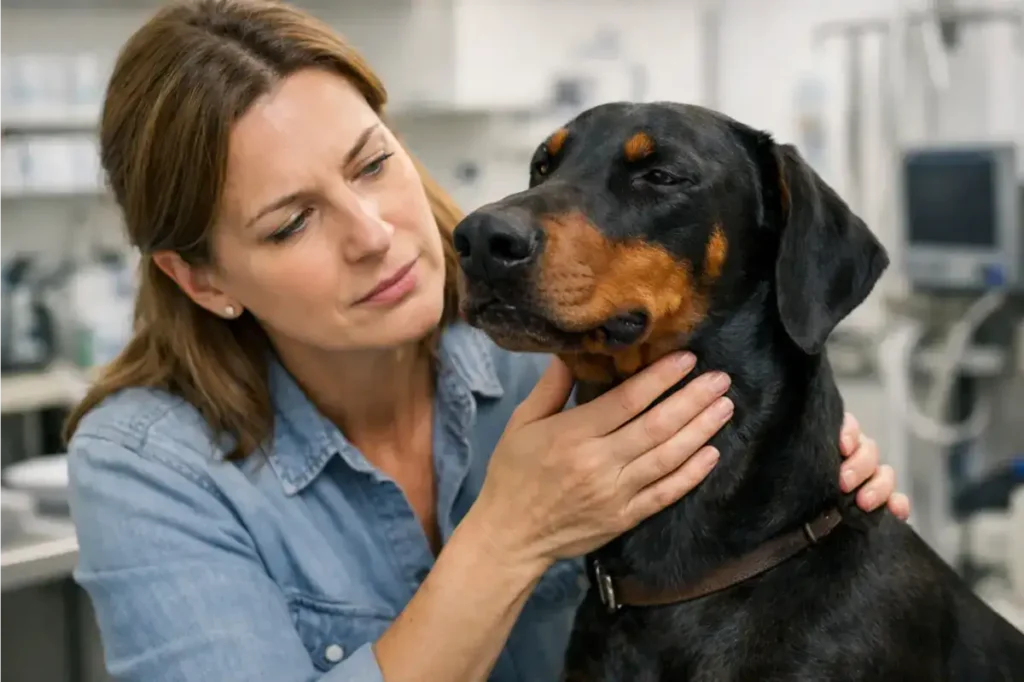
A European study by Wess and colleagues examined 412 Doberman Pinschers across 775 examinations, using echocardiography and 24-hour Holter monitoring. It reported a cumulative prevalence of Doberman cardiomyopathy of 58.2%. That word does work. The study counted the dogs it diagnosed with DCM alongside healthy dogs over seven. The figure describes one study population, not the odds for a single dog. The authors wrote that the prevalence “is very high in Europe” and recommended yearly screening from 2 years of age.
The same 2023 Doberman health-survey analysis reached the same place from a different direction. It found that heart disease accounted for 28% of deaths in the breed, with cancers together accounting for 14%.
What you should not expect is a simple DNA test. The OFA offers a DCM DNA test, but its own page states it is available “for Standard and Giant Schnauzers ONLY”. Doberman DCM genetic tests are sold commercially, and their predictive value varies between populations. A 2026 study looked at Dobermans in Europe and North America. It found that the previously reported PDK4 and TTN associations were not replicated in either population, while a signal near RNF207 was shared by both. Genetic research has found something real; it has not produced a test that tells you whether your dog will develop DCM. Screening still means a Holter and an echo.
If you are buying a puppy, ask for the parents’ cardiac results. If you already own a Doberman, ask your vet when to start screening and how often to repeat it.
Health Screening: What to Ask a Breeder
The AKC lists five recommended health tests from the national breed club. Ask to see the results for both parents, not a promise that they were done.
- Hip evaluation, recorded through the OFA
- Cardiac exam
- Ophthalmologist evaluation
- Thyroid evaluation
- Von Willebrand Disease I (VWDI) DNA test
One question is worth asking on top of the list. How was the cardiac exam done? A breeder who says “the vet listened and it sounded fine” has given you less than a breeder who can show Holter and echo results. The DCM research behind the breed’s own screening advice used both.
The OFA’s CHIC program is a useful reference for what responsible screening looks like. It does not replace the breed club’s list. It shows you the standard other breeders are being measured against.
Buying or Adopting a Doberman
Before you pay a deposit, work through this list.
- Check the parents’ AKC papers for a “Z” designation, and walk away if you find one
- Meet the mother, and see where the puppies were raised
- Ask what the breeder does to socialize the litter
- Ask why they chose this pairing, and listen for health reasons rather than looks
- Confirm the puppy will live indoors with your family
We do not publish a price range for this breed. Puppy prices swing wildly by country, region, and bloodline, and a number quoted on a blog is out of date before it is written. Ask several breeders what they charge, compare what screening they can prove, and treat a very cheap puppy from unscreened parents as the expensive option.
Adoption is the other route. The Doberman Pinscher Club of America runs a rescue network, and the AKC lists rescue groups across the country. Adult Dobermans usually come into rescue for ordinary reasons: a death in the family, a move, a divorce, a home that underestimated the exercise. Rescue groups usually know the dog’s history and can tell you how it lives in a home.
Who a Doberman Suits
Good fit:
- You have owned a large, strong dog before, or you will pay for a trainer
- You are home enough for a dog that wants to be with its people
- You can commit to daily exercise in all weather
- You want a dog that trains, works and participates in family life
- You will screen for heart disease and keep the dog lean
Probably not a fit:
- You want a dog that lives in the yard or spends most of the day alone
- Nobody in the house can physically handle 80 pounds of determined dog
- You want a dog that is friendly with every stranger it meets
- You are not prepared for the cost of cardiac screening
- You want a low-drive companion that is happy with a short daily walk
The blunt version: this is a good family dog for a family that trains it, socializes it, and supervises it. It is a poor choice for a household that wants a dog to manage itself.
Frequently Asked Questions
Is a Doberman the same as a Dobermann?
Yes. Dobermann is the German spelling, and Doberman Pinscher is the name the AKC uses. Both describe the same breed. European kennel clubs generally use Dobermann.
Are Dobermans good for first-time dog owners?
Usually not the easiest first dog. This is a strong, driven animal that learns fast, including the habits you did not want it to learn. A first-time owner can do well with a trainer, a routine, and a plan.
Do Dobermans bark a lot?
The AKC rates the breed’s barking level as medium. Dobermans do alert bark. A bored or under-exercised one will bark more than a settled one.
Are Dobermans hypoallergenic?
No. The coat is short, but the dog still sheds and still produces dander. No breed is truly hypoallergenic, and anyone with a dog allergy should spend time with an adult Doberman before committing.
What is the difference between American and European Dobermans?
They are two breeding populations rather than two breeds. The same 2023 analysis of Doberman health-survey and genomic data identified four major groups, including European exhibition-bred and American exhibition-bred dogs. Levels of inbreeding and genetic diversity differ between those groups, and so do breeding goals. Judge each dog and each breeder on its own.
How long can a Doberman be left alone?
Dobermans do best with company, so keep time alone short, especially for puppies. There’s no magic number of hours; watch how your dog actually copes. Build up absences step by step, and remember that a tiring walk beforehand won’t stop separation distress.
Do Dobermans drool?
Far less than a Mastiff or a Great Dane. Some Dobermans drool a little around food, after drinking, or when they are excited. A dog that suddenly starts drooling heavily needs a vet check.
Do Dobermans get cold easily?
Yes, more than most people expect. The coat is short and single, and lean dogs carry little insulation. In cold weather, shorten the walks and use a coat on an older or thin dog.
At what age is a Doberman fully grown?
Most of the height is in by around a year, then the dog fills out. Large breeds generally keep developing for 18 months or more. Ask your vet about growth and body condition rather than aiming for a weight on a chart.
Do Dobermans get separation anxiety?
Some individuals do, and no breed-level study gives a rate for it. Watch for pacing, howling, destructive chewing at exits, and house soiling that only happens when you leave. That pattern needs a vet or a qualified behaviorist, not a telling-off.
How much do Doberman puppies cost?
Prices vary widely by country, bloodline, and what the breeder has spent on screening, so we do not publish a range. Compare what each breeder can prove, not what they charge. Rescue and adoption cost far less than buying a puppy.
How often should a Doberman see the vet?
At least once a year for a healthy adult, and more often for a senior or a dog with a heart condition. The breed’s own screening research recommends yearly cardiac checks from about 2 years of age.
Are Dobermans easy to house-train?
Usually yes, with consistency. A big puppy has a small bladder, so take it out often and reward what it does outside. Never punish an accident, because it teaches the dog to hide rather than to wait.
Can two Dobermans live together?
Yes, with planning. Two dogs of the same sex can be harder to settle than a mixed pair. Feed them apart, supervise toys and chews, and introduce them on neutral ground before either one lives there.
Are Dobermans good with children?
Yes, with adults supervising. The AKC lists the breed as good with young children, and the same standing caveat applies to every breed on its site. Size is the practical issue, so both the child and the dog need to learn how to handle each other.
Are Dobermans good guard dogs?
The AKC calls the Doberman one of the world’s finest protection breeds. The standard asks for a dog that is watchful and alert, not aggressive or fearful. A guarding instinct is not the same thing as a biting dog, and it needs training either way.
Do Dobermans shed a lot?
Dobermans shed regularly all year, despite the short coat. The hairs are fine, so they cling to fabric and soft furnishings rather than falling in tufts. A rubber grooming mitt or a damp cloth lifts most of it.
Glossary
- Dilated cardiomyopathy (DCM): A heart condition where the lower chambers enlarge, and the muscle pumps weakly. In Dobermans, it is an inherited disease, and it is the breed’s biggest health concern.
- Echocardiogram: An ultrasound scan of the heart. It shows the size of the chambers and how well the muscle contracts, which is how early DCM is found.
- Holter monitor: A small recorder the dog wears for 24 hours to log the heart’s rhythm. Doberman screening uses a Holter because an irregular beat may not show up during a short visit.
- Bloat (GDV): Gastric dilatation and volvulus. The stomach fills with gas and can twist, which cuts off blood flow. It can be fatal within hours without surgery.
- Von Willebrand’s disease (vWD): An inherited clotting disorder that makes bleeding last longer than normal. A DNA test finds the main Doberman variant.
- Albinism, or the “Z” factor: A lack of pigment that leaves a Doberman white or cream with a pink nose and pale eyes. The breed club treats it as a genetic fault, and dogs descended from the first registered albino carry a “Z” on their papers.
How This Guide Was Checked
The size, color, and disqualification details come from the AKC’s official breed standard PDF, not from a breed summary page or a breeder’s listing. The height figures and the recommended health tests come from the AKC breed page. Everything else is credited in the Sources list.
The two lifespans in this guide measure different things, so both are labeled where they are used. The AKC’s 10 to 12 years is a typical range for the breed. The 9.1 years figure is a life expectancy at birth from a survey cohort, and it includes dogs that died young.
The 58.2% cardiomyopathy figure comes from a European study population, not a US one. Averages from one region do not transfer neatly to another, and no study predicts what happens to an individual dog.
The AKC’s breed page gives two different AKC recognition years, 1900 in one place and 1908 in another. Rather than pick one, this guide leaves the recognition year out and gives the origin date and the parent club’s founding year instead.
Sources
- American Kennel Club — Doberman Pinscher breed page (height, weight, life expectancy, health summary, grooming, exercise and training notes, breed traits)
- American Kennel Club — Official Standard of the Doberman Pinscher (approved 1982, reformatted 1990)
- Doberman Pinscher Club of America — breed club home and parent-club information
- Doberman Pinscher Club of America — Policy regarding the albinistic “white” Doberman
- Doberman Pinscher Club of America — The Albino Doberman Pinscher (health effects, the Z list, carrier testing)
- Orthopedic Foundation for Animals — Dilated Cardiomyopathy (condition description, symptoms, test availability)
- Orthopedic Foundation for Animals — Hip Dysplasia
- Orthopedic Foundation for Animals — CHIC program
- Wess G, Schulze A, Butz V, et al. (2010) — Prevalence of dilated cardiomyopathy in Doberman Pinschers in various age groups, Journal of Veterinary Internal Medicine
- Wade CM, Nuttall R, Liu S (2023) — Comprehensive analysis of geographic and breed-purpose influences on genetic diversity and inherited disease risk in the Doberman dog breed, Canine Medicine and Genetics
- US Food and Drug Administration — Investigation into potential link between certain diets and canine dilated cardiomyopathy
- Hulsman AH, Flokstra G, Kijan C, et al. (2026) — A Large-Scale Cross-Population Evaluation of Genetic Risk Variants for Dilated Cardiomyopathy in Dobermanns, Animal Genetics (RNF207 shared signal; PDK4 and TTN not replicated)
- Cornell University, Riney Canine Health Center — Gastric dilatation volvulus (GDV) or “bloat” (gastropexy, recurrence rates)
- Merck Veterinary Manual — Gastric Dilation and Volvulus in Small Animals
- British Veterinary Association — Policy position on the use of aversive training devices in dogs and cats
Medical Disclaimer
This guide is for information only. It is not veterinary advice, and it does not replace an examination. Breed-level figures describe populations, not your dog. If your Doberman shows any of the warning signs above, contact your veterinarian or an emergency clinic. The sources listed were checked in November 2026, and every link was confirmed to load.

Leave a Reply
You must be logged in to post a comment.