
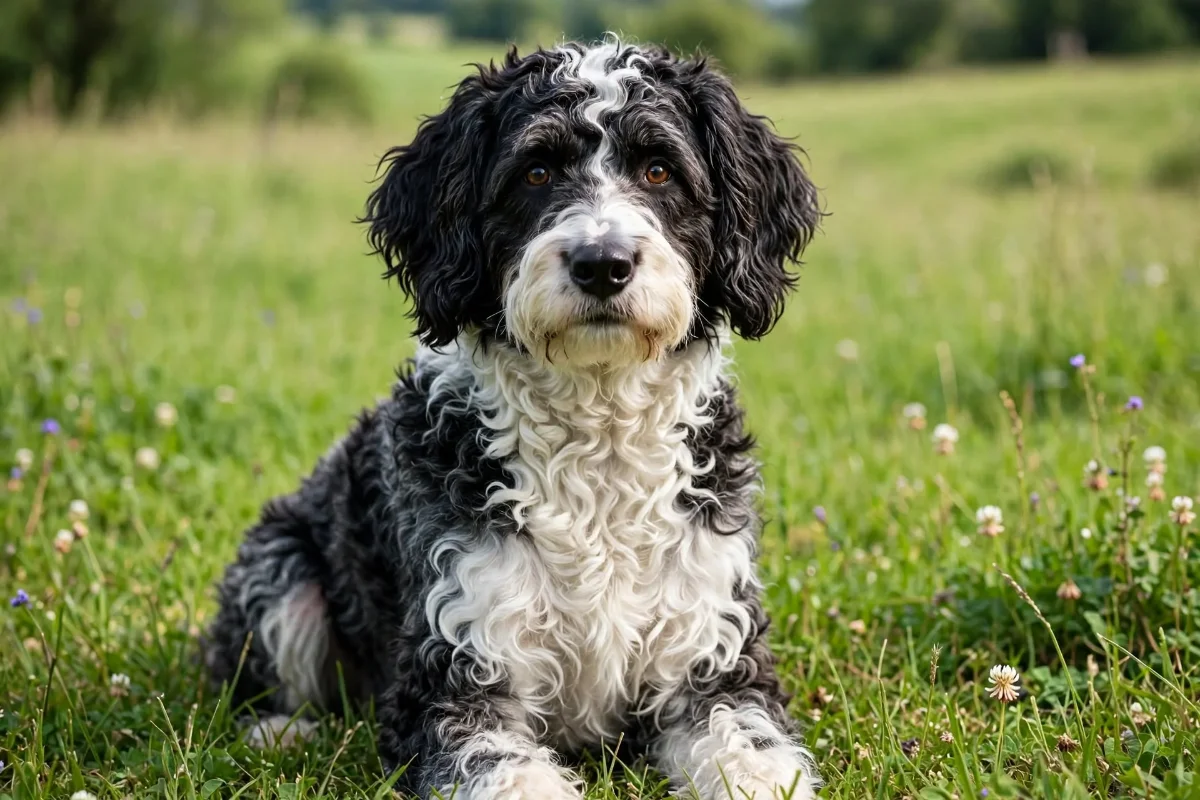
What Is a Bordoodle? Border Collie Poodle Mix Explained
A Bordoodle is a cross between a Border Collie and a Poodle, usually a Standard or Miniature Poodle. This smart, energetic mix can be a great partner for active owners who enjoy training, outdoor days, and daily mental work. Adult size, coat type, shedding, and personality depend on the Poodle parent and on the genes each puppy inherits.
Bordoodles are not a standardized breed, so nobody can predict exactly how a puppy will turn out. This guide covers what to expect from a Border Collie Poodle mix. It walks through size, exercise, grooming, health, lifespan, and cost. It also helps you decide whether one fits your home.
Note: Because this is a mixed breed rather than a standardized breed, individual dogs can differ a lot in appearance, energy level, personality, and health. Most of what follows comes from research on Border Collies and Poodles, not from large studies of Bordoodles themselves.
Key Takeaways
- Dog-to-dog variation is the rule — your Bordoodle may look or behave very differently from another one in the same litter.
- Very high exercise needs — many Bordoodles need around one to two hours of activity and mental work a day.
- Highly trainable — Border Collies and Poodles both score near the top in Stanley Coren’s working and obedience intelligence rankings.
- Often a good fit for active families — especially homes ready for a lot of exercise, training, and mental work.
- Coat care varies — wavy coats shed more but are easier to brush; curly coats need regular professional grooming.
- Budget $1,500–$3,000+ for a healthy U.S. puppy from a responsible breeder, or $300–$800 through adoption (costs vary by country).
Table of Contents
Quick Facts Table
| Feature | Details |
|---|---|
| Parent Breeds | Border Collie × Poodle (Standard or Miniature) |
| Other Names | Border Doodle, Border Collie Doodle |
| Adult Size | About 20–65 lb (10–30 kg). A reported range across Standard and Miniature crosses, not a breed standard. |
| Height | About 14–22 inches. Another reported estimate, not an established measurement. |
| Estimated Lifespan | Around 12–15 years (limited published data for the mix) |
| Coat Types | Wavy to tightly curled. Colors include black, brown, and parti, plus merle patterns. |
| Shedding | Low to moderate, depending on coat type and which parent dominates |
| Energy Level | High to very high |
| Best Suited For | Active households able to provide daily exercise, training and mental work |
What Is a Bordoodle?
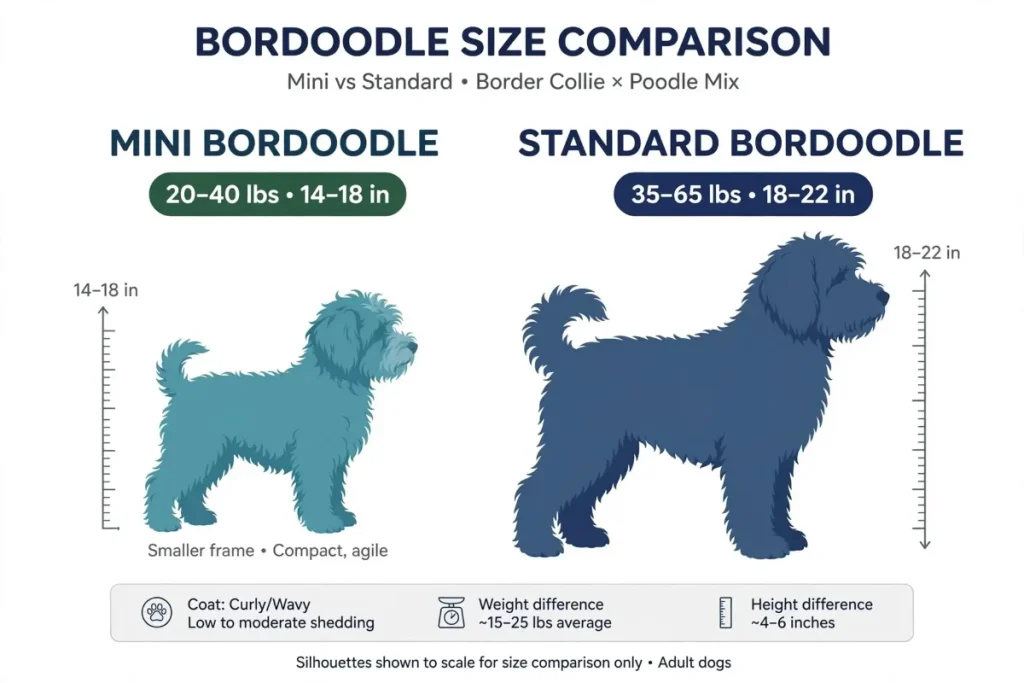
A Bordoodle is a deliberate cross between a Border Collie and a Poodle. Most Bordoodle puppies come from either a Standard Poodle (producing a medium-to-large dog) or a Miniature Poodle (producing a smaller companion). Standard Poodle crosses typically reach 35–65 pounds, while Miniature Poodle crosses land around 20–40 pounds.
The Border Collie was bred in the Scottish Borders centuries ago to herd sheep across rugged terrain. Breeders selected them for stamina, problem-solving ability, and a close bond with the handler. Today, the AKC describes them as “energetic, intelligent, and keen.” That is a fair description of a dog built to think and work alongside people (AKC Border Collie page).
The Poodle, despite its French reputation, likely originated in Germany as a water retriever. The AKC recognizes three Poodle sizes. Standards stand over 15 inches and weigh 40–70 pounds. Miniatures run 10–15 inches and weigh 10–15 pounds. Toys stay under 10 inches and top out around 4–6 pounds. Both Standard and Miniature Poodles are crossed with Border Collies to produce Bordoodles. Toy Poodle crosses do exist, but they are uncommon and produce a much smaller adult.
Generations Explained
- F1 (First Cross): One pure Border Collie and one pure Poodle, usually described as 50% of each. Coat, size, and personality can vary, even among puppies in the same litter. This is the most common generation available.
- F1B (Backcross to Poodle): F1 Bordoodle × Poodle (75% Poodle, 25% Border Collie). Bred to increase the likelihood of a low-shedding, curly coat. May increase the likelihood of a Poodle-like, lower-shedding coat, but coat genetics still vary.
- F1B Reverse Backcross (to Border Collie): F1 Bordoodle × Border Collie (75% Border Collie, 25% Poodle). Less common. May increase the likelihood of stronger herding traits and more shedding. Breeders sometimes use different names for this cross.
- F2 (Second Generation): Two F1 Bordoodles bred together. Traits can vary widely, and puppies in the same F2 litter may look and behave very differently from each other.
Note: Increasing the proportion of Poodle genetics does not guarantee a low-shedding coat. Coat genetics still vary at every generation.
Bordoodle Size and Appearance
A Bordoodle’s looks depend on which Poodle variety was used, the generation, and which parent’s genes show up more strongly in a given dog.
Bordoodles do not have a standardized adult size. A cross with a Miniature Poodle will often be smaller than one with a Standard Poodle, but adult size also depends on the individual parents and what the puppy inherits. The ranges here are broad estimates taken from the parent breeds, not guaranteed outcomes. As a rough guide, a Miniature-cross adult often lands under 40 lb and under 18 inches, and a Standard-cross adult often lands between 35 and 65 lb and 18 to 22 inches. Plenty of dogs fall outside those numbers.
Body and Build
Bordoodles are lean and athletic. They inherit the Border Collie’s sturdy frame combined with the Poodle’s refined bone structure. Some look more like compact Border Collies with curly hair; others take after the Poodle’s square proportions and leggy build. Because this is a mixed breed, adult size and appearance can vary considerably within a single family.
Coat Types
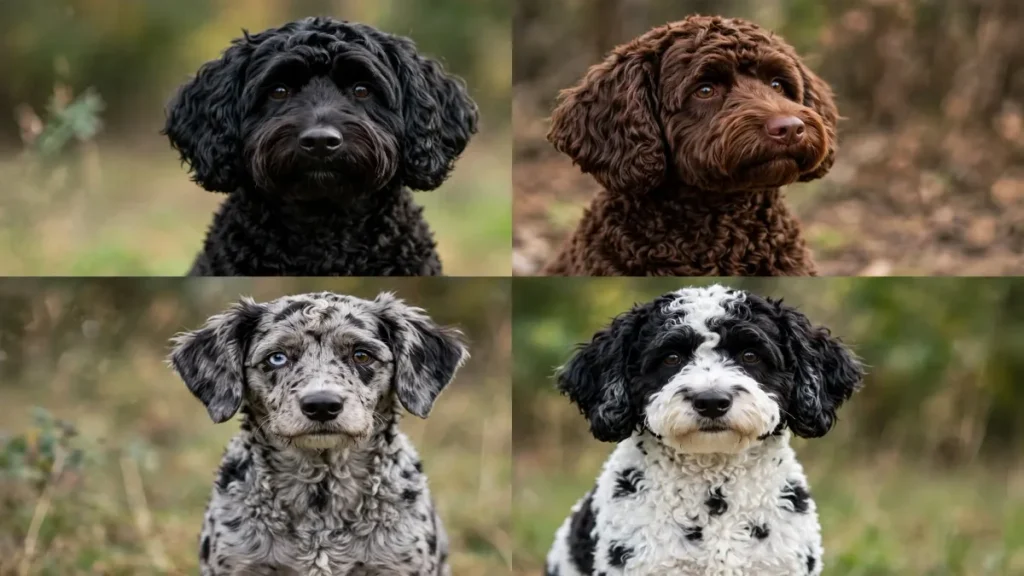
A Bordoodle’s coat ranges from straight and smooth (rare, but possible) to wavy to tightly curled. Wavy coats tend to show more Border Collie influence and will likely shed more than curly-coated dogs. Curly coats tend toward the Poodle side and require regular clipping and brushing to prevent matting.
Colors
Common Bordoodle colors include black, brown, chocolate, red, silver, and parti-color, which means two or more solid colors. Merle can appear when the relevant coat-color genes are present, but do not assume the pattern came from the Poodle side. Ask about both parents’ colors and their genetic testing. Breeding two merles together can produce puppies with two copies of the merle variant, and those dogs have a much higher risk of deafness and eye problems (AKC on merle genetics). One copy usually means a mottled coat. Two copies usually mean a lot of white and a real chance of hearing or vision loss, which is why responsible breeders avoid merle-to-merle pairings.
Ears, Eyes, and Tail
Bordoodles usually carry floppy ears inherited from either parent. Eye color is typically dark brown. Tail length and carriage vary. Some Bordoodles have long tails with a slight plume; others have shorter, straighter tails. There’s no fixed pattern.
Bordoodle Temperament
Both Border Collies and Poodles rank near the top of Stanley Coren’s working and obedience intelligence rankings (AKC smartest breeds list). See our Border Collie intelligence overview for context. That shared intelligence shapes nearly every aspect of a Bordoodle’s personality. It means you get a dog that thinks fast and notices everything.
The traits most commonly seen in Bordoodles include attentiveness, playfulness, loyalty to their family, and responsiveness to positive reinforcement. Many are affectionate with family but more reserved with strangers. Some owners call them velcro dogs. They stay close and want to be part of whatever you are doing.
Personality is shaped by genetics, early socialization, and environment. Your mix may inherit any combination of these traits, and some dogs will lean far more toward one parent than the other. A Bordoodle raised in a calm home with structured activities will express its drive very differently from one left alone in a backyard for hours.
Some Bordoodles are eager workers who thrive on having a job to do. Others pick up the Poodle side and become more playful and less work-focused. Some may develop unwanted behaviors such as pacing, repetitive behaviors or anxiety, particularly when their physical, social, or mental needs aren’t being met.
Are Bordoodles Good Family Dogs?
With children
Well-socialized Bordoodles can be wonderful with older children who can match their energy and respect boundaries. Their herding instinct means younger kids might find themselves being gently corralled, nudged, or stared down. Supervision is important, especially with toddlers. If you have small children, start with a dog whose parents were gentle around kids and start early, careful socialization.
With other dogs
Many Bordoodles can do well with other dogs, particularly when well socialized and introduced appropriately. The Border Collie herding drive can manifest as chasing or circling behavior toward unfamiliar dogs, though positive reinforcement training can redirect this. Early exposure to different dog types helps.
With cats and small pets
Herding instinct may trigger chase behavior toward cats, rabbits, hamsters, or other small animals. Some Bordoodles learn to coexist peacefully with resident cats. Others never fully suppress the urge to herd. Careful, gradual introductions and supervised cohabitation reduce risk, but there’s no guarantee.
For first-time dog owners
Bordoodles may be challenging for many first-time dog owners because of their exercise, training and mental work needs. First-time owners who are prepared to learn about training and meet those needs can still succeed with one.
How Much Exercise Does a Bordoodle Need?
There is no published exercise requirement for Bordoodles alone. Both parent breeds are active working and sporting dogs. Because of that, many adult Bordoodles may need around one to two hours of activity and mental work a day. The right amount varies with age, health, size, personality, and drive.
Border Collies were bred for endurance and worked fields for hours. Poodles, especially Standards, were bred as sporting dogs with substantial stamina. Put those drives together, and you get a dog that wants more activity than most owners anticipate.
Exercise should include both physical and mental components:
- Physical exercise: Running, hiking, brisk walking, fetch, swimming (Poodles love water)
- Mental work: Puzzle toys, scent games, obedience drills, trick training, nose work
- Structured sports: Agility courses, rally obedience, disc dog, flyball, treibball (herding ball)
When a Bordoodle’s needs go unmet, some develop unwanted habits: chewing furniture, barking, pacing, or repetitive chasing. Those behaviors have other possible causes too, including pain and anxiety, so a sudden change is worth a vet visit or a call to a qualified trainer. A steady daily routine prevents most of it, which is cheaper than fixing it later. If your dog struggles with ordinary activity, talk to your vet.
Note: Exercise needs change with age. Puppies benefit from short, frequent sessions rather than long continuous runs, as their growing joints are vulnerable. Senior Bordoodles may still want mental engagement even if physical endurance declines. Ask your vet for age-appropriate guidance.
Training a Bordoodle
Both parent breeds learn new commands quickly. Border Collies can pick up patterns in remarkably few repetitions, and Poodles are nearly as fast. Training is usually rewarding, but Bordoodles can lose interest when sessions become repetitive.
Start early. Begin safe, positive socialization during puppyhood, following your vet’s advice about vaccination and disease risk. Positive exposures during the critical developmental window help your Bordoodle become confident and adaptable.
Use reward-based methods. Bordoodles respond best to rewards: treats, praise, and play. Harsh or inconsistent methods can damage trust and make learning harder, especially with a dog this tuned in to your tone.
Keep sessions short and varied. Ten to fifteen-minute sessions with changing exercises beat a single hour-long drill. Switch between obedience, tricks, scent games, and agility obstacles to keep their minds engaged.
Teach recall and loose-leash walking. A solid recall matters. Even smart dogs can impulse-control their way into trouble outdoors. Loose-leash walking matters because a driven Bordoodle may pull toward movement, such as a bike, a squirrel, or another dog.
Channel herding behavior. Redirect natural herding instincts into structured activities. A Bordoodle that herds your kids around the yard will eventually grow too strong to manage casually. Agility, herding ball, or obedience classes give that drive a proper outlet.
Intelligence does not make training easy. It means the dog needs a plan, because a Bordoodle left to entertain itself will find ways to frustrate you.
See our Border Collie temperament guide for more on how one of the parent breeds approaches training and behavior.
Herding Instinct and Prey Drive
Herding instinct runs deep in Bordoodles. They may circle children, stalk moving objects, or stare intently at anything they perceive as needing “managing.” Chasing can occur too. A dog with strong herding or motion sensitivity may go after bikes, joggers, vehicles, or small animals. Consistent training and management can help redirect this.
Off-leash reliability varies between dogs. Some Bordoodles develop excellent recall through structured training. Others remain driven by motion and may bolt toward movement regardless of commands. Secure fencing matters a lot. A Bordoodle with strong herding or chasing tendencies can slip through gaps or dig under perimeter fences in pursuit of something interesting.
If off-leash freedom is part of your routine, build a solid recall before you let your Bordoodle roam. Secure fencing is the other half of that plan.
Bordoodle Grooming and Shedding
A Bordoodle’s grooming needs depend almost entirely on coat type, which varies from dog to dog, even within the same litter.
Curly Coats
Tightly curled coats generally benefit from brushing several times a week and professional grooming every six to eight weeks to prevent mats and tangles. The coat grows continuously, much like a Poodle’s, so trimming is necessary for hygiene and comfort. Typical grooming costs run $60–$120 per session in the U.S., depending on region and coat condition. At one trim every six to eight weeks, that adds up to roughly $400–$1,000 a year. Those are illustrative U.S. estimates, not local prices.
Wavy Coats
Wavy coats tend to shed more than curly ones but are generally easier to maintain. Weekly brushing with an undercoat rake helps control loose fur during seasonal coat changes. A suitable de-shedding tool may help remove loose hair from some wavier coats.
Additional grooming tasks
Check ears weekly for buildup. Floppy ears trap moisture. Brush teeth regularly to prevent periodontal disease. Trim nails monthly. Clip fur between paw pads for traction and comfort.
Are Bordoodles Hypoallergenic?
No dog is fully hypoallergenic. Bordoodles are often marketed as such because many inherit the Poodle’s low-shedding coat. A curly-coated Bordoodle may produce fewer airborne allergens than heavier-shedding breeds, but results vary. If allergies are a major concern, spend extended time with a specific Bordoodle before committing.
Bordoodle Health Problems
Bordoodles can inherit health issues from either parent breed. Responsible breeders should use the health tests recommended for the relevant parent breeds and breeding lines. The exact tests may vary depending on whether the Poodle parent is Standard or Miniature.
| Condition | Associated Parent Breed | What to Know |
|---|---|---|
| Hip Dysplasia | Both breeds | A joint condition where the hip socket doesn’t fit properly. Both parent breeds carry some risk. Ask for OFA or PennHIP hip scores on both parents (OFA Hip Dysplasia page). |
| Elbow Dysplasia | Both breeds | Abnormal growth in the elbow joint that can lead to arthritis later. Breeders screen with OFA elbow grading on both parents (OFA elbow dysplasia page). |
| Collie Eye Anomaly (CEA) | Border Collie | A congenital eye disorder associated with Border Collies and some related breeds. Ask breeders for DNA testing where available, plus a current eye exam from a board-certified eye specialist (OFA CEA page). |
| Progressive Retinal Atrophy (PRA) | Both breeds | A degenerative eye disease leading to blindness. DNA tests are available for several PRA variants. Ask the breeder which PRA variants matter for the parent breeds, and whether those tests were run (VCA on PRA). |
| Epilepsy (Idiopathic) | Both breeds | Seizure disorder with unknown cause. Epilepsy occurs in Border Collies and Poodles, and there is no definitive DNA screening test for all forms of idiopathic epilepsy. Ask breeders about seizure history in the lineage, since that is the most useful information available (AKC on epilepsy). |
| MDR1 Drug Sensitivity | Border Collie | A genetic variant that changes how some dogs handle certain drugs. It is not universal in Border Collies, so relevance depends on the dog’s line. DNA testing can identify a dog’s status, and results should be discussed with a vet (Cornell on MDR1). |
| Addison’s Disease | Poodle (primarily Standard) | Autoimmune adrenal insufficiency requiring lifelong hormone replacement. Diagnosis requires an ACTH stimulation test. Some Standard Poodle lines show higher prevalence, so ask the breeder about health history in their line (VCA on Addison’s disease). |
| Gastric Dilatation-Volvulus (Bloat) | Larger dogs / deep-chested builds | A life-threatening emergency where the stomach twists. Symptoms include unproductive retching and distended abdomen. Emergency surgery required. Larger, deep-chested dogs may have increased risk of gastric dilatation-volvulus (GDV). Discuss gastropexy (a preventive procedure) with your vet (VCA on GDV). |
Hybrid vigor is the idea that mixed-breed dogs are automatically healthier. The reality is more nuanced than marketing claims suggest. Crossbreeding can reduce recessive disorders concentrated within closed breed populations, but it does not eliminate inherited risks. A Bordoodle can inherit any condition present in either parent line.

Health Testing: What to Ask a Breeder
There is no breed-wide testing standard for a mix, because there is no breed standard. What matters is that the breeder tested both parent dogs for the problems found in their own breeds and lines.
For the Border Collie parent, the AKC lists hip evaluation and an ophthalmologist eye exam among the recommended tests. Extra DNA testing, such as CEA or MDR1, may make sense based on the dog’s family history and line. The AKC herding group health testing requirements are the starting point.
For the Poodle parent, the recommendations depend on the variety. The Poodle Club of America publishes a separate list for Toy, Miniature and Standard Poodles, covering eye exams and PRA testing, with joint screening added where that variety needs it. Standard Poodles also need at least one elective test. Ask the breeder for results that match the parent’s variety and family history, and check the current PCA list before you commit, because these recommendations get revised.
The OFA CHIC program shows which tests each breed club recommends. A CHIC number means the recommended tests were done and the results are public. It does not mean every result came back normal, so read the actual results.
None of these lists is a complete protocol for a mixed breed, so ask for the results that match the actual parent dogs. Two limits are worth knowing. A DNA test only covers the conditions it is designed to detect, so a clear result is not a clean bill of health. And two clear parents still do not guarantee a clear puppy. That is why the breeder’s full records matter more than a single test result.
Regular preventive vet care, health testing of parent dogs, and maintaining a healthy weight all contribute to longevity and quality of life. See our guide on dog lifespan for general principles that apply across breeds.
Bordoodle Lifespan
A reasonable working estimate is around 12–15 years for a Bordoodle. Smaller individuals from Miniature Poodle lines may live toward the longer end of this range. However, there is limited published lifespan data for Bordoodles alone. The estimate is based largely on the reported lifespans of the parent breeds. Border Collies average 12–15 years and Poodles range from 10–18 years depending on size (PetMD Standard Poodle; AKC Border Collie). Maintaining a healthy weight, providing regular exercise, and scheduling annual vet checkups all support a longer, healthier life.
These are population-level estimates, not predictions for your dog. Some Bordoodles live shorter lives due to untreated health conditions. Others exceed expectations.
Bordoodle Puppies
Finding a healthy Bordoodle puppy starts with finding responsible breeders who health-test their parent dogs. Ask breeders to provide documented hip evaluations and a current eye exam from a board-certified eye specialist. Ask for DNA results for conditions such as CEA, PRA, and MDR1. Reputable breeders expose puppies to appropriate experiences (sounds, surfaces, handling) before they go to their new homes. If a breeder hesitates to share paperwork, walk away.
Socializing begins when the puppy goes to its new home. Expose your Bordoodle to varied environments, people, and safe canine interactions during the critical developmental window, following your vet’s advice about disease risk. Handle paws, ears, and mouth routinely so grooming procedures feel normal later.
Growth rate varies considerably depending on the Poodle parent’s size and the puppy’s own genes. Feed a complete and balanced diet formulated for active, growing dogs. Avoid over-exercising growing puppies. Their joints are still developing.
Rescue and adoption are viable options. Search IDOG Rescue, Border Collie rescue networks, and regional Doodle rescue groups. Adult Bordoodles entering rescue often provide the most accurate picture of their mature personality, size, and health history.
How Much Does a Bordoodle Cost?
These are illustrative U.S. estimates, not quotes or local prices. Costs vary by country, breeder, and region.
| Expense Category | Estimated Range |
|---|---|
| Responsible breeder (U.S.) | $1,500–$3,000+ (price varies with health testing performed; costs differ outside the U.S.) |
| Adoption / Rescue | $300–$800 |
| Annual food | $500–$900 (high-quality kibble + treats) |
| Professional grooming | $400–$1,000/year, based on a $60–$120 trim every six to eight weeks (curlier coats cost more) |
| Preventative vet care | $500–$1,000/year (checkups, vaccinations, flea/tick prevention) |
| Training classes | $100–$300 (group obedience, agility basics) |
You can also use our Dog Cost Calculator to estimate ongoing expenses for your specific situation.
Is a Bordoodle Right for You?
A Bordoodle is a good fit if you:
- Have time for roughly one to two hours of daily activity
- Enjoy training and brain games
- Have experience with high-drive, intelligent breeds
- Want a dog that participates actively in outdoor activities
- Can commit to regular grooming, especially if the coat turns curly
- Live in a home with secure fencing or access to safe running areas
- Are comfortable spending $1,500–$3,000+ on a responsibly bred puppy or $300–$800 through adoption
A Bordoodle may NOT be a good fit if you:
- Work long hours away from home and cannot provide companionship
- Prefer a low-energy, couch-only dog
- Lack experience training active breeds
- Cannot afford initial purchase/adoption fees or recurring grooming costs
- Live in a small apartment without a realistic plan for daily exercise and mental work
- Expect a guaranteed “designer” outcome. You may get unpredictable size, coat, or personality
Ask yourself whether you can meet that daily need. An under-stimulated Bordoodle may become frustrated and may develop unwanted behaviors such as destructive chewing, excessive barking or anxiety. The dog isn’t being difficult. It’s asking for something you haven’t provided.
Bordoodle vs Border Collie
| Trait | Bordoodle | Border Collie |
|---|---|---|
| Size | Variable — 20–65 lb (depends on Poodle parent) | Consistent — 30–55 lb |
| Coat | Wavy to curly; low to moderate shedding | Double coat; moderate to heavy shedding |
| Energy Level | High to very high | Very high |
| Trainability | High, but can be strong-willed | Extremely high, highly biddable |
| Health Predictability | Variable (can inherit from either parent) | Known breed-specific risks |
| Appearance Predictability | Low — each dog looks different | High — follows breed standard closely |
| Best For | Owners seeking a potentially lower-shedding Border Collie-type mix | Owners wanting predictable size and coat |
Compare our Border Aussie guide for more on herding mixes. See also our guides on are Border Collies cuddly?
Bordoodle vs Other Doodle and Herding Mixes
| Trait | Bordoodle (BC × Poodle) | Sheepadoodle (OES × Poodle) | Border Aussie (BC × Australian Shepherd) |
|---|---|---|---|
| Typical Weight | 20–65 lb | 40–80 lb | 35–60 lb |
| Energy Level | High to very high | High | Very high |
| Coat Care | Moderate to high (curly = higher) | High (thick, double coat curls) | Moderate to high |
| Herding Instinct | Can be strong | Mild to moderate | Very strong |
Every cross here is variable. The weight and coat notes are rough ranges that depend on the actual parents, not fixed breed values. If you like the herding side, our Shollie guide covers a Border Collie cross with a very different build.
Finding a Bordoodle
Reputable breeders
Look for breeders who perform health testing on both parents, raise puppies indoors with early socialization programs, and welcome visits to meet the mother dog. Ask for documentation. Red flags include breeders who cannot name the health tests performed. Other red flags: refusing a visit, dodging questions about their testing, pushing for fast payment, always having puppies ready, never asking about your home, or letting puppies go too young.
Adoption and rescue
Bordoodles and doodle mixes frequently enter rescue. Try IDOG Rescue (International Designated Obedience Group), search Border Collie rescue networks, and contact regional Doodle rescue organizations. Rescue sites often list adult dogs, meaning you see exactly what you’re getting.
Frequently Asked Questions
Are Bordoodles good for apartment living?
A Bordoodle can live in an apartment if its exercise and mental work needs are met. Many will need around one to two hours of activity and mental work a day. The quality and consistency of exercise matter more than simply having a large home.
Do Bordoodles bark a lot?
They can. Herding breeds vocalize to communicate. Training, managing triggers, and providing sufficient outlets for energy reduce unnecessary barking. Some Bordoodles simply have more to say than others.
Are Bordoodles hypoallergenic?
No dog is fully hypoallergenic. Curly coats may produce fewer airborne allergens, but results vary from dog to dog.
How big do Bordoodles get?
Adult size is hard to predict precisely. Bordoodles come from different Poodle sizes and inherit different mixes of their parents’ traits, so the ranges in this guide are estimates.
Can Bordoodles live with cats?
Many can, especially if introduced early and properly supervised. Herding instinct may trigger chase behavior in some dogs. Never leave a new Bordoodle and cat unsupervised until you are confident their interaction is safe.
Are Bordoodles good with young children?
Well-socialized Bordoodles can be great with older children. Supervision matters with younger kids. Teach children how to interact calmly with dogs to prevent misunderstandings.
How long do Bordoodles live?
Around 12–15 years is the usual estimate for the mix. There is little published data on Bordoodles themselves, so treat it as a rough guide.
Can a Bordoodle be left alone all day?
Some adults learn to cope with shorter stretches alone. This mix is still a poor choice if the dog will be alone most of the day, every day. Build up time alone slowly, and leave the dog something to do while you are out.
How much does a Bordoodle cost?
U.S. breeders charge $1,500–$3,000+; adoption runs $300–$800. Yearly costs come mostly from food, grooming, and vet care. The cost table above breaks those down.
Where can I adopt a Bordoodle?
Start with IDOG Rescue, Border Collie rescue organizations, and regional Doodle rescues. Search “Doodle rescue near me” or check Petfinder.com. Rescue listings typically feature adult dogs, so you get a clearer picture of their personality and size.
What is the difference between an F1 and F1B Bordoodle?
An F1 Bordoodle is a first-generation cross (50% Border Collie, 50% Poodle). An F1B is a backcross: an F1 Bordoodle bred with either a Poodle (75% Poodle) or a Border Collie (75% Border Collie). F1Bs tend toward more predictable coat types, though personality remains variable at every generation.
Are Bordoodles aggressive?
Bordoodles are not generally described as an inherently aggressive mix. However, any dog can develop fear, anxiety, or defensive behavior, and personality varies. Good socialization and training reduce risk across all breeds.
Can Bordoodles participate in dog sports?
Many Bordoodles can thrive in agility, rally obedience, nose work, disc dog and other activities. Their intelligence, athleticism, and willingness to work make them excellent candidates for structured activity.
How much exercise does a Bordoodle need?
There is no published exercise requirement for Bordoodles alone. Many adults may need around one to two hours a day, adjusted to the dog’s age, health, and drive. The exercise section above shows what counts toward that total.
Do Bordoodles shed a lot?
Shedding usually runs from low to moderate. Wavy coats tend to shed more than curly ones. Regular brushing keeps loose hair off your floors either way.
What health problems do Bordoodles have?
The main concerns are hip and elbow dysplasia, inherited eye conditions, epilepsy, Addison’s disease, and bloat in larger dogs. Risk depends on the parents, which is why health testing matters.
Glossary
Collie Eye Anomaly (CEA) — A congenital eye disorder associated with Border Collies and some related breeds. Ask breeders for appropriate DNA testing where available and a current eye examination performed by a board-certified eye specialist.
MDR1 (Multidrug Resistance 1) — A genetic variant that can affect how some dogs respond to certain medications. Border Collies and other herding breeds can carry MDR1 variants. DNA testing can identify a dog’s MDR1 status.
OFA (Orthopedic Foundation for Animals) — An organization that keeps health-screening registries and publishes results for several canine evaluations, including hip and elbow assessments. Read the actual results for each parent rather than relying on a certification label alone.
CAER (Companion Animal Eye Registry) — A vet eye exam program used to screen dogs for inherited eye conditions. Ask breeders for current eye examination results performed by a board-certified eye specialist and recorded through the appropriate registry.
F1 — First-generation cross. A Bordoodle from two purebred parents (50% Border Collie, 50% Poodle). Maximum genetic diversity, highest trait variability.
F1B — A backcross. An F1 Bordoodle bred with either a Poodle (75% Poodle, 25% Border Collie) or a Border Collie (75% Border Collie, 25% Poodle). A Poodle backcross may increase the likelihood of a lower-shedding coat, but coat and personality can still vary.
Merle — A mottled coat pattern caused by a variant in the SILV gene. It appears in some Border Collies and in a few Poodle lines. Puppies that inherit two copies of the variant can have hearing and vision problems, so breeders avoid merle-to-merle pairings.
Sources
- AKC — Border Collie breed page: akc.org/dog-breeds/border-collie — Breed purpose, temperament, and the “energetic, intelligent, and keen” description.
- AKC — Poodle (Standard) breed page: akc.org/dog-breeds/poodle-standard — Poodle history, traits, and lifespan range.
- PetMD — Standard Poodle breed guide: petmd.com/dog/breeds/standard-poodle — Standard Poodle health issues, lifespan, and exercise needs.
- AKC — Smartest breeds of dogs: akc.org/dog-breeds/smartest-dogs — Working and obedience intelligence rankings.
- AKC — Merle in dogs: akc.org/expert-advice/dog-breeding/merle-in-dogs — How the merle variant works, and why double-merle pairings raise the risk of deafness and eye problems.
- OFA — Hip dysplasia: ofa.org/diseases/hip-dysplasia — Screening and grading information for hip dysplasia.
- OFA — Collie eye anomaly: ofa.org/collie-eye-anomaly — CEA description and testing guidance.
- OFA — CHIC program: ofa.org/programs/chic-program — Breed-specific recommended health testing.
- AKC — Herding group health testing requirements: akc.org/breeder-programs/breed-health-testing-requirements/herding-group-health-testing-requirements — National breed club recommended tests for Border Collies.
- Border Collie Society of America — Health overview: bordercolliesocietyofamerica.com/breed-health-overview — Inherited concerns including CEA, PRA, MDR1, and epilepsy.
- Poodle Club of America — Health: poodleclubofamerica.org/health-concerns — Poodle health and screening resources.
- Cornell University Riney Canine Health Center — MDR1 drug sensitivity: vet.cornell.edu/departments-centers-and-institutes/riney-canine-health-center/canine-health-topics/drug-sensitivity-mdr1 — How the MDR1 variant affects drug response in herding breeds.
- VCA Hospitals — Progressive retinal atrophy in dogs: vcahospitals.com/know-your-pet/progressive-retinal-atrophy-in-dogs — Causes, diagnosis, and management of PRA.
- VCA Hospitals — Addison’s disease in dogs: vcahospitals.com/know-your-pet/addisons-disease-in-dogs — Diagnosis and long-term management of Addison’s disease.
- VCA Hospitals — Gastric dilatation and volvulus in dogs: vcahospitals.com/know-your-pet/gastric-dilatation-and-volvulus-in-dogs — Bloat signs and emergency care.
- AKC — Epilepsy in dogs: akc.org/expert-advice/health/epilepsy-in-dogs — Seizure causes, diagnosis, and treatment.
Medical Disclaimer
This guide is for informational purposes only and is not a substitute for professional veterinary advice. Always consult a licensed veterinarian for health concerns about your dog. Individual dogs may present differently from general breed descriptions. See the Sources section for additional reference material.
Leave a Reply
You must be logged in to post a comment.