

The French Bulldog is a small, muscular companion breed with a flat face, upright bat ears, and a playful, people-focused nature. The AKC lists them at 11 to 13 inches tall and under 28 pounds. Breathing trouble, heat, and water are the real risks for this breed, so this guide puts those first.
Key Takeaways
- ✅ Small, quiet, indoor. The AKC tags the breed as good for apartment dwellers and rates its barking “infrequent.”
- ✅ Easy to live with, easy to teach. Frenchies are playful, adaptable, and food-motivated, which makes short training sessions work.
- ⚠️ Breathing is the breed’s main risk. In UK vet records, French Bulldogs had about 31 times the odds of a BOAS diagnosis compared with other dogs.
- ⚠️ Heat, water, and collars. They are poor swimmers, overheat fast, and walk better in a harness than on a neck collar.
- ⚠️ Colors sold as “rare” are disqualifications. The 2018 breed standard rules out merle, blue, liver, solid black, and black and tan.
- ⚠️ Lifespan varies. The AKC gives 10 to 12 years; a 2024 study of UK dogs reported a median of 9.8. Both describe populations, not your dog.
Table of Contents

What Is a French Bulldog?
The French Bulldog is a small companion dog built low to the ground and bred to live close to people. Two features define it: a bat ear the standard requires, and a short, wide skull with heavy wrinkles over the nose.
That skull shape is why so much of this guide is about breathing. The look that makes a Frenchie a Frenchie also narrows the airway, and that affects heat, exercise, and stress for the dog’s whole life.
French Bulldog Quick Facts
| Detail | French Bulldog |
|---|---|
| Height | 11 to 13 inches |
| Weight | Under 28 lb; heavier is a disqualification |
| Life expectancy | 10 to 12 years (AKC); 9.8-year median in a 2024 UK study |
| Coat | Short, smooth, fine |
| Standard colors | White, cream, fawn, in any combination |
| AKC group | Non-Sporting |
| Barking | Listed by the AKC as infrequent |
| Apartment fit | Listed by the AKC as good for apartment dwellers |
French Bulldog History: From England to France
The breed started in England, not France. Lace makers in Nottingham bred a smaller Bulldog as a lap dog, and the breed club’s history calls the result the Toy Bulldog. When the lace trade collapsed, many of those workers crossed the Channel and took their small dogs with them.
In France, the dogs found a new audience. The AKC’s breed history notes that Edgar Degas and Toulouse-Lautrec painted Frenchies into scenes of Parisian life. That is how a small English dog became a French one.
The American chapter began with an argument about ears. The French Bull Dog Club of America formed in 1897 and wrote a standard that allowed only the bat ear. At the 1898 Westminster show, the American breeders found the classes split between bat-eared and rose-eared dogs. The club’s history describes their reaction as outrage. The bat ear won.
The breed nearly vanished anyway. Only 100 Frenchies were registered with the AKC by 1940, and 106 in 1960. In the AKC’s 2025 registration rankings, the French Bulldog held the number one spot for the fourth year running.
Popularity is not the same as suitability. A breed that tops the registry list can still be the wrong dog for a hot apartment and a long workday.
French Bulldog Size, Weight, and Build
The official standard names three hallmarks of the breed: a square head, bat ears, and a roach back, meaning a back that curves upward over the loin. Add heavy bone and a compact body, and you get a dog that weighs more than it looks like it should.
The weight rule is strict. The standard sets the ceiling at 28 pounds and treats anything heavier as a disqualification. It gives no floor.
That ceiling is a show-ring limit, not a target weight. A vet is the right judge of body condition. It matters more in this breed than in most, because extra weight sits on an airway that is already narrow.
The head is broad and square, with a short muzzle, wide nostrils, and loose skin across the nose and brow. That loose skin is part of the look, and it is also where moisture and debris collect.
The chest is wide and set forward of the back legs. That build is why the AKC states plainly that Frenchies cannot swim. A heavy front end, a compact body, and short legs make it hard to keep the head above water.
French Bulldog Colors: Standard and Disqualified
The breed standard is a specific document, approved in 2018, and it treats color quite differently from the “rare color” listings you see for sale.
| Accepted by the standard | Disqualified by the standard |
|---|---|
| White, cream, fawn (light fawn to red fawn), in any combination of those | Solid black, black and tan, black and white, white with black |
| Patterns: brindle, piebald, black masks, black shadings, white markings | Blue, blue fawn, liver, merle |
| Ticking, acceptable but not desired | Any other color or pattern |
The club’s breed-information page summarizes the same rule as brindle, fawn, white, brindle and white, and fawn and white (pied). The two pages describe it differently: the standard treats white, cream, and fawn as the base colors and brindle, piebald, and black masks as patterns. Where they differ, the standard is the document that decides, and it is the one a judge works from.
This matters when you are buying. Sellers charge a premium for “rare blue” or “fluffy merle” Frenchies, and both are disqualifications in a breed ring. The AKC’s merle explainer adds that one merle copy carries a low risk of deafness. Two copies greatly raise the chance of deafness and small, nonfunctional eyes. Merle-to-merle breeding is what produces those dogs, and it is the pairing responsible breeders avoid.
An off-standard dog can still be a fine pet. The point is that the color is a price story, not a health or quality signal. Judge the breeder by the test results on both parents.

French Bulldog Temperament: Personality and Trainability
The AKC’s own breed traits describe the French Bulldog as smart, adaptable, and playful, and list it as a good family dog and good with children. Like most small breeds, Frenchies do best with adults who supervise and children who handle them gently. The AKC also lists the breed as good with other dogs when an adult supervises.
Quiet is not the same as silent. Most Frenchies bark little, but they snore, snort, and grunt, and labored breathing should never be waved off as part of the breed’s personality.
The stubborn label is half true. The breed club is blunt about it: most Frenchies “strive to please their owners and are therefore very trainable with the proper motivation (usually food).” Short sessions, food rewards, and repetition work. Long drilling sessions do not.
Frenchies are also social to the point of being clingy. They were bred to sit with people, and many follow their owner from room to room. That makes them warm company and makes being alone harder. Read our guide on whether French Bulldogs can be left alone before you plan around a full workday.
Training is a matter of repetition, not force. Our 12-week Frenchie training schedule lays out what to teach and when. For families, the deciding factor is usually the children’s ages rather than the dog’s. Our guide to the French Bulldog as a family dog covers supervision and toddler safety.
Are French Bulldogs Good Apartment Dogs?
Yes. This is one of the breed’s real strengths. The AKC lists the French Bulldog as good for apartment dwellers; the dog is small, and it does not need a yard.
Two apartment problems come with the breed. Upper-floor apartments get warm, and a Frenchie cannot shed heat the way a long-nosed dog can. Stairs may be hard for a Frenchie with spinal, joint, or breathing problems. Watch how comfortably your dog manages them, especially as it gets older.
Noise is rarely the issue. Neighbors are more likely to hear a snore through a wall than a bark.

Exercise: Short, Cool, and Never Flat Out
French Bulldogs generally need moderate daily activity rather than long or strenuous exercise. Their breathing, fitness, age, and the weather decide how much they can safely manage. Two short walks a day plus indoor play suits most adults. Timing matters more than distance: early morning and late evening in summer, never the middle of a hot afternoon.
No single minute count fits every Frenchie. The gap between a dog with clear airways and a dog with severe BOAS is bigger than any breed average can capture. Watch for noisy breathing, a fast breathing rate that will not settle, heavy panting, or a dog that stops on the walk. Any of those means turn back.
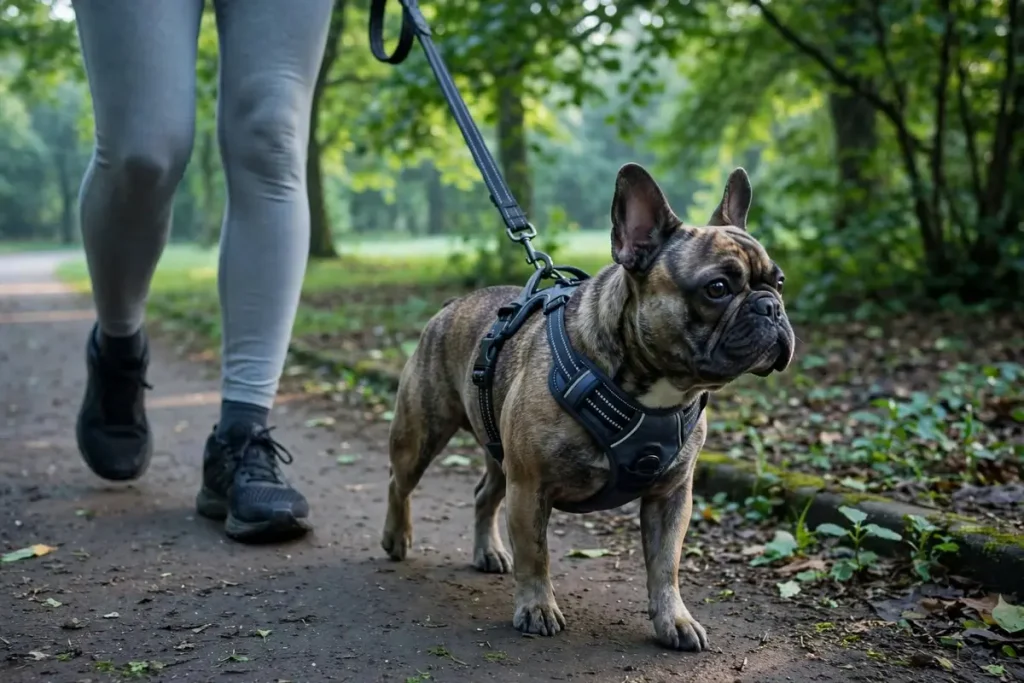
Cornell’s veterinary team lists controlled activity, a healthy weight, and a harness instead of a neck collar. Those are the basic steps for managing a dog with airway disease.
On collars, the evidence is narrower than the advice suggests. A 2025 study recruited 24 dogs and analysed 20 of them, half of them flat-faced. It found no significant difference in breathing rate between a collar and a harness during exercise. It did find that a collar raised pressure inside the eye, including in flat-faced dogs at rest, and a harness did not. The study was small and did not test whether either one prevents breathing problems. A well-fitted harness still makes sense for a Frenchie. Ask your vet if your dog struggles with ordinary activity.
Heat, Water, and Breathing Risks
Brachycephalic obstructive airway syndrome, or BOAS, is the central health issue in this breed. The short skull packs the same soft tissue into less space. The nostrils are narrow, the soft palate is often too long for the mouth, and both block airflow.
Cornell names the parts. Stenotic nares are small nostrils that can collapse on the in-breath. An elongated soft palate blocks airflow into the larynx, and everted laryngeal saccules get pulled into the airway. A dog can have one of these or all of them, and severity ranges from a mild snuffle to collapse.
That anatomy drives three rules.
- Keep the dog cool. Frenchies do badly in heat and humidity. The French Bull Dog Club of America’s guidance is direct: above roughly 70°F, air conditioning in the house and the car is a must, not a luxury.
- Keep the dog out of deep water. A Frenchie cannot swim. Pools, ponds, and bathtubs are drowning risks, and a life jacket only helps so much.
- Keep the dog lean. The breed club warns that an obese Frenchie faces far higher risk from the breed’s other health problems. Extra weight sits on an airway that is already narrow.
Snoring and noisy breathing are common in the breed, and common is not the same as normal. The breed club’s own advice is to have the airway checked if a dog overheats easily or spits up foam when stressed. Cornell adds that surgery works better when it happens early, ideally before age two, and that a specialist consultation is worth having.

Grooming: Wrinkles, Ears, and Shedding
The coat is short and smooth, so grooming is quick. The wrinkles are the part people skip.
- Face folds. Wipe and dry the deep folds across the nose and brow regularly. Trapped moisture leads to skin fold dermatitis, one of the conditions UK vet data links to the breed.
- Ears. Check and clean them regularly. Ear discharge showed up about 14 times more often in Frenchies than in other dogs in the same study.
- Nails. Trim them on a routine. The breed club calls regular nail trimming a must, since many dogs never wear their nails down by running.
- Bathing. Bathe when the dog is dirty or when your vet advises it. There is no single schedule that fits every dog.
- Teeth. The breed club advises regular dental checkups and brushing at home.
- Shedding. The AKC lists the breed as shedding regularly. Short hair, but it does come out. Our guide to whether French Bulldogs shed covers tools and expectations.
If you sneeze around dogs, check this before you assume the breed is safe for you: French Bulldogs are not hypoallergenic.

Feeding a Frenchie
Feed a complete and balanced diet suited to your dog’s age, weight, and activity level, and measure the portion rather than free-feeding. Preventing obesity is the most useful thing you can do for this breed, because every extra pound works against an airway that is already narrow.
There is no fixed calorie number for the breed, and no protein percentage that suits every Frenchie. Ask your vet for a target weight and a portion size, then recheck both as the dog matures.
Flat-faced dogs gulp air when they eat fast, so a slow feeder or a few small meals can help. The breed club also warns against rawhide chews, because softened rawhide can lodge in a Frenchie’s throat.
Before you choose a grain-free diet, talk it through with your vet. The FDA has investigated a possible association between certain diets and a heart condition called DCM. Many of the reported diets were grain-free and listed peas, lentils, or potatoes among their main ingredients. The relationship is not fully understood, and this is not a verdict against every grain-free food.

Health Problems in French Bulldogs
French Bulldogs have several well-documented health problems, and research comparing them with other dogs in UK veterinary practices found especially high odds of certain respiratory, skin, ear, and reproductive disorders. A VetCompass study compared Frenchies in UK primary-care practice with all other dogs and found sharply higher odds for a short list of disorders.
Breathing and Airway Problems
| Condition | Odds in French Bulldogs versus other dogs |
|---|---|
| Stenotic nares (pinched nostrils) | About 42 times higher |
| BOAS (airway obstruction) | About 31 times higher |
| Ear discharge | About 14 times higher |
| Skin fold dermatitis | About 11 times higher |
| Dystocia (difficult birth) | About 9 times higher |
Those figures come from one study of UK dogs. They compare recorded diagnoses, and they describe the breed rather than your dog. An individual Frenchie may have none of these problems. The odds are high enough to take seriously. Look for a breeder who screens for them, can show documented results, and is open about health problems in the lines behind the litter.
Other Conditions Reported in the Breed
- Spine problems. Hemivertebrae and vertebral kyphosis are reported in the breed and cited by the same study, though it produced no odds figure for them.
- Eye conditions. The AKC names cherry eye, juvenile cataracts, and entropion. Blue or green eyes, or any trace of either, are a disqualification in the standard.
- Joints. Patellar luxation is a kneecap that slips out of its groove, and it is one of the four conditions the breed club screens for.
- Skin. The same study put allergic skin disorder at about 7.7 times the odds of other dogs, and food hypersensitivity at about 7 times. The AKC adds that autoimmune skin disorders also occur in the breed.
When to Call a Vet
Most of what follows is manageable when it is caught early. These are the signs that should not wait for a routine visit.
| Warning sign | What to do |
|---|---|
| Noisy or labored breathing | Book a veterinary assessment |
| Blue or pale gums, or collapse | Emergency care, immediately |
| Red, moist, or smelly facial folds | Have the skin checked, then follow the cleaning routine |
| Head shaking or ear discharge | Book an ear examination |
| Back pain, weakness, or trouble walking | Prompt veterinary attention |
| Squinting or a painful-looking eye | Urgent assessment |
Health Screening: What the Breed Club Recommends
The AKC lists four recommended tests for the breed, drawn from the national breed club:
- Patella evaluation
- Hip evaluation
- Cardiac exam
- Ophthalmologist evaluation
Ask for the results, not the paperwork. A dog can hold a CHIC number and still have an abnormal finding, because CHIC records that the tests were done and published, not that they came back clear. Screening lowers risk. It does not guarantee that a puppy will never develop a problem.
Respiratory Function Grading: The Check the Four Tests Miss
None of those four tests assesses breathing. The Royal Kennel Club, with the University of Cambridge, runs a separate Respiratory Function Grading Scheme for Bulldogs, French Bulldogs, and Pugs. An approved assessor listens to the dog at rest and again after a three-minute walk at a quick pace, then gives a grade.
- Grade 0: clinically unaffected and free of respiratory signs of BOAS.
- Grade 1: clinically unaffected, but with some respiratory noise that does not affect exercise performance.
- Grade 2: clinically affected, with moderate respiratory signs that should be monitored and may need treatment.
- Grade 3: clinically affected, with severe respiratory signs that need a full veterinary examination and treatment.
Dogs can be assessed from 12 months old, and the scheme asks for a repeat every two years, because BOAS can develop later in life.
Ask whether both parents have current grades. A low grade is a good sign, but it does not promise a puppy will stay free of airway problems.
The scheme uses specially trained assessors and a standardised grading process, so a routine health check is not a substitute for it. If you live where the scheme does not operate, ask your vet about a formal BOAS assessment and whether a recognized screening program exists locally.
Dystocia deserves its own question. Difficult births are far more common in this breed than in most, and the FAQ below explains what the study measured.
How Long Do French Bulldogs Live?
The AKC gives the breed a life expectancy of 10 to 12 years. A 2024 study in Scientific Reports looked at 584,734 UK dogs. It put the French Bulldog’s median lifespan at 9.8 years, with a hazard ratio of 2.2 against the crossbreed baseline.
Both figures describe different things. The AKC gives a breed range; the 9.8 years is the median in a UK population study. Half the dogs in that population died before that age and half lived longer. The study also found a higher hazard of death than in crossbred dogs. Neither figure predicts how long an individual dog will live.
For planning, the median is the more useful number. Our French Bulldog lifespan guide works through the study data breed by breed, and covers what changes for a senior.
Buying or Adopting a French Bulldog
What matters is the evidence behind the puppy, not the price tag or the color.
- Ask for OFA hip and patella results, cardiac and eye examination reports, and current respiratory function grades for both parents where the scheme is available.
- Ask what happens to a dog the breeder cannot place. A breeder with a waiting list and a return policy behaves differently from one with a website.
- Ask to see the dam with the litter, and watch her breathing at rest. Also ask for her respiratory grade: a dog that looks comfortable sitting still can still have a serious airway problem under exercise.
- Walk away from any listing that prices merle or blue as “rare” with no health testing behind it.
How Much Does a French Bulldog Cost?
Prices swing too widely by region, bloodline, and color fad for any figure to be honest, so this page does not quote one. A higher price is not a health guarantee, and a “rare color” premium buys a disqualification rather than a better dog.
Budget for the parts that are predictable: insurance or savings for airway and eye care, a vet who knows flat-faced breeds, cooling for summer, and a harness instead of a collar. Our dog cost calculator turns those into a yearly number.
Adoption is a real route for this breed. Rescue groups rehome Frenchies of every age, and an adult dog may give you a clearer picture of its size, personality, and everyday behavior. It does not guarantee a healthy airway: ask the rescue for veterinary records, any breathing assessments, and how the dog behaves at home. See the French Bulldog Rescue Network for listings.
If you are still deciding between breeds, the dog breed quiz is the shorter route than reading ten profiles.
Who a French Bulldog Suits
Good fit if: you want a small, sociable dog that lives indoors. You are home most of the day. You can keep the house cool in summer. You are ready for the vet costs that come with a flat-faced breed.
Probably not if: you want a running partner. You live somewhere hot without cooling. You are out of the house for ten hours a day. You want a dog that can swim and hike in July.
If you are choosing between the two flat-faced companion breeds, start with the French Bulldog vs Pug comparison. For the longer version of this decision, read whether a French Bulldog is right for you.
Frequently Asked Questions
How big does a French Bulldog get?
Adults stand 11 to 13 inches tall and weigh under 28 pounds. The standard makes anything over 28 pounds a disqualification, and it sets no minimum weight.
Can French Bulldogs live in hot climates?
They struggle. A Frenchie cannot cool itself efficiently, and the breed club calls air conditioning a must above roughly 70°F. If you live somewhere hot, indoor cooling and early-morning walks are not optional.
Do French Bulldogs bark a lot?
No. The AKC rates the breed’s barking level as infrequent. A Frenchie may bark at a doorbell or a stranger, but most are quiet most of the time.
How much exercise does a French Bulldog need?
French Bulldogs generally need moderate daily activity rather than long or strenuous exercise. Two short walks plus indoor play may suit many adults, but the right amount depends on breathing ability, fitness, age, and weather. There is no universal minute count, because dogs with airway disease need less than dogs with clear breathing.
Can French Bulldogs swim?
No. A heavy front end, a compact body, and short legs make it hard for a Frenchie to keep its head above water, and the AKC states plainly that the breed cannot swim. Never leave one unattended near a tub, pool, or body of water.
Do French Bulldogs shed?
Yes. The AKC lists the breed as shedding regularly, and the hair is short enough to be easy to manage but not absent. This is not a low-shedding breed.
Are French Bulldogs hypoallergenic?
No. No dog breed is truly hypoallergenic, and Frenchies shed dander like any other breed. If you react to dogs, spend time with an adult Frenchie before you buy a puppy.
What is the biggest health concern in French Bulldogs?
Airway disease. Narrow nostrils and BOAS are the breed’s defining risks, at roughly 42 and 31 times the odds of other dogs in UK vet data. These are relative odds, not a ranking of how many Frenchies get each problem. Skin folds, ear discharge, and difficult births are next on the study’s list.
Can French Bulldogs be left alone?
Short periods are fine for many adults, but the breed is strongly people-focused. Puppies and dogs with separation distress need a gradual plan rather than a sudden full workday alone.
Are French Bulldogs good with kids?
The breed is listed by the AKC as good with children, and many Frenchies are gentle and tolerant. Small children should always be supervised, and no dog should be left alone with a toddler.
Are French Bulldogs good for first-time owners?
Often, yes. The breed is small, adaptable, and motivated by food, which makes basic training manageable. The harder part is medical rather than behavioral: you need a vet who knows flat-faced breeds and a budget for it.
What colors are not allowed in French Bulldogs?
Solid black, black and tan, black and white, white with black, blue, blue fawn, liver, and merle are all disqualifications in the 2018 standard. Breeders still sell them, usually at a premium.
Are French Bulldogs easy to train?
They are trainable, not effortless. The breed club notes most Frenchies work well for food rewards and want to please. Keep sessions short and consistent, and plan on repetition.
Are French Bulldogs at risk of difficult births?
Yes, they have a higher risk. Dystocia showed up at about nine times the odds of other dogs in UK vet data. Studies like that record difficult births, not how many end in surgery, so ask a breeder how they plan for a difficult whelping.
Can French Bulldogs breathe normally?
Many live comfortably, but the skull shape predisposes the breed to airway obstruction, and noisy breathing is the sign to watch. Persistent snoring, snorting, gagging, or difficulty recovering after ordinary activity can be signs of BOAS. Have a vet assess them rather than treating them as normal for the breed.
Do French Bulldogs get cold?
Yes. The breed club advises supervising Frenchies in both high and low temperatures, and names shivering as a sign of too much cold. A short coat and low body fat give them little insulation.
Are French Bulldogs healthy?
Not especially. The breed has well-documented risks around breathing, skin folds, ears, eyes, spine, and birth. That does not make a Frenchie a bad choice. It does mean health testing, savings or insurance, and a vet who knows the breed matter more than with a hardier dog.
Glossary
- Brachycephalic: a short-headed, flat-faced skull shape. Brachycephalic breeds include French Bulldogs, Pugs, and Bulldogs.
- BOAS: brachycephalic obstructive airway syndrome, the airflow blockage caused by narrow nostrils, a long soft palate, and related tissue changes.
- Stenotic nares: nostrils that are too narrow, sometimes collapsing inward on the in-breath.
- Hemivertebrae: wedge-shaped spinal bones that can cause a curved spine, called kyphosis, and in some dogs press on the spinal cord.
- Dystocia: a difficult or blocked birth. It is more common in flat-faced, large-headed breeds.
- Patellar luxation: a kneecap that slips out of its groove, common in small breeds.
- CHIC: the OFA’s Canine Health Information Center number. It means the required tests were done and published, not that the results were normal.
How This Guide Was Checked
Registry figures come from the AKC breed page and the 2018 official standard, read directly rather than copied from another article. Disease odds come from a VetCompass study of UK primary-care records. Lifespan medians come from the 2024 Scientific Reports study. Where two sources disagree, as the AKC range and the UK median do, this page gives both and says which is which. The AKC figures come from US breed records; the disease odds and the lifespan median come from UK veterinary data, and they describe dogs in that system rather than a US population.
Sources
- American Kennel Club — French Bulldog breed page (height, weight, life expectancy, temperament tags, recommended health tests)
- Official Standard of the French Bulldog (2018; weight disqualification, colors, eye color, coat)
- American Kennel Club — Most Popular Dog Breeds (number one ranking, four years running)
- French Bull Dog Club of America — Breed Information (color summary, swimming and water safety, heat, feeding, training)
- French Bull Dog Club of America — Breed History (1897 club formation, 1898 bat-ear dispute, 100 dogs registered by 1940)
- The Royal Kennel Club — French Bulldog breed profile (Toy Bulldog origins and the breed’s Paris years)
- The Royal Kennel Club — Respiratory Function Grading Scheme (grades 0 to 3, assessment from 12 months, repeat every two years)
- Cornell Riney Canine Health Center — Brachycephalic Obstructive Airway Syndrome (airway components, management, surgery timing)
- Teng et al. — “French Bulldogs differ to other dogs in the UK in propensity for many common disorders: a VetCompass study” (odds ratios for BOAS, stenotic nares, ear discharge, skin fold dermatitis, dystocia)
- McMillan et al. (2024) — “Longevity of companion dog breeds”, Scientific Reports (median lifespan 9.8 years, hazard ratio 2.2)
- American Kennel Club — Merle in Dogs (single-copy versus double-merle deafness and eye risk)
- Orthopedic Foundation for Animals — CHIC Program (what a CHIC number does and does not mean)
- U.S. Food and Drug Administration — Investigation into diets and canine DCM
- Bailey et al. (2025) — “Effect of a Collar and Harness on Intraocular Pressure and Respiration Rate of Brachycephalic and Dolichocephalic Dogs”, Veterinary Medicine and Science (20 dogs; no breathing-rate difference between collar and harness, collar raised eye pressure)
Medical Disclaimer
This guide is for information only and is not a substitute for veterinary advice. French Bulldogs have breed-specific risks that a vet needs to assess in person. If your dog struggles to breathe, overheats, or collapses, contact a veterinarian immediately.

Leave a Reply
You must be logged in to post a comment.