

French Bulldog vs Pug
French Bulldogs and Pugs are both small, flat-faced companion breeds with huge personalities, but they differ in key ways. French Bulldogs are generally more playful and independent. Pugs are usually more relaxed and eager to please. Pugs generally cost less to buy and may have lower routine and insurance costs. Both breeds are brachycephalic, so breathing and heat-related problems are a real concern with either one.
You want a small, snorty, lovable companion. A dog that fits in your lap, your apartment, and your heart. Both breeds fit that picture.
The French Bulldog has been the most popular dog breed in the U.S. according to AKC registration statistics for four consecutive years, including 2025. The Pug has been a popular companion breed for centuries
This guide compares the two breeds on size, temperament, training, health, lifespan, grooming, and cost.
Key Takeaways
- ✅ Similar size, different build. French Bulldogs are heavier and more muscular. Pugs are lighter and more compact.
- ✅ Pugs are generally easier to train. They tend to be more food-motivated and eager to please. French Bulldogs can be more independent.
- ✅ Pugs have a longer median lifespan. A 2024 study found a median of 11.6 years for Pugs versus 9.8 years for French Bulldogs.
- ⚠️ Both breeds are brachycephalic (flat-faced), which can cause breathing trouble and heat intolerance.
- ⚠️ French Bulldogs usually cost more to buy, insure, and treat.
- ⚠️ Pugs shed heavily despite their short coat. French Bulldogs generally shed less.
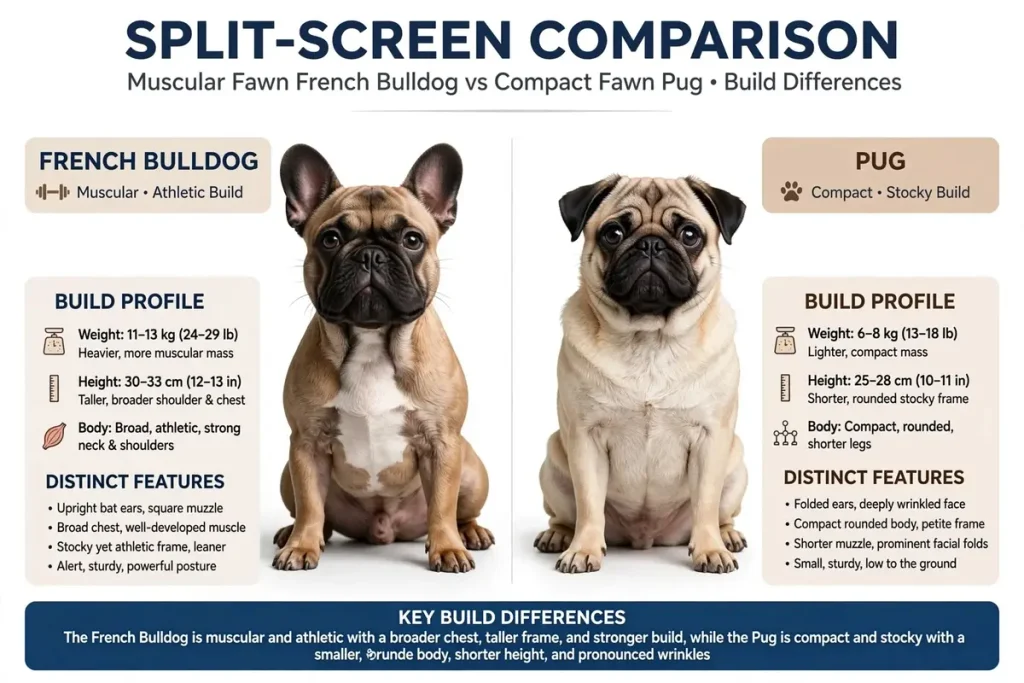
Table of Contents
The Biggest Difference: Health Comes First
The biggest difference between these breeds isn’t appearance or personality. It’s how their health risks affect everyday life.
Both are brachycephalic, so both can have breathing problems and trouble handling heat. French Bulldogs have particularly important concerns involving breathing, skin, and reproduction. Pugs also face significant breathing risks, along with eye and neurological problems.
If you are choosing between them, look past purchase price and temperament. Ask breeders for health-testing records. Think about the possible lifetime cost of vet care. Brachycephalic dogs are not a low-cost, low-maintenance choice, whichever one you pick.
Breed History: Where French Bulldogs and Pugs Came From
Knowing where these dogs came from explains a lot about how they behave today.
French Bulldog: The breed grew out of English Bulldogs, but the small ones. Lace workers in Nottingham kept toy-sized Bulldogs and took them to France during the Industrial Revolution. Parisians fell for the bat ears, and the breed took off. French Bulldogs became city dogs from day one, bred for companionship rather than work.
Today, French Bulldogs are primarily companion dogs and are well suited to indoor living. Their brachycephalic head shape is also associated with airway problems such as BOAS.
Pug: The Pug is much older. The breed traces back to ancient China, where short-nosed dogs were kept by emperors. Traders brought them to Europe in the 1500s. Dutch and British royalty adored them, and the Pug became a fixture of court life.
Centuries of living indoors shaped the Pug into a lap dog. Pugs generally enjoy close human companionship and often prefer being near their owners.
Appearance: Key Physical Differences
At a glance, these breeds look alike: flat faces, small bodies, wrinkly skin.
The differences are clear once you know what to look for.
| Feature | French Bulldog | Pug |
|---|---|---|
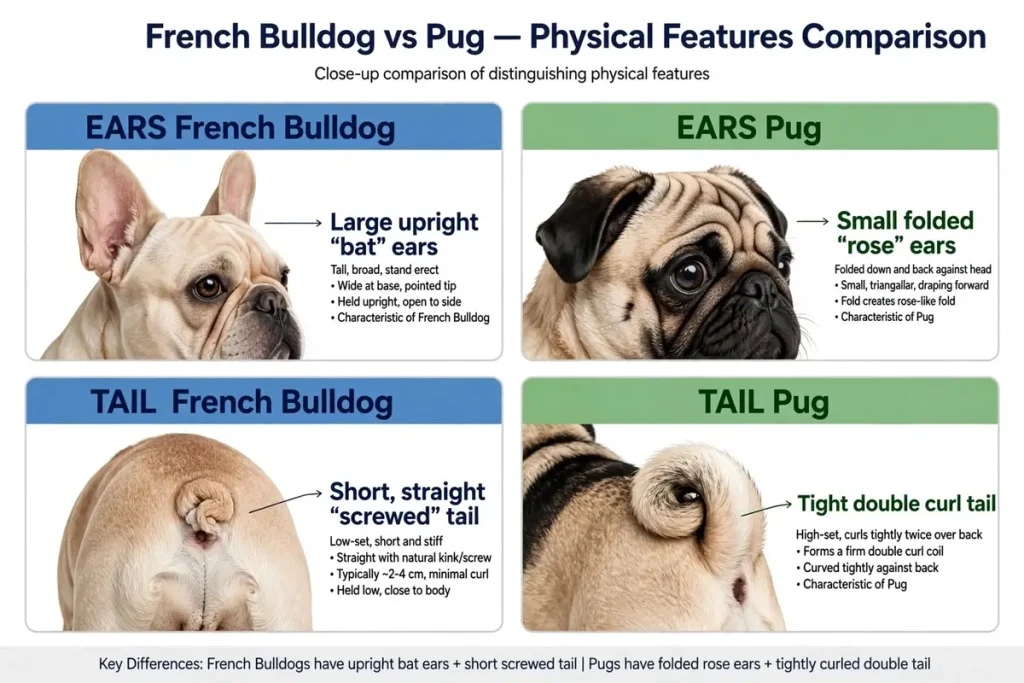
| Ears | Large, upright “bat ears” | Small, folded “rose ears” |
| Head | Square, broad skull | Round, dome-shaped skull |
| Muzzle | Very short and wide | Extremely short, pushed in |
| Body | Stocky and muscular | Compact and cobby |
| Tail | Naturally short, straight or screwed | Curled tightly over the back |
| Coat colors | Brindle, fawn, white, pied | Fawn, black, apricot, silver |
| AKC group | Non-Sporting | Toy |
The ears are the biggest giveaway. French Bulldogs have those famous bat ears: large, upright, and rounded at the tips. Pugs have small rose ears that fold flat against the head.
The tail is the next clue. French Bulldogs have short tails that are straight or slightly screwed. A Pug’s double-curl tail sits tight over the back.
Size Comparison: Height, Weight & Build
| Metric | French Bulldog | Pug |
|---|---|---|
| Height | About 28–33 cm (11–13 in) | About 25–33 cm (10–13 in) |
| Weight (male) | About 10–15 kg (22–33 lbs) | About 6–10 kg (13–22 lbs) |
| Weight (female) | About 9–13 kg (20–28 lbs) | About 6–9 kg (13–20 lbs) |
| Build | Stocky, broad chest | Compact, square |
French Bulldogs are heavier and more muscular, with a broad chest. Pugs are lighter and more square. A Frenchie feels dense when you pick them up, and a Pug feels like a sturdy little loaf.
Temperament: Personality Showdown
The two breeds are more different than their looks suggest.
French Bulldog: The AKC lists this breed as adaptable, playful, and smart. Frenchies have a clownish streak and love to show off. They also have an independent side.
That independence shows up in training. French Bulldogs can be independent during training, so consistent positive reinforcement is important.
Pug: The AKC calls the Pug charming, mischievous, and loving. The Royal Kennel Club breed standard describes an “even tempered, happy and lively disposition.”
Pugs live to be with their people. They are natural clowns with famously expressive faces. They tend to be less stubborn than French Bulldogs and more eager to please.
Pugs are also sensitive to harsh handling. They shut down if you are rough with them, so gentle guidance works far better.
Temperament comparison: Pugs may be more responsive to training because they want to please. French Bulldogs may suit you better if you want a more independent, playful dog.
Energy Levels & Exercise Needs
Both breeds have modest exercise needs. Neither is suited to long, strenuous exercise.
French Bulldog: Short walks and play sessions are usually more appropriate than intense exercise. Adjust the amount for your dog’s age, fitness, body condition, and breathing ability. Tolerance varies a lot between dogs, especially those with BOAS. Ask your vet if your dog struggles with ordinary activity.
One safety note: French Bulldogs are poor swimmers and can struggle to keep their heads above water because of their body shape. Never assume a Frenchie can swim safely. Never allow a French Bulldog near water without close supervision and appropriate flotation support.
Pug: The same guidance applies. Gentle walks and indoor play suit this breed better than long outings. Adjust for age, weight, and breathing.
Pugs overheat easily, as do all flat-faced breeds. Keep exercise gentle in warm weather. The AKC notes that flat-faced dogs are at higher risk of heatstroke.
Exercise comparison: Neither breed needs a lot of exercise. Pugs tend to be lower-energy indoors, while French Bulldogs tend to stay playful and active for longer.
Trainability: Which Is Easier?
French Bulldog: Training takes patience. Frenchies are smart but independent, and they are not driven to please you.
Positive reinforcement is the approach that works best. Food rewards land well. Harsh corrections backfire, because Frenchies can be sensitive under all that stubbornness.
House training can take longer with this breed. They have small bladders and strong opinions about where they go. Crate training and a steady routine help. Our French Bulldog training schedule walks through the early weeks.
Pug: Pugs may be easier to train. They tend to be more food-motivated and more willing to please, and they respond well to treats and praise.
Pugs can still be stubborn. They will ignore you if something smells better than your training treats. Overall, they tend to cooperate more than French Bulldogs.
Trainability comparison: Pugs tend to be more responsive to reward-based training. French Bulldogs may need more patience and consistency.
Barking & Noise Levels
Both breeds are on the quiet side. The AKC lists both as infrequent barkers.
French Bulldog: Frenchies bark to alert you to visitors or odd sounds. They are not yappy dogs. They do snore loudly, because their flat faces make breathing noisy. A light sleeper may struggle with a Frenchie in the bedroom.
Pug: Pugs snort, snuffle, and snore more than they bark. They also make a “reverse sneeze” sound. It sounds alarming but is usually harmless. It happens when the soft palate gets irritated.
Noise comparison: Neither breed is a quiet sleeper. If noise matters to you, spend time around both breeds in person before you commit.
Good With Kids & Other Pets?
French Bulldog: Frenchies are playful and patient, but they are small and can be fragile. They do best with children who know how to handle a small dog gently.
They usually get along with other dogs and cats, especially when raised together. The AKC notes they do best with other dogs when supervised. Learn more in our guide to whether a French Bulldog is a good family dog.
Pug: Pugs can be affectionate family dogs. They are gentle and enjoy being part of family life.
With either breed, interactions with young children should always be supervised. Children should also be taught how to handle dogs gently. No dog is automatically suitable for children of every age.
Pugs usually do well with other pets. They are social dogs who enjoy company.
Family life comparison: Both can do well in families with children when adults supervise interactions and teach children to handle dogs gently.
Health Comparison: The Brachycephalic Reality
Both breeds are brachycephalic, which means flat-faced. That shape causes breathing problems, heat sensitivity, and other issues. This is the single most important factor in choosing between them.
Brachycephalic Obstructive Airway Syndrome (BOAS) is a set of breathing problems caused by narrow nostrils, a long soft palate, and a narrow windpipe. Signs include noisy breathing, snoring, snorting, and trouble exercising. Cornell’s Riney Canine Health Center has a full breakdown of symptoms and treatment.
| Health concern | French Bulldog | Pug | Source |
|---|---|---|---|
| BOAS / breathing problems | Major concern | Major concern | Cornell |
| Skin-fold problems | Common concern | Common concern | VetCompass |
| Eye problems | Can occur | Important breed concern | Pug Dog Club of America |
| Difficult birth | Major breed concern | Can occur | VetCompass |
| Hip dysplasia | Reported | Less commonly reported | OFA |
| Patellar luxation (slipping kneecap) | Can occur | Can occur | OFA |
| Heat intolerance | Major concern | Major concern | VCA |
These labels describe how often each problem is reported in the breed. They are not a ranking system, and they are not a prediction for your dog.
A large UK study of 2,781 French Bulldogs compared them with 21,850 other dogs. French Bulldogs had much higher odds of several disorders linked to their body shape. The study reported about 31 times the odds of BOAS, about 11 times the odds of skin fold dermatitis, and about 9 times the odds of difficult birth (VetCompass).
French Bulldog specific issues: Breathing problems, skin fold infections, difficult births, spinal problems, and allergies. Skin folds need regular cleaning to prevent infection.
Pug specific issues: Breathing problems plus a higher rate of eye problems, including ulcers. Pugs also have a breed-specific neurological risk called Pug Dog Encephalitis (PDE). PDE is a fatal brain inflammation that runs in some families. The Pug Dog Club of America publishes a health statement for the breed.
Health comparison: Both breeds carry significant breed-associated health risks. The profiles differ: French Bulldogs face more breathing, skin, and reproductive concerns, while Pugs face more eye and neurological concerns.
How to Spot Breathing Trouble Early
BOAS signs can become more noticeable over time, and early veterinary assessment can help identify appropriate treatment options. Watch for these signs:
- Noisy breathing during rest, not just play
- Snoring that wakes the dog up
- Gagging, retching, or vomiting after exercise
- Stopping mid-walk to catch a breath
- Blue gums or tongue after activity
- Sleeping with the head propped up to breathe
Tell your vet about any of these. Surgery can help some dogs, especially when done early. Weight control also matters, because extra weight makes breathing harder. Ask your vet whether your dog is at a healthy weight, and what treatment options fit your dog.
Questions to Ask Before You Buy
A responsible breeder will answer all of these without getting defensive:
- Can I see breathing, hip, knee, and eye screening for both parents?
- How do the parents breathe during normal activity?
- Have any puppies in past litters needed airway surgery?
- Can I meet the mother?
- Will you take the dog back if things do not work out?
A low purchase price should not be the main factor when you choose a breeder. Health testing, responsible breeding practices, and lifetime vet costs all matter more. You can also check screening records through the OFA database, which tracks results for many breeds.
Costs You Should Plan For
Budget for more than routine care. Flat-faced dogs often need:
- Airway surgery, which can run into thousands of dollars
- Skin fold treatment and medication
- Specialist visits for eye or spinal problems
- Emergency care for heatstroke or breathing crises
An emergency visit can cost more than a year of premiums. That is why insurance and a savings buffer both matter for these breeds.
Lifespan: Who Lives Longer?
Pugs have the longer median lifespan. A 2024 study in Scientific Reports looked at 584,734 dogs in the UK and reported these medians.
| Group | Median lifespan |
|---|---|
| French Bulldog | 9.8 years |
| Pug | 11.6 years |
| Crossbred dogs (all) | 12.0 years |
Source: McMillan et al. (2024), “Longevity of companion dog breeds,” Scientific Reports. Read the study.
These are population medians, not predictions for any one dog. Some French Bulldogs and Pugs live much longer than these figures, and some live shorter lives.
French Bulldogs were identified in the same study as one of the breeds most at risk of early death. Their flat faces and related health problems are a big part of the reason.
Lifespan comparison: Pugs have the higher median. For a deeper look at the French Bulldog side, read our French Bulldog lifespan guide.
Grooming & Shedding
| Task | French Bulldog | Pug |
|---|---|---|
| Brushing | Regular | More frequent |
| Bathing | When dirty | When dirty |
| Face fold cleaning | Regular | Regular |
| Shedding | Moderate | Heavy |
| Professional grooming | Not needed | Not needed |
The shedding surprise: Pugs shed more than French Bulldogs. Despite the short coat, Pugs shed year-round and blow coat seasonally. You will find Pug fur on everything you own.
French Bulldogs shed moderately. Their single short coat is easier to manage, and regular brushing keeps shedding under control. See our guide on whether French Bulldogs shed for the details.
Face folds: Both breeds need regular fold cleaning. Moisture and dirt build up in the wrinkles and can cause infections. A quick wipe with a damp cloth is a good habit, especially after meals or time outdoors.
Grooming comparison: French Bulldogs generally shed less and need less brushing, but both breeds need regular wrinkle care.
Cost of Ownership Comparison
French Bulldogs generally cost more at every stage, though both breeds are expensive. The table below is an example U.S. planning budget, not a survey of real-world spending.
| Expense | French Bulldog | Pug |
|---|---|---|
| Purchase price (breeder) | $3,000–$8,000 | $1,500–$4,000 |
| Food (annual) | $300–$500 | $250–$400 |
| Routine vet care (annual) | $700–$1,500 | $500–$1,000 |
| Pet insurance (annual) | $600–$1,200 | $400–$800 |
| Supplies (one-time) | $300–$500 | $300–$500 |
| Total first year | $5,000–$11,000 | $3,000–$6,500 |
These figures are illustrative planning estimates, not national breed-specific averages or quotations. Actual costs vary widely by location, breeder, insurance provider, and individual health needs. Rescue and adoption usually cost far less than buying from a breeder.
Purchase price is the biggest gap. French Bulldogs generally cost more to buy. Their popularity drives prices up, and breeding is harder because difficult births are common in the breed. The VetCompass study reported about nine times the odds of difficult birth compared with other dogs.
Ongoing vet costs tend to run higher for French Bulldogs too, because their health problems are often more severe and more expensive to treat.
Run your own numbers with our dog cost calculator, and see our Frenchie starter kit for the gear a new owner actually needs.
Cost comparison: French Bulldogs generally cost more to purchase and may have higher veterinary and insurance costs.
Apartment Living, Travel & Handling
Both breeds adapt well to apartment life. They are small, quiet indoors, and need little exercise.
French Bulldog: Adapts well to apartment life. They are active indoors but rarely destructive, and toys burn off their playful energy.
Pug: A good apartment dog. Pugs are lower-energy and content to relax indoors, and they do not need a yard.
If you work long days, plan for company or a dog walker. French Bulldogs can become distressed when left alone for long periods, so owners should plan for companionship and gradual alone-time training. Our guide to whether French Bulldogs can be left alone covers how to handle it.
Heat: Both breeds are extremely heat-sensitive. Never leave either one in a hot car. Keep walks short in warm weather.
Air travel: Many airlines restrict flat-faced breeds in cargo because of the risk of breathing distress.
Noise: Both snore. If you are a light sleeper, factor that in.
Living space comparison: Both breeds suit apartment living. Pugs tend to be lower-energy and quieter indoors, which some neighbors prefer.

French Bulldog vs Pug Puppies: What to Expect
Both breeds are expensive as puppies and need careful buying.
Ask any breeder for health records on both parents. Useful screening includes breathing, hip, knee, and eye checks. Skip breeders who cannot show paperwork or who will not let you meet the mother.
Puppies of both breeds overheat easily. Keep play sessions short and avoid the midday sun. Both breeds also need early socialization with new people, new places, and gentle handling. Our French Bulldog puppy guide covers the first year in detail.
Consider a rescue first. Both breeds turn up in breed-specific rescues, and adult dogs are often cheaper and already house-trained.
Which Breed Might Suit Your Lifestyle?
These scenarios describe tendencies, not rules. Individual dogs vary a lot, and any dog needs daily companionship, exercise, and vet care.
You live in a small apartment and want a lower-energy companion. A Pug may fit better if you want a dog that generally enjoys relaxing indoors, provided you still meet its exercise and companionship needs. Neither breed should routinely be left alone for long periods.
You want a dog to play with every evening. A French Bulldog may suit you better. They tend to stay playful and active indoors for longer.
You hate dog hair on your clothes. French Bulldogs generally shed less than Pugs.
You want to keep lifetime costs down. French Bulldogs generally cost more to purchase and may have higher vet and insurance costs.
You have toddlers at home. With either breed, close supervision matters, because young children may unintentionally handle a small dog too roughly.
You want a walking or hiking buddy. Neither breed is well suited to long or strenuous walks, especially in warm weather. A longer-nosed small breed would suit you better.
How to Choose: Which Breed Is Right for You?
A French Bulldog may suit you if:
- You do not mind a more independent personality
- You want a more playful, energetic companion
- You prefer less shedding
- You can handle higher vet costs
- You love the bat-ear look
A Pug may suit you if:
- You want a more easygoing, low-energy companion
- You want a dog that tends to be easier to train
- You want a breed with a longer median lifespan
- You want lower purchase and routine costs
- You do not mind heavy shedding
- You love a curly tail and a wrinkly face
Still torn? Our guide to whether a French Bulldog is right for you goes deeper on the Frenchie side, and our dog breed quiz matches you to breeds in a few minutes.

Quick Comparison Table
| Factor | French Bulldog | Pug |
|---|---|---|
| Energy level | Moderate | Low to moderate |
| Trainability | More independent | Tends to be eager to please |
| Barking | Infrequent | Infrequent |
| Shedding | Moderate | Heavy |
| Good with kids | With supervision | With supervision |
| Good with pets | Usually, with supervision | Usually |
| Median lifespan | 9.8 years | 11.6 years |
| Main health concerns | Breathing, skin, reproductive | Breathing, eyes, neurological |
| Purchase price | $3,000–$8,000 | $1,500–$4,000 |
| Grooming effort | Low | Low to moderate |
| Apartment living | Excellent | Excellent |
Conclusion: French Bulldog or Pug?
Both breeds can make affectionate companions, but they have different needs, costs, and health considerations.
French Bulldogs tend to be more playful and more independent. They shed less, and they usually cost more to buy and insure. Pugs tend to be lower-energy indoors and more responsive to reward-based training, with a longer median lifespan, but they shed heavily.
Both breeds carry serious health risks tied to their flat faces. Both need careful attention to breathing, heat tolerance, and weight. Both need regular vet care, and both may need treatment for breed-associated problems at some point.
Choose the breed whose exercise, companionship, grooming, health, and financial needs you can realistically meet for the next decade or more. Whichever you pick, go in knowing that flat-faced dogs need extra care with breathing, heat, and weight. Snoring is often part of the package.
This guide is for informational purposes only. It is not a substitute for professional veterinary advice. Always talk to your vet about your dog’s individual health needs, and consider adoption as your first option.
FAQ: French Bulldog vs Pug
Which breed is healthier?
Both breeds have significant breed-associated health risks. French Bulldogs have particularly important concerns involving breathing, skin, and reproduction, while Pugs can have serious respiratory, eye, and neurological problems. Individual health varies considerably between dogs.
Which breed lives longer?
Pugs have the longer median lifespan. A 2024 study reported 11.6 years for Pugs and 9.8 years for French Bulldogs. These are population medians, not predictions for one dog.
Which breed is easier to train?
Pugs tend to be easier. They are usually more food-motivated and want to please. French Bulldogs can be more independent and take more patience.
Which breed sheds more?
The Pug. Pugs have a double coat and shed year-round. French Bulldogs shed less, though both breeds need regular wrinkle cleaning.
Which breed costs more?
French Bulldogs generally cost more to purchase and may have higher veterinary and insurance costs. Rescue and adoption usually cost far less than buying from a breeder.
Which breed is better for first-time owners?
Many first-time owners may find Pugs easier to train because Pugs tend to be food-motivated and responsive to reward-based training. French Bulldogs can be a harder first dog. Either way, both breeds need real owner commitment and regular vet care.
Which breed is better with children?
Both can do well with children when adults supervise and teach gentle handling. No dog is automatically suitable for children of every age.
Can French Bulldogs and Pugs live together?
Yes. Both are social dogs that usually accept other dogs. Watch play sessions so the larger French Bulldog does not push the Pug around.
Which breed is better for apartments?
Both are good apartment dogs. Pugs tend to be lower-energy and quieter indoors, which some neighbors prefer.
Do both breeds have breathing problems?
Yes. Both are brachycephalic, so both can develop BOAS. Breathing problems are the most important health issue for either breed.
Which breed needs more exercise?
Neither breed needs much. Short walks and play sessions suit both. The amount should be adjusted for each dog’s age, fitness, body condition, and breathing ability. Ask your vet if your dog struggles with ordinary activity.
Can French Bulldogs swim?
French Bulldogs are poor swimmers and can struggle to keep their heads above water because of their body shape. Never assume a Frenchie can swim safely.
Which breed handles hot weather better?
Neither handles heat well. Both are flat-faced and overheat quickly. Keep walks to early morning or evening in summer.
Do both breeds snore?
Yes. Both breeds commonly make snoring, snorting, or other noisy breathing sounds because of their short facial structure.
How much does it cost to insure each breed?
Insurance costs vary by breed, age, location, insurer, and coverage. French Bulldogs may be more expensive to insure because of their higher risk of certain health problems. Get quotes for both breeds before you commit.
Glossary
Brachycephalic: A flat, wide skull shape. Brachycephalic dogs have short muzzles and often have trouble breathing.
BOAS: Brachycephalic Obstructive Airway Syndrome. A group of breathing problems caused by narrow nostrils, a long soft palate, and a narrow windpipe.
Difficult birth (dystocia): A slow or blocked birth. It is a major concern in French Bulldogs and often ends in a C-section.
Patellar luxation: A slipping kneecap. The kneecap slides out of place, which can cause limping.
Pug Dog Encephalitis (PDE): A fatal brain inflammation that runs in some Pug families.
Skin fold dermatitis: A skin infection in the wrinkles. It happens when moisture and dirt get trapped in the folds.
Sources
- American Kennel Club — French Bulldog breed profile
- American Kennel Club — Pug breed profile
- American Kennel Club — Most Popular Dog Breeds of 2025
- American Kennel Club — Heatstroke in dogs
- Cornell Riney Canine Health Center — Brachycephalic Obstructive Airway Syndrome
- McMillan et al. (2024) — Longevity of companion dog breeds, Scientific Reports
- VetCompass — French Bulldogs and common disorders
- PLOS One — Conformational risk factors for BOAS in Pugs, French Bulldogs and Bulldogs
- VCA Hospitals — Brachycephalic airway syndrome
- The Royal Kennel Club — Pug breed standard
- Pug Dog Club of America — Pug health statement
- Orthopedic Foundation for Animals — Hip dysplasia
- Orthopedic Foundation for Animals — Patellar luxation
Leave a Reply
You must be logged in to post a comment.