
Border Beagle: What to Know Before You Get One
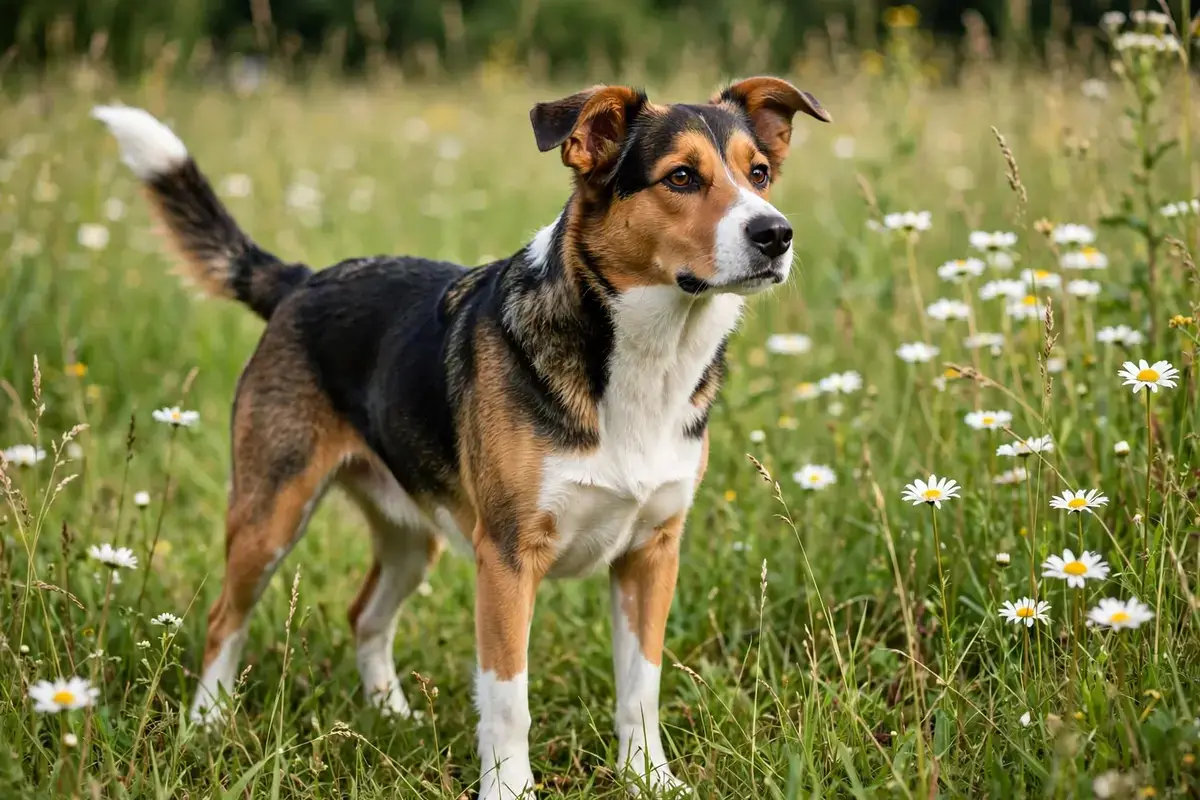
A Border Beagle is a Border Collie crossed with a Beagle. Before you get one, know the two hard parts: recall may never be reliable off lead, and the Beagle voice carries through walls. Those two challenges deserve the most attention before you choose this mix.
This is a mixed breed, not a standardised one. Dogs vary in size, coat, drive, and health. Most of what is known comes from the two parent breeds, not from studies of the cross itself.
Key Takeaways
- ⚠️ Expect a medium dog, roughly 18 to 45 pounds, with energy to match a working breed.
- ❌ Off-leash reliability is the hardest thing to build here. Many dogs never earn it.
- ⚠️ The Beagle voice is loud. Flats and thin-walled houses will hear it.
- ✅ Two drives run this dog: herding and scenting. Give both a job and life gets easier.
- ⚠️ Ask about hip and eye screening on both sides, plus any genetic tests the breeder has run.
- ✅ Grooming is simple. Feeding is not, because this dog will eat past full.
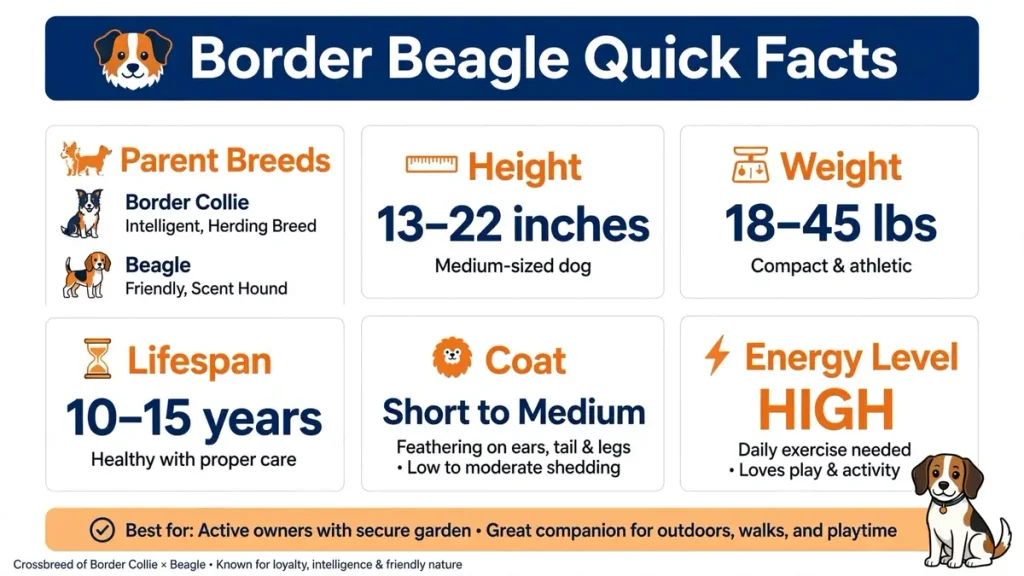
Table of Contents
What Is a Border Beagle?
The Border Beagle is not a recognised breed. There is no breed standard, no registry, and no club behind the name. It is a cross between a Border Collie and a Beagle, sometimes sold as a Border Collie Beagle mix or a Beagle Collie mix.
The two parents were built for different jobs. The Border Collie is a herding dog from the border country between England and Scotland, bred to move sheep and read signals at distance. The AKC calls it a “remarkably bright workaholic”. It also warns the breed may be too much dog for owners without the time to keep it busy.
The Beagle is a scent hound, bred to hunt in packs with its nose down and its voice up. The AKC notes that Beagles were bred to hunt in packs, so they enjoy company and are generally easygoing.
That is the story of this cross. One parent wants to work with you. The other wants to follow its nose. Everything below follows from that.
What this dog is not. It is not a designer breed with a registry, and it is not hypoallergenic. It is not a Beagle in a Collie body, and it is not a Collie that happens to have floppy ears. Owners who expect either are the ones who give up at eighteen months. That is when the dog is at full energy and still cannot be trusted off lead.
Why the cross exists at all. Unlike an established working breed, this cross has no single recognised working purpose. Some are bred deliberately as companions. Others come from accidental litters. That matters when you are buying, because unplanned litters rarely come with health testing, and the burden of asking falls on you.
| Quick facts | Typical range |
|---|---|
| Parent breeds | Border Collie and Beagle |
| Other names | Border Collie Beagle mix, Beagle Collie mix |
| Height | Roughly 13 to 22 inches, with most landing 15 to 21 |
| Weight | Roughly 18 to 45 pounds |
| Lifespan | No cross-specific data. Border Collies are cited at 12 to 15 years, Beagles at 10 to 15 |
| Coat | Short to medium, often with feathering on the tail or legs |
| Energy | Usually high, but it varies between dogs |
| Best for | Active owners who enjoy training and have a secure garden |
Size and Appearance
A Border Collie stands roughly 18 to 22 inches at the shoulder. A Beagle is smaller, with two height varieties in the breed: 13 inches and under, and 13 to 15 inches. Most crosses fall between 15 and 21 inches, but that is an estimate taken from the parents. There is no established average height for this cross, and littermates can differ.
Weight follows the same logic. A 13-inch Beagle is under 20 pounds. A 15-inch Beagle is 20 to 30 pounds. A Border Collie is heavier again. A Border Beagle can be anywhere from about 18 to 45 pounds. That is a wide spread for a dog you plan to lift into a car.
Coat and build give you the clearest clue about which parent is winning.
| Trait | Beagle-leaning | Collie-leaning |
|---|---|---|
| Build | Shorter, stockier, heavier for height | Longer in the leg, lighter, athletic |
| Ears | Long, low, hound-style | Semi-prick, folding forward at the tip |
| Coat | Short, dense, flat | Medium length with feathering on tail and legs |
| Tail | Carried low | Higher, often with a white tip |
| Nose use | Constant. Head down on every walk | Intermittent. Checks in with you |
Colours vary widely: tricolour, black and white, red, and golden all appear. Merle can occur if the Border Collie parent carries the merle variant. Ask about the parents’ genetic status before buying a merle puppy, because breeding two merle dogs raises the risk of puppies with hearing and vision problems.
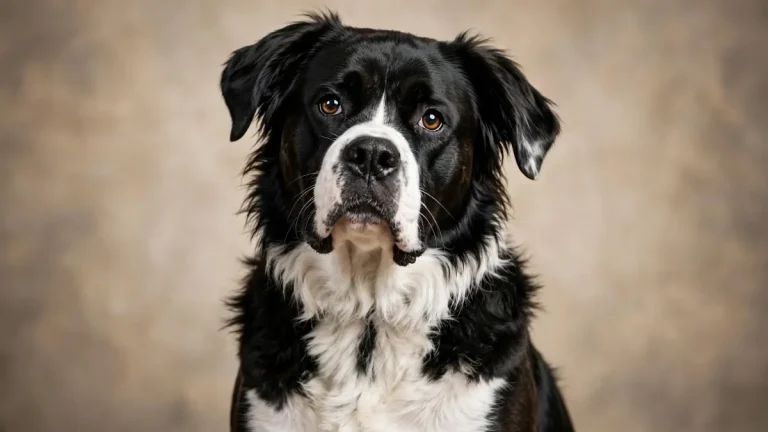
Ears are the giveaway most owners notice first. Many Border Beagles have ears that sit halfway between the Collie’s upright ear and the Beagle’s long hound ear.
Predicting adult size is guesswork. A puppy’s paws and parents give clues and nothing more. Two littermates from the same cross can end up fifteen pounds apart, because one inherited the Beagle frame and the other did not. If a specific weight matters, an adult dog is the only way to know what you are getting.
Coat length is the other variable. Short-coated dogs dry fast after a walk and need less brushing. Dogs with Collie feathering collect burrs, hold water, and need more time with a brush. Neither is harder to live with, but they are different jobs.
Temperament and Family Life
Your dog may inherit any mix of traits from either parent. Breed descriptions predict tendencies, not your individual dog. The honest way to read this section is as a list of possibilities to test for, not a guarantee.
What the Collie side tends to bring: biddability and sensitivity to tone. It also brings a need to be near its person, and a habit of staring at moving things.
What the Beagle side tends to bring: sociability, food drive, a stubborn streak when a scent is involved, and a voice that carries.
Many may be sociable with people, but temperament varies. Some may do well with older children who can join in training and respect a dog’s space. Supervise interactions, and teach children not to chase, hug, or disturb a resting dog. Herding behaviour such as chasing or heel-nipping can happen, but it is not inevitable. Toddlers are harder, because a herding dog may try to move a running child by nipping at heels.
Other dogs. Beagles were bred to work in packs, but that does not guarantee dog sociability in a cross. Introduce dogs carefully and judge the individual. Two high-drive dogs in one house need more management than one.
Noise is the trait people underestimate. A Border Beagle that hears the postman, a fox, or a dog two streets away may answer. Some owners find it charming. Neighbours in a terrace or a flat rarely do. If quiet matters more than anything else on this list, this is the wrong cross.
Cats and small pets. This is the risky area. A Collie herds, a Beagle hunts, and either drive can become a chase. Some Border Beagles live safely with cats they were raised with. Some never do. Our guide to Border Collies and other pets covers introductions.
Which Drive Is Running Your Dog?
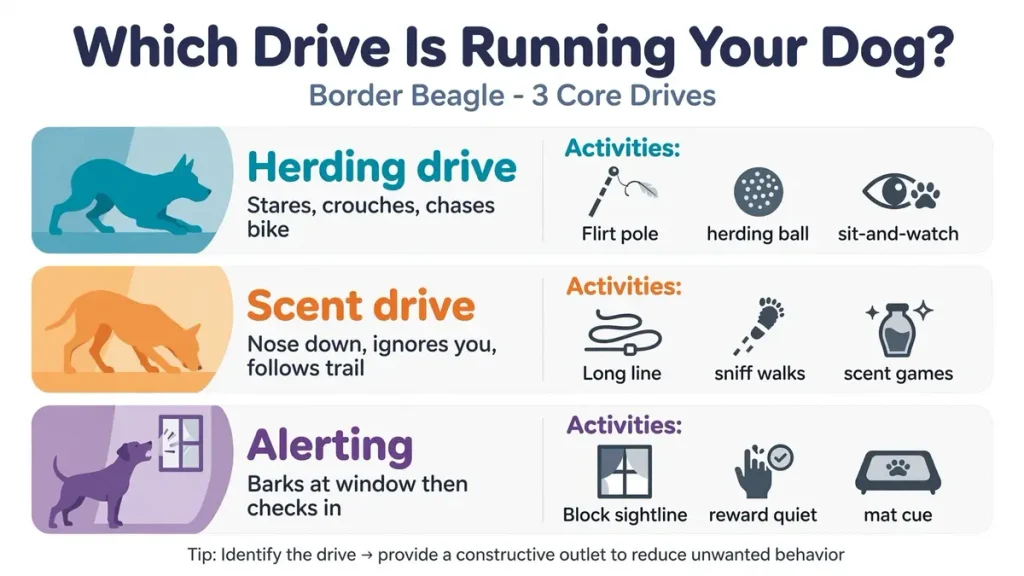
Watch what happens when the dog is excited. The pattern tells you which drive to work with.
| What you see | Likely drive | What helps |
|---|---|---|
| Stares, crouches, then chases a bike or a running child | Herding | Flirt pole, herding ball, a sit-and-watch cue |
| Nose down, ignores you, follows a trail across a path | Scent | Long line, sniff walks, scent games at home |
| Barks at the window, then checks in with you | Alerting | Block the sightline, reward quiet, teach a mat cue |
Exercise Needs
No published exercise requirement exists for this cross. Both parents are working breeds, so plan for more than a pavement loop.
Most Border Beagles do well with roughly an hour or more of activity a day. That is an estimate built from the parent breeds, not a rule from a study. The AKC’s guidance is that exercise needs vary by age, breed, and health, which is the honest answer for a cross too.
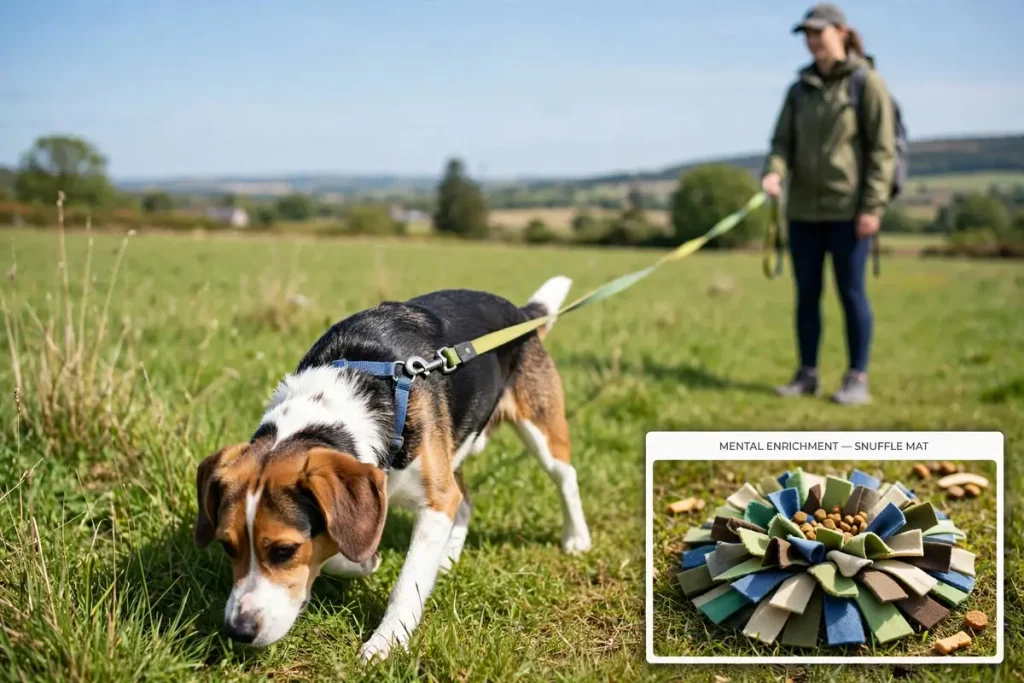
Split the hour into two kinds of work. A sniff-heavy walk on a long line tires the hound side. A training session, a puzzle, or a game of find-it tires the Collie side. A dog that gets only one of those will still be restless.
Puppies and seniors need different amounts. A growing puppy should not be running long distances or doing repeated jumps, because growth plates are still open. Short play, sniffing, and training do more for a young dog than mileage. An older dog usually self-regulates, but arthritis and hearing loss can change both activity and barking.
No Garden? Tire the Dog Anyway
Plenty of Border Beagles live in flats with no garden, and they do fine when the work is deliberate. A sniff walk on a long line does more than an hour of ball throwing, because scenting is hard mental work.
Indoors, scatter feeding, cardboard-box shredding, and hide-and-seek with treats all burn energy without space. A flirt pole needs about three metres and tires a herding dog in minutes. Two short sessions beat one long one for a dog that gets over-aroused.
Watch for the dog that never settles after a long walk. More distance does not fix a dog with no mental outlet. Our Border Collie exercise guide explains the difference between tired and satisfied.
Training, Recall and Prey Drive
This cross learns fast and gets distracted faster. A Border Beagle hears you perfectly well. It has found something better to do.
Train in short sessions with good rewards, and raise distraction slowly. Positive reinforcement works on both parent breeds, and the Beagle side will shut down if training turns unpleasant.
Recall is the skill that decides your dog’s freedom. Build it in three stages:
- Indoors. Say the cue, pay generously, every time. No exceptions.
- Garden or enclosed field. Add distance and mild distractions. Practise when the dog is already coming towards you.
- Real world on a long line. Add grass, scent, and other dogs. Never remove the line until the dog has passed this stage repeatedly.
Some Border Beagles may never develop reliable recall around strong scent. That is not a training failure. A hound following a fresh scent is not ignoring you; it is doing the job it was bred for. Keep those dogs on a long line in open or unsafe areas.
Herding and chasing. Redirect the nip onto a toy, reward a sit instead, and give a legal outlet. Punishment raises the arousal that caused the nip. Our guides to obedience training and socialisation cover the mechanics.
Teach an interruption cue early. A cheerful “this way” that predicts a treat is worth more than shouting a name into a hedge.
A rough plan for the first year:
| Age | Focus | What to avoid |
|---|---|---|
| 8 to 16 weeks | Socialisation, name response, handling, toilet training | Waiting until vaccinations are complete before any social contact |
| 4 to 6 months | Recall foundations, loose lead, settle on a mat | Long repetitive sessions |
| 6 to 12 months | Distraction work, scent games, herding outlets | Assuming the teenage dog has forgotten everything. It has not |
| 12 months and up | Proofing recall in new places, impulse control around animals | Removing the long line too early |
Common Behaviour Problems
Some behaviour problems arise when a dog’s needs are not met. Pain, fear, and anxiety cause behaviour changes too, so rule those out before you assume it is training.
Barking and howling. Usually alerting, boredom, or demand. Block the window, pay for quiet, and give the dog a job. Our guide to understanding why dogs bark covers the causes that need a vet rather than a trainer.
Nipping at heels. Herding, not aggression. Stop the game when teeth touch clothing and redirect to a toy.
Pulling on the lead. A nose-down hound does not notice a tight lead. Reward a loose lead, and use a front-clip harness while you train.
Counter-surfing and bin raiding. Management beats training. Clear the counters, lock the bin, and stop testing the dog’s self-control.
Destructive chewing. Can be teething, under-exercise, frustration, anxiety, or simply not enough to chew. Rule out teething and boredom first, add sniffing work and legal chews, and see a vet or behaviourist if it starts suddenly in an adult dog.
Running off after a scent. The dangerous one. Long line, well-paid recall, and a route away from roads.
Grooming and Feeding
Grooming is the easy part of this cross, but coat type varies. A short, dense Beagle-type coat may shed year-round and more heavily in season. A longer Collie-type coat needs more brushing to prevent tangles and remove loose hair. Ask what the parents look like, because that is the best guide you will get. Brush two or three times a week, and daily during the seasonal coat blow. A slicker brush handles the short coat, and an undercoat rake helps when the coat is coming out.
Nails, ears, and teeth are the parts owners skip. Trim nails every few weeks, or pay a groomer to do it. Check ears weekly, especially on dogs with Beagle-style drop ears, and ask your vet for a cleaning routine rather than improvising one. Brush teeth most days if you can manage it, because dental disease is common and expensive to treat.
Bathing has no single correct schedule. Vet-reviewed guidance suggests about once a month for many dogs, with more frequent baths for dogs that swim or get muddy. Adjust to your dog’s coat and smell rather than a calendar. Our grooming guide covers tools and technique.
Feeding is where Beagle genetics show up. This is a cross that will eat past full, counter-surf, and argue about it. Measure meals rather than free-feeding, and use part of the daily ration as training rewards instead of adding treats on top.
The WSAVA treats guide puts treats at under 10% of daily calories. On a 30-pound dog that is a small allowance, and it is easy to spend in one training session.
Puppies need a growth diet until they are near adult height. Ask your vet when to switch.
Is a Border Beagle Right for You?
A good fit if you:
- Enjoy training and want a dog to work with
- Can give an hour or more of activity most days
- Have a secure garden or access to enclosed space
- Do not mind a dog that talks
- Will keep the dog on a long line where recall is unproven
Probably not a good fit if you:
- Want a dog that can be trusted off lead without training
- Live where noise complaints are likely
- Work long hours away from home
- Keep free-ranging small pets
- Are a first-time owner looking for a calm, low-drive dog
Be honest about the daily time. An hour of exercise, plus training, plus grooming, plus the management that comes with a scent-driven dog, is a real commitment on top of work. Add the cost of a secure fence or a long line, and the practical picture is clearer than any breed description.
If you are still deciding, an adult dog in foster care tells you more than any puppy will. Fosterers can describe the dog’s voice, recall, and behaviour around cats, which are the three things you cannot assess in an eight-week-old puppy.
Health Problems
No condition is guaranteed in a cross, and none is guaranteed absent. Risk depends on what the parents carried. This table covers the conditions worth screening for, not every possible risk.
| Condition | What to know | Which side it comes from |
|---|---|---|
| Hip dysplasia | A developmental joint problem that can lead to arthritis | Listed by both the Border Collie and Beagle breed health programmes |
| Collie eye anomaly (CEA) | An inherited eye condition affecting collie-type breeds | Collie side |
| MDR1 (ABCB1) sensitivity | A gene mutation that changes which drugs are safe | Collie side. Rare in Border Collies, but testing matters |
| Idiopathic epilepsy | Repeated seizures with no other cause found | Named by the National Beagle Club among the Beagle’s more common problems |
| Hypothyroidism | An underactive thyroid, treatable with daily medication | Named by the National Beagle Club. A blood test confirms it |
| Musladin-Lueke syndrome (MLS) | A rare inherited condition in Beagles affecting connective tissue | Beagle side. DNA test available |
| Allergies | Skin and ear irritation from food or environment | Named by the National Beagle Club among common Beagle problems |
| Back problems | Pain or stiffness, more likely in a long-backed or overweight dog | Named by the National Beagle Club. Keep the dog lean |
| Weight gain | Food drive plus a sedentary life adds up fast | Management issue, not inherited |
Hips and Eyes
Hip dysplasia is a developmental condition where the joint does not fit together properly. It can cause stiffness and arthritis later. The OFA grades hips on a published scale and the results are public, which is why hip scores are the first thing to ask a breeder for.
Collie eye anomaly affects the retina and is inherited in collie-type breeds. A DNA test checks only for the variant it targets. An eye exam by an ophthalmologist looks at the eye directly and can catch other problems the DNA test would miss. Both parent clubs expect breeders to screen.
Epilepsy and Thyroid Problems
Idiopathic epilepsy is diagnosed when a dog has repeated seizures and other causes have been ruled out. It is usually managed with medication, and most dogs live normal lives between episodes.
Hypothyroidism means an underactive thyroid. Signs include weight gain without a change in appetite, a dull coat, and low energy. A blood test confirms it, and daily medication controls it.
How Long Do Border Beagles Live?
There is no published lifespan study for the Border Beagle. The parent-breed estimates overlap: Border Collies are commonly cited at 12 to 15 years, Beagles at 10 to 15. Those figures give context, not a prediction for an individual dog. Weight, dental care, and inherited health risks all affect how long a dog lives.
Health Testing, Puppies and Where to Find One
There is no single route to finding one of these dogs, so the screening questions matter more than the source. Both breed clubs publish what responsible breeders test for, and the two lists differ.
| Parent | Screening to ask about |
|---|---|
| Border Collie | Hip evaluation, eye exam by an ophthalmologist, and DNA tests such as CEA |
| Beagle | Hip evaluation, eye exam, MLS DNA test, cardiac exam, and autoimmune thyroid testing |
| Both | Written results you can see, family history, and a vet review of the paperwork |
The Beagle list comes from the National Beagle Club’s CHIC requirements, which cover hips, eyes, MLS, cardiac, and thyroid screening. Check the current list with the club or the breeder, because breed club requirements do change. It is more than most buyers think to ask for, which is exactly why asking it separates serious breeders from the rest.
What About MDR1?
The MDR1 mutation is rare in Border Collies, according to the ABCA Health & Education Foundation. That does not make testing pointless. It means the question is worth asking when the Collie parent’s status is unknown, or when a line has produced a carrier.
A dog with one copy may look completely healthy and still react badly to certain drugs. What changes is the drug list your vet keeps on file. VCA notes that dogs with the mutation are more likely to react badly to some dewormers at high doses, to loperamide, and to certain other medicines. Keep any test result with your dog’s records.
On puppies. Socialisation matters more than obedience in the first months. Aim for new people, surfaces, sounds, and calm dogs before four months old. A nervous parent often produces a nervous puppy, so temperament of the parents counts as health information.
On rescues. An adult dog in foster care comes with a behaviour report, which is the only reliable way to know how vocal a dog is or whether it can live with cats. Ask the fosterer directly rather than relying on the listing.
On breeders. Walk away from anyone who cannot show health testing, who has multiple litters year-round, or who will not let you meet the mother. Price is not a quality signal.
On cost. Prices for this cross vary widely by region and by whether the dog is papered, and none of that predicts health. Budget instead for the first year of care: vaccinations, microchipping, neutering if you choose it, insurance or a savings fund, and a decent crate and harness. Those costs are predictable. The purchase price is not a measure of quality.
Border Beagle vs Border Collie and Beagle
| Trait | Border Beagle | Border Collie | Beagle |
|---|---|---|---|
| Size (approximate) | Roughly 18 to 45 lb | Roughly 30 to 55 lb | Under 20 to 30 lb, by variety |
| Bred for | Herding and scent work in one dog | Herding sheep at distance | Hunting in packs by scent |
| Training style | Sharp or stubborn, often both | Fast, sensitive, needs a job | Food-motivated, easily distracted |
| Vocal | Often, with a hound voice | Alert barking, not usually noisy | Very. Voice is part of the job |
| Off lead | Hard to build, sometimes impossible | Good with training | Poor when a scent is fresh |
| Grooming | Easy | Moderate | Easy |
If you are comparing Collie crosses, a Borgi is smaller and stockier with a big voice. A Border Beagle is taller and far more led by scent. For what a working brain actually demands, read our notes on Border Collie intelligence.
Frequently Asked Questions
What is a Border Beagle?
A cross between a Border Collie and a Beagle. It is not a recognised breed, so size, coat, and temperament vary between dogs.
How big do Border Beagles get?
Usually 13 to 22 inches tall, with most landing 15 to 21, and roughly 18 to 45 pounds. A dog with a 13-inch Beagle parent can be under 20 pounds.
Do Border Beagles bark a lot?
Often, yes. The Beagle side brings a loud voice that carries. Some individuals are quiet, but you cannot count on it in a puppy.
Are Border Beagles hypoallergenic?
No. No dog is truly hypoallergenic, and this cross sheds. Spend time with the individual dog before committing if allergies are a concern.
Can Border Beagles live in apartments?
Some can, with daily exercise and mental work. Noise is the bigger problem than space, so meet the neighbours before you commit.
Can a Border Beagle be off lead?
Only after solid recall training, and some never earn it. A long line in open areas is the safe default.
Do Border Beagles get along with cats?
Some do, especially cats they grow up with. Others chase, because the herding and hunting drives are strong. Supervise every introduction.
Are Border Beagles good first dogs?
Usually not. Herding drive plus scent drive is a lot for a first-time owner, especially without a secure garden.
Related Mixed Breeds Guides

Glossary
Herding instinct — The drive to move other animals by staring, stalking, and nipping.
Scent drive — The drive to follow a smell, strong in hounds.
Collie eye anomaly — An inherited eye condition in collie-type breeds.
MDR1 (ABCB1) — A gene mutation that makes some dogs sensitive to certain medicines.
Idiopathic epilepsy — Repeated seizures with no other cause found.
Sources
- AKC — Border Collie breed information
- AKC — Beagle breed information
- OFA — Hip Dysplasia
- OFA — Collie Eye Anomaly
- VCA Animal Hospitals — Multidrug Resistance Mutation (MDR1)
- AKC — Epilepsy in Dogs
- VCA Animal Hospitals — Hypothyroidism in Dogs
- AKC — How Much Exercise Does a Dog Need?
- PetMD — How Often Should You Bathe Your Dog?
- WSAVA — Feeding Treats to Your Dog (PDF)
- Border Collie Foundation — Genetic Diseases
- ABCA Health & Education Foundation — Understanding the MDR1 Mutation (PDF)
- National Beagle Club of America — Health Statement
Medical Disclaimer
This guide is for information only and is not a substitute for veterinary advice. Mixed-breed dogs vary, and no article can predict an individual dog’s health. Ask your vet about screening, weight, and medication before changing your dog’s care. If your dog shows pain, seizures, or a sudden behaviour change, contact your vet.

Leave a Reply
You must be logged in to post a comment.