
Border Springer: Border Collie English Springer Spaniel Mix – Size, Temperament, Care & Lifespan
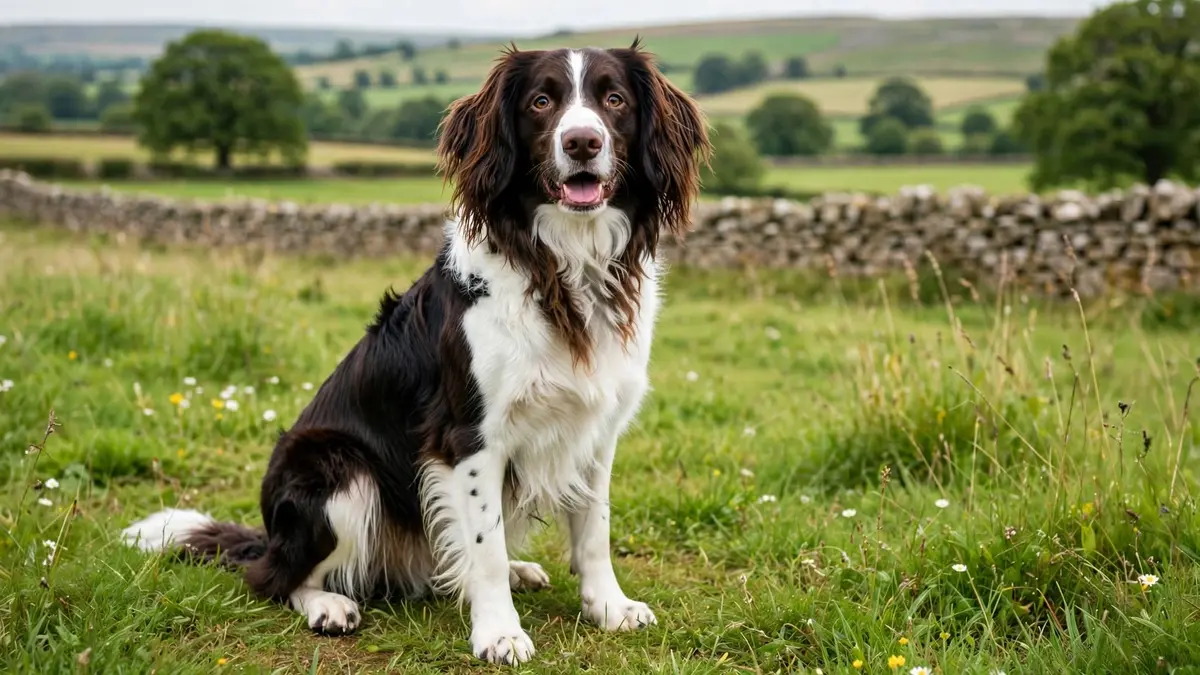
A Border Springer (also called a Sprollie) is a cross between a Border Collie and an English Springer Spaniel. This active, intelligent mix may inherit the Border Collie’s herding instincts and the Springer Spaniel’s enthusiasm for retrieving and outdoor activities. Border Springers can make affectionate companions for active households, but their size, temperament, coat, and exercise needs vary depending on the parents.
About this guide: Because the Border Springer is a mixed breed rather than a standardized breed, its traits are not fixed. Individual dogs vary — even within the same litter. This guide describes what is commonly seen in this cross based on the parent breeds, but your dog may be different.
Quick Facts
- ✅ Highly trainable — May inherit the Border Collie’s learning ability
- ✅ People-oriented — Both parent breeds are often responsive to training
- ✅ Good with families — Can be affectionate when properly socialized
- ❌ High energy — Needs serious daily exercise or it may become destructive
- ❌ Can be mouthy — Herding and retrieving instincts may lead to nibbling and carrying things
- ❌ Prone to separation anxiety — May bond intensely and struggle with alone time
- ❌ Challenging for first-time owners — Activity and training needs may be demanding
Border Springer Quick Facts
| Trait | Details |
|---|---|
| Parent breeds | Border Collie + English Springer Spaniel |
| Other names | Sprollie, Border Springer Spaniel |
| Size | Medium; varies with parents (roughly 18–22 inches) |
| Weight | Varies considerably; approximately 35–55 lbs |
| Lifespan | No established average; roughly 12–15 years based on parent breeds |
| Coat | Medium-length; may be feathered |
| Energy level | High to very high |
| Best for | Active families, outdoorsy individuals, experienced dog owners |
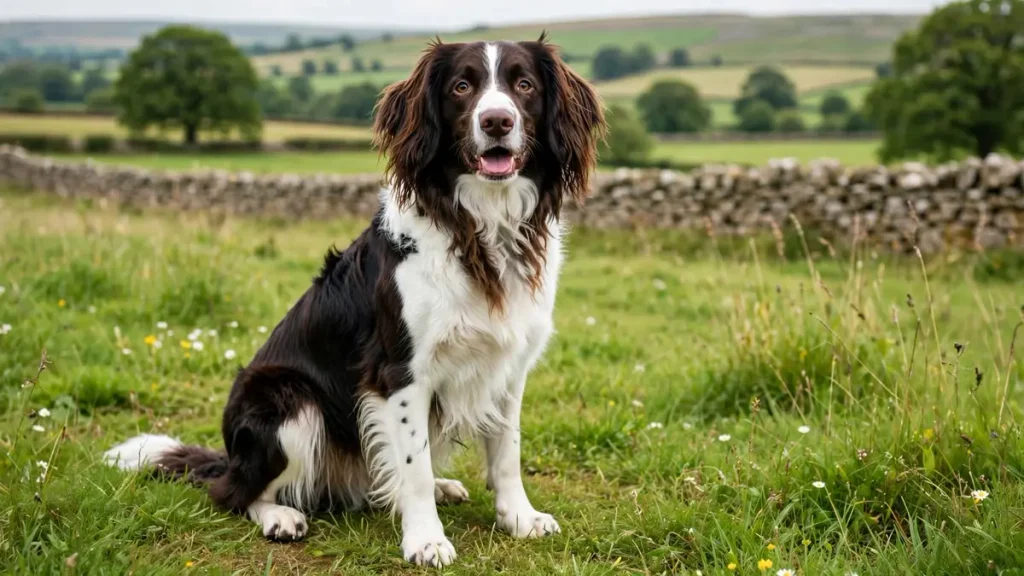
Table of Contents
What Is a Border Springer?
The Border Springer is a cross between a Border Collie and an English Springer Spaniel. Both parent breeds were developed for demanding work alongside humans — the Border Collie for herding sheep in the British highlands, the Springer for flushing and retrieving game birds in the field. That shared work ethic is why this mix often works well for active owners. For more on the parent breeds, see our Border Collie lifespan and Border Collie health articles.
Also called the Sprollie (especially in the UK), this crossbreed first gained attention on farms where Border Collies and Springers worked side by side. Accidental litters proved the combination could work well, and today some breeders intentionally produce Border Springers as active family companions and working dogs. They remain uncommon enough that most people will ask, “What kind of dog is that?” at the dog park.
The mix may get the Border Collie’s intensity, focus, and problem-solving drive. From the Springer, it may get a softer, more social personality and a natural enthusiasm for water. The result can be a dog that works hard and stays cheerful about it — but every dog is an individual.
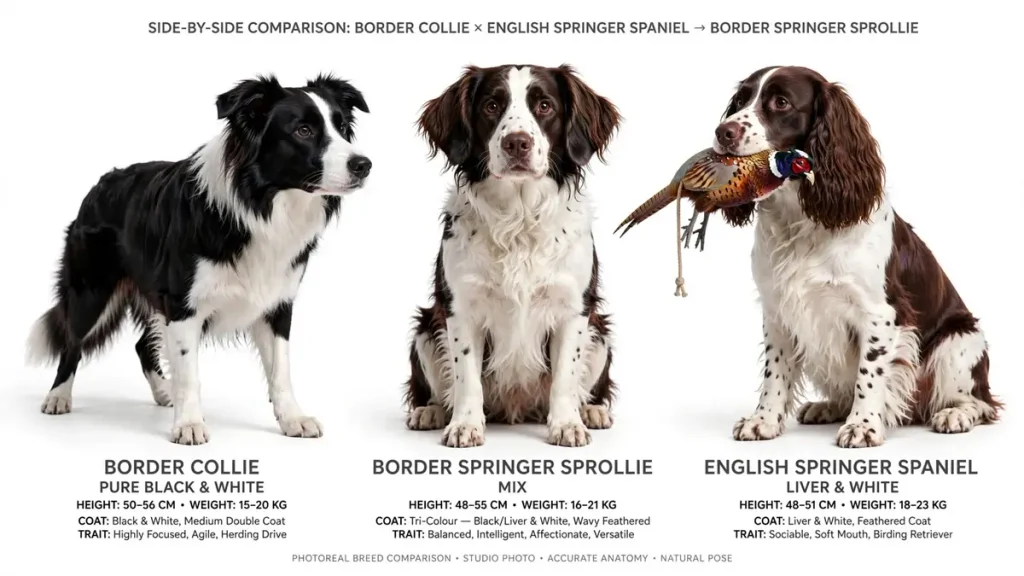
Parent Breed Comparison
| Trait | Border Collie | English Springer Spaniel | Border Springer (Mix) |
|---|---|---|---|
| Original role | Herding sheep | Flushing and retrieving game | Varies |
| Size | 18–22 in, 30–55 lbs | 19–20 in, 40–55 lbs | Varies; roughly between parents |
| Energy | Very high | High to very high | High to very high |
| Trainability | Excellent | Very good | Often good, varies |
| Stranger response | Reserved, can be wary | Friendly, outgoing | Varies |
| Barking | Moderate; alert | Moderate; excited | May be moderate |
| Coat | Medium, rough or smooth | Medium, feathered | Medium, often feathered |
| Exercise needs | High | High | High |
Border Springer Temperament
A mix of herding and sporting instincts can mean a dog that’s always up for something. A Border Springer may be enthusiastic about every activity you propose. It may be affectionate with its family. Many are biddable — genuinely willing to follow your lead.
Common personality traits seen in this mix:
- Eager to work — Many need a job, whether it’s fetching a ball, learning a trick, or going on a hike.
- Social and friendly — The Springer influence may make this mix warmer and less intense than a pure Border Collie. Many greet everyone as a potential friend, though individual dogs vary.
- Playful — Many keep their puppy-like enthusiasm for years. Expect toy flinging, play bows, and goofy antics.
- Sensitive — Like both parent breeds, this mix often picks up on your mood. Harsh training can damage your bond. Reward-based training is generally the better approach.
- Velcro dog tendencies — Border Springers may follow their people from room to room. They are not usually aloof; they can be your constant companion.
What Traits Can This Mix Inherit?
Border Springers can lean toward either parent, or land somewhere in between:
If the dog takes after the Border Collie side:
- More intense and focused on tasks
- Stronger herding instincts (chasing, staring, nipping at heels)
- Reserved around strangers
- Highly driven during training and play
If it takes after the Springer side:
- More outgoing and social with everyone
- Stronger retrieving instincts
- Enthusiastic about water and swimming
- Softer and less intense in daily behavior
Most dogs don’t fit neatly into either bucket. They’re a mix of both.
Border Springer Size, Weight & Appearance
Border Springers are generally medium-sized dogs, but adult height and weight vary considerably depending on the size and genetics of their parents.
The Border Collie ranges from 18–22 inches and 30–55 lbs. The English Springer Spaniel ranges from 19–20 inches and 40–55 lbs. A Border Springer puppy may end up anywhere within or between these ranges.
Coat length also varies. Some have a shorter, smoother coat more like a working Border Collie; others have the longer, feathered coat of a Springer. Feathering on the legs, chest, ears, and tail is common.
Border Springer Lifespan
No established average lifespan exists specifically for this mix. Based on the parent breeds — Border Collies (12–15 years) and English Springer Spaniels (12–14 years) — a rough estimate of 12–15 years is reasonable. Lifespan depends on genetics, diet, exercise, and preventive veterinary care.
Exercise Needs
Exercise needs vary widely depending on the dog. As a rough starting point, many healthy adult Border Springers need substantial daily activity — potentially around 90 minutes — but this depends on age, health, and temperament. There is no published requirement specifically for this mix.
Activities that work well:
- Fetch — The Springer side often enjoys retrieving.
- Swimming — Some may enjoy water. Introduce swimming gradually and supervise at all times.
- Hiking and trail running — Many cover ground efficiently.
- Agility — The Border Collie side may crave obstacle courses. Agility combines mental and physical exercise.
- Nose work and scent games — Both parent breeds have excellent noses. Hide treats and let them hunt.
Without enough exercise, a bored Border Springer may invent its own amusements — chewed furniture, dug flower beds, or nonstop barking. This is not a dog that entertains itself quietly.
Training the Border Springer
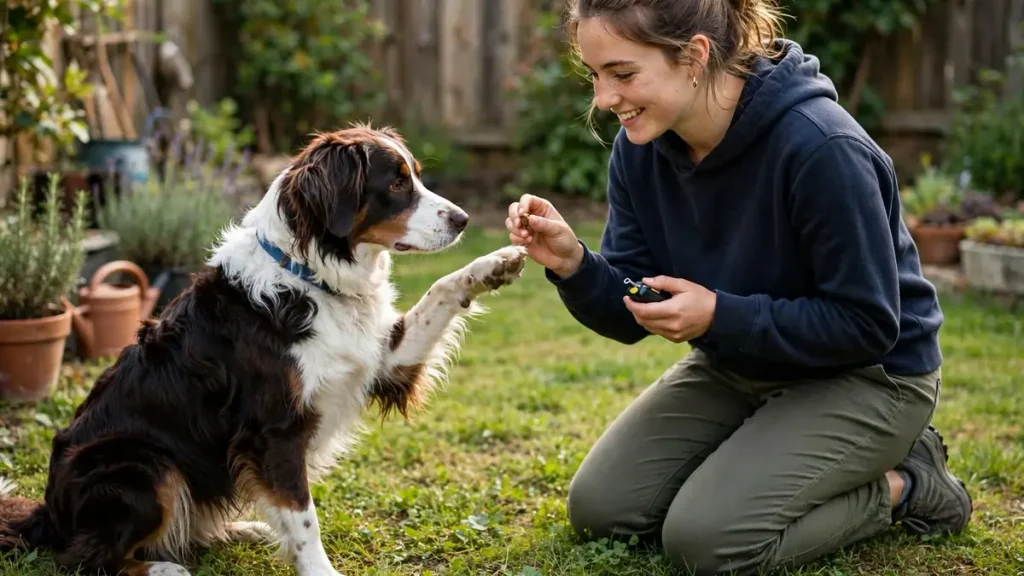
The Border Springer is often eager to please and learns quickly. The Border Collie side may pick up new commands in just a few repetitions. The Springer side often wants to make you happy. That combination can work well for training.
That said, this mix is often sensitive. Yelling or harsh corrections may shut them down fast. Reward-based training — using rewards, praise, and play — is generally a better approach than harsh or punitive methods.
For Border Collie-specific training strategies that work well with this mix, see our full guide on Border Collie obedience training.
Training priorities:
- Early socialization — Expose your puppy to many people, dogs, places, and sounds in the first 12 weeks.
- Impulse control — Teach “wait,” “leave it,” and “settle” early. This mix can get overexcited.
- Recall — A solid “come” command is important. Both parent breeds can get distracted by movement and scent.
- Mouth manners — Springers may carry things in their mouths. Border Collies may nip heels. Without training, your arms and ankles may become chew toys.
Border Springer Health
The Border Springer is generally a healthy mix, but it can inherit health issues from both parent breeds. Health risks depend on the parents and their genetic background. Prospective owners should ask breeders for documented health-test results for both parents.
Common health concerns:
- Hip dysplasia — Common in medium-to-large active breeds. Keep your dog at a healthy body weight and discuss screening with your veterinarian. The Orthopedic Foundation for Animals (OFA) maintains hip and elbow databases for both parent breeds.
- Ear infections — Those floppy ears can trap moisture and debris. Check ears regularly and clean them as recommended by your veterinarian, especially if your dog is prone to infections.
- Collie Eye Anomaly (CEA) — A genetic eye condition that can affect the Border Collie side. Responsible breeders screen for this.
- Progressive Retinal Atrophy (PRA) — A degenerative eye disease that can affect both parent breeds. Discuss eye screening with your veterinarian.
- Epilepsy — Border Collies have a higher-than-average incidence of epilepsy. This mix may inherit the tendency.
- Allergies and skin issues — Springers are prone to skin problems. Watch for itching, redness, and hot spots.
Health Testing for Parents
Before getting a Border Springer puppy, ask the breeder for health-test results for both parents. Recommended tests vary by breed club:
Border Collie: The Royal Kennel Club recommends eye screening, hip scoring, and DNA tests for CEA, TNS (Trapped Neutrophil Syndrome), and IGS (Imerslund-Gräsbeck Syndrome). Its guidance distinguishes between Good Practice and Best Practice tests. The Border Collie Health & Education Foundation provides further information.
English Springer Spaniel: The English Springer Spaniel Club recommends hip and elbow testing, eye screening, and DNA tests for GPRA and EIC (Exercise-Induced Collapse). As with the Border Collie, these tests are not all mandatory — some fall under Best Practice rather than Good Practice.
In the US, a CHIC number from the Orthopedic Foundation for Animals (OFA) confirms that recommended tests were completed and results made public — it does not guarantee every result was normal. In the UK, you can also ask to see Royal Kennel Club health-test records for both parents. Use whichever system applies in your region.
Grooming Your Border Springer
The Border Springer often has a medium-length feathered coat that sheds year-round with heavier seasonal blows in spring and fall. The feathering on the legs, chest, ears, and tail gives this mix a classic spaniel look — but it also catches burrs, mud, and tangles.
Grooming basics:
- Brush 2–3 times per week with a slicker brush and a metal comb. Daily during shedding season.
- Check and clean ears as advised by your veterinarian. Those floppy, feathered ears can trap moisture.
- Bathe when dirty or when your groomer or veterinarian recommends it.
- Trim feathering on the paws and legs to prevent matting.
- Trim nails every 2–3 weeks. Active dogs on pavement may wear them naturally; others need regular clipping.
Living With a Border Springer
Children: Border Springers can be good with children when properly socialized and supervised. Both parent breeds can be devoted to their families, but the Border Collie’s herding instinct may lead to heel-nipping at running children. Train this behavior early and supervise interactions with young children.
Other dogs and pets: The herding instinct may cause chasing behavior toward other pets, particularly cats. Early socialization and training help, but some individuals may be selective about which animals they accept. The Springer’s hunting background may also be a factor with smaller pets.
Apartment living: Apartment living can be challenging because of this mix’s potential size, energy level, and exercise needs. A securely fenced area for exercise is helpful, but meeting the dog’s needs through walks, runs, and structured activities matters more than having a yard alone.
Being left alone: This mix often bonds closely with its people and may struggle with being left alone for long periods. Crate training and gradual alone-time practice help, but 8-hour workdays are a stretch for many individuals.
Barking: Some Border Springers bark at excitement or when alerting. With sufficient exercise, many are quiet indoors. Without it, expect noise. Training can help but may not eliminate all vocalization.
What to Ask a Border Springer Breeder
If you’re considering a Border Springer from a breeder, ask:
- Can I see health-test results for both parents (hips, elbows, eyes, DNA tests)?
- What is the temperament of the parents — are they working-line or show-line?
- How are the puppies socialized before they go home?
- Have the puppies had veterinary checks and age-appropriate vaccinations?
- Can you provide references from previous puppy buyers?
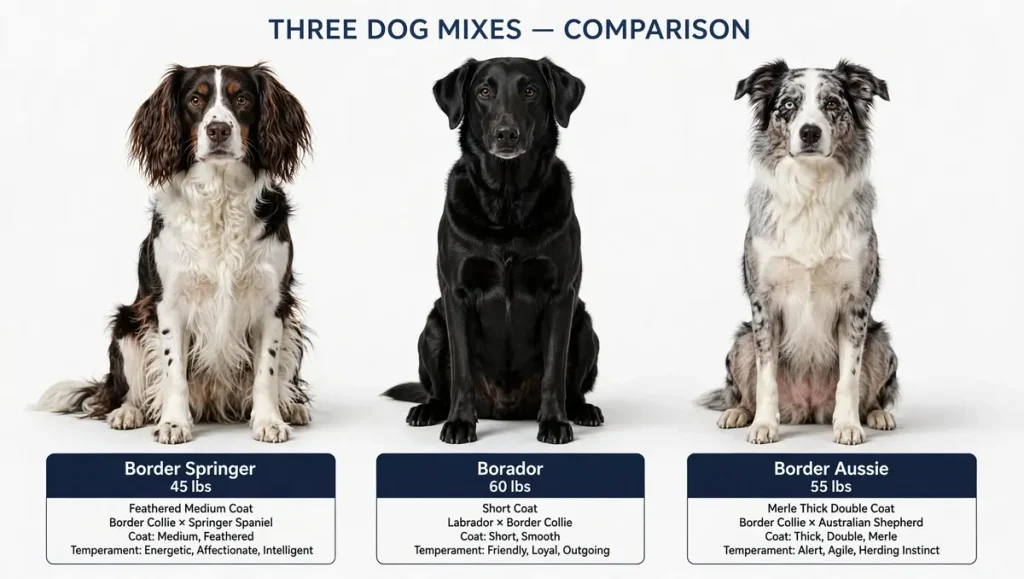
Border Springer vs. Borador vs. Border Aussie
How does the Border Springer compare to other popular Border Collie mixes? Here’s a side-by-side look based on breed tendencies. For a full comparison of all Border Collie mixes, see our comparison chart. You can also read more about the Borador.
| Trait | Border Springer | Borador (BC + Lab) | Border Aussie (BC + Aussie) |
|---|---|---|---|
| Size | 35–55 lbs, 18–22 in | 40–65 lbs, 19–24 in | 30–65 lbs, 18–23 in |
| Temperament | Enthusiastic, affectionate, biddable | Outgoing, friendly, may be less intense | Driven, focused, may be reserved |
| Energy level | High | High | Very high |
| Trainability | Often excellent | Often excellent — food motivated | Often excellent — wants to work |
| Good with kids | With socialization | Often naturally good | With socialization |
| Good with other pets | Can be challenging — herding instincts | Generally good | Can be challenging — strong prey drive |
| Grooming | Moderate — feathered coat, ear care important | Low — short coat, minimal grooming | Moderate-heavy — thick double coat |
| Lifespan | 12–15 years (estimate) | 10–14 years (estimate) | 12–15 years (estimate) |
| Best for | Active families, outdoor enthusiasts | Families, first-time active owners | Experienced handlers, working homes |
These are general tendencies, not guarantees. Individual dogs vary. The Borador may be more laid-back because the Labrador influence often softens the Border Collie’s intensity, making it a potentially better fit for first-time owners. The Border Aussie may be the most driven since both parent breeds are intense herding dogs — this mix may need an experienced handler and a real job. The Border Springer may tend toward the middle for some traits, but individual dogs can inherit more of either parent. A Border Springer could be as driven as a Border Aussie or as laid-back as a Borador — it depends on the dog.
Is the Border Springer Right for You?
The Border Springer may be a wonderful dog for the right owner. Before you commit, think through these questions:
- Can you provide substantial daily exercise? Not casual walks — real workouts.
- Are you home most of the day? This mix often struggles with being left alone for long stretches.
- Do you enjoy training and working with your dog? If you want a dog that’s mentally engaged, this may be your match. If you want one that entertains itself, it may not be.
- Do you have a securely fenced area for exercise? The Springer side may follow scents. The Border Collie side chases movement. Neither is safe off-leash in an unsecured area.
- Are you willing to maintain regular grooming and ear care?
- Can you handle some herding behavior? Nipping at heels, circling, and staring may be part of the package. See our guide on Border Collies and other pets for strategies.
If you answered yes to most of those, the Border Springer may be your best friend. If you hesitated on several, consider a lower-energy breed or an adult rescue whose temperament is already known. This mix often does well with a high-quality diet to support its energy levels. Check our Border Collie diet guide for nutrition principles that also apply to Border Springers.

Pros & Cons
| Pros | Cons |
|---|---|
| Highly trainable and biddable | Very high energy — needs substantial daily exercise |
| Affectionate with family | May develop separation anxiety if left alone too long |
| Good with active owners who enjoy outdoor activities | May chase small animals or herd children |
| Relatively healthy if parents are screened | Floppy ears need regular monitoring |
| Eager to please and responsive to training | Can be destructive if understimulated |
Frequently Asked Questions
How big does a Border Springer get?
Generally medium-sized. Adult weight and height depend on the parents — roughly 35–55 lbs and 18–22 inches, but individual dogs vary.
Is the Border Springer good with children?
Can be good with children when properly socialized and supervised. Herding-related nipping at running children is possible — train early.
Do Border Springers have strong herding instincts?
Some inherit the Border Collie’s drive to chase and nip at moving things. The strength varies, and early training helps manage it.
Are Border Springers easy to train?
Generally responsive because both parent breeds were bred to work with people. Energy level and sensitivity can affect training pace.
How long do Border Springers live?
No established average exists for this cross. A rough estimate of 12–15 years is reasonable based on the parent breeds.
Is a Sprollie the same as a Border Springer?
Yes. Sprollie is a commonly used UK name for a Border Collie and English Springer Spaniel cross. Naming conventions aren’t standardized, so it’s worth confirming the parent breeds when researching an individual dog.
Are Border Springers hypoallergenic?
No. Shedding varies, but regular grooming does not eliminate allergens.
How much does a Border Springer puppy cost?
Prices vary by location, breeder, health testing, and parentage. Rescue and adoption are also options.
Does the Border Springer bark a lot?
Moderately. Some bark when excited or alerting. With enough exercise, many are quiet indoors.
Are Border Springers good for apartment living?
Can be challenging. Meeting exercise and enrichment needs matters more than having a yard
Do Border Springers shed?
Yes — year-round with heavier seasonal shedding. They are not hypoallergenic.
Can a Border Springer be left alone?
Not easily for long hours. This mix may be prone to separation anxiety. Crate training and gradual alone-time practice help.
Glossary
- Biddable — Willing to follow direction and take instruction; cooperative in training.
- Collie Eye Anomaly (CEA) — A congenital eye condition affecting collie-type breeds, ranging from mild to severe.
- Feathering — Longer, silky hair on the ears, legs, chest, and tail common in spaniel breeds.
- Herding instinct — A dog’s innate drive to control the movement of other animals or people.
- Impulse control — A dog’s ability to resist acting on an immediate urge; a trained behavior.
- Positive reinforcement — Training method that rewards desired behaviors with treats, praise, or play.
- Progressive Retinal Atrophy (PRA) — A degenerative eye disease that leads to vision loss and blindness.
- Sprollie — A nickname for the Border Springer, popular in the UK (Springer + Collie).
- Velcro dog — A dog that sticks close to its owner constantly.
Sources
- AKC — Border Collie breed standard.
- AKC — English Springer Spaniel breed standard.
- The Royal Kennel Club — Border Collie health testing.
- English Springer Spaniel Club — Health resources.
- Orthopedic Foundation for Animals — Hip and elbow databases.
- Border Collie Health & Education Foundation — Genetic screening resources.
- PetMD — Border Aussie crossbreed profile.
Medical Disclaimer: This article is for informational purposes only and does not constitute veterinary advice. Every dog is an individual, and health concerns vary. Always consult a licensed veterinarian for medical decisions, diagnosis, or treatment for your pet. If you suspect your dog has a health problem, seek professional veterinary care immediately.
Leave a Reply
You must be logged in to post a comment.